
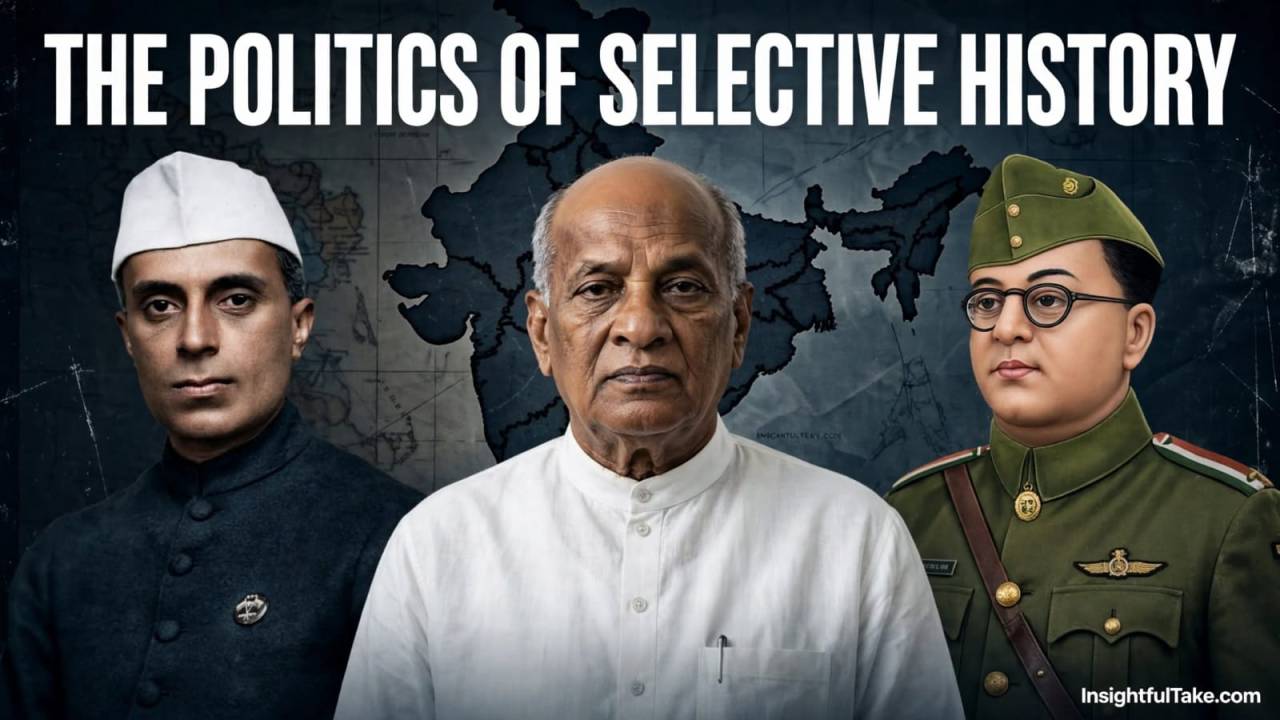
Patel and Bose were Congress leaders too. Can India's political history celebrate their legacy while selectively questioning the party that shaped their journeys?
There is something curious about the way India's political history is being narrated in contemporary politics. Jawaharlal Nehru, the country's first Prime Minister, is frequently presented in the political discourse of the Bharatiya Janata Party (BJP) as a leader whose ambitions, decisions and legacy deserve relentless scrutiny. His contribution to nation-building is often placed under a cloud of suspicion, while his disagreements with other national leaders are repeatedly brought into public debate.
Yet, in the same political vocabulary, Sardar Vallabhbhai Patel and Subhas Chandra Bose are celebrated with extraordinary enthusiasm. Their portraits appear in political campaigns, their anniversaries become occasions for grand public commemorations, and their achievements are invoked as evidence of a supposedly neglected chapter of Indian history.
There is nothing objectionable about celebrating Patel or Bose. They were extraordinary figures in India's freedom struggle. The question, however, is more fundamental: Can a political party selectively inherit the heroes of a movement while distancing itself from the political organisation that gave those heroes their national platform?
History does not work like a political inheritance document in which convenient chapters can be retained and inconvenient ones discarded.
Patel Was Not an Outsider to the Congress Story
Sardar Vallabhbhai Patel was not a political figure standing outside the Congress movement, waiting to be discovered by a future government. He was one of its most influential architects.
He presided over the Karachi session of the Indian National Congress in 1931. He led the Bardoli Satyagraha, worked closely with Mahatma Gandhi and became a central figure in the national movement. After independence, he served as India's first Deputy Prime Minister and Home Minister in the government led by Jawaharlal Nehru.
The official parliamentary Who's Who of 1950 identifies Patel as a Congress member. His political career was inseparable from the organisation through which he fought colonial rule and helped shape independent India.
The irony becomes particularly interesting when one recalls Prime Minister Narendra Modi's own words.
On October 31, 2016, while inaugurating a digital exhibition on Patel, Modi acknowledged the historical distinction explicitly: "I belong to BJP and Sardar Saheb belonged to Congress." He also argued that great national figures should not be used to divide future generations.
That was a sensible observation. But it raises an uncomfortable question for the political discourse that followed: if Patel's Congress association does not diminish his stature as a national leader, why should Nehru's Congress association become a reason to diminish his place in national history?
A national leader cannot be celebrated selectively according to present political convenience.
Netaji Bose: A Congress President Before He Became a Revolutionary Icon
The case of Subhas Chandra Bose requires an equally careful understanding.
Netaji was elected President of the Indian National Congress in 1938 at the Haripura session. He was re-elected in 1939 at Tripuri, defeating Pattabhi Sitaramayya, who had Gandhi's support.
His differences with Gandhi and sections of the Congress leadership were real and substantial. They concerned political strategy, the pace of the freedom struggle and the question of how aggressively India should challenge British rule.
Bose eventually resigned from the Congress presidency in 1939 and established the Forward Bloc. He subsequently pursued a separate and extraordinary path towards India's independence, eventually leading the Indian National Army.
These differences deserve historical recognition. But they do not erase his years in the Congress or his association with the wider national movement.
More importantly, Bose's relationship with Nehru was not simply one of political rivalry, as some contemporary narratives might suggest. Both shared important positions on economic planning, socialism and the need for complete independence, even though their political strategies differed.
Bose himself acknowledged Nehru's contribution to strengthening radical and progressive forces within the Congress in his writings.
To portray Netaji merely as an alternative to Nehru is to reduce a complex historical relationship to a convenient political contest.
The Nehru Question and the Selective Memory of Politics
Criticism of Jawaharlal Nehru is legitimate. No democratic leader should be beyond scrutiny, and Nehru's decisions on Kashmir, China, economic planning, foreign policy and institutional development deserve rigorous historical examination.
But criticism and historical erasure are two different things.
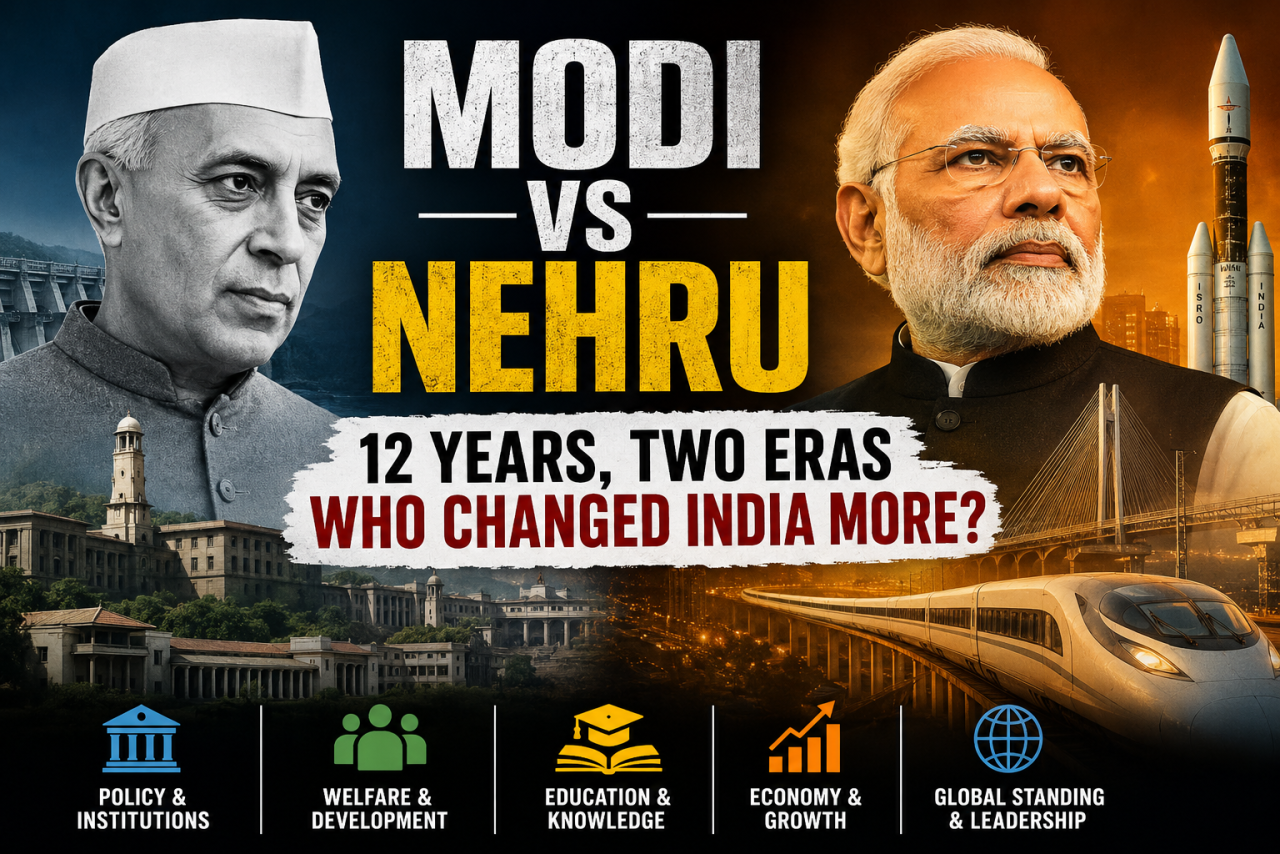
Nehru was a central figure in the freedom struggle, served as Congress president several times and became India's first Prime Minister. His role in building parliamentary institutions, scientific establishments, universities and the foundations of India's planned economy remains part of the country's historical record.
He also had disagreements with Patel and Bose. Those disagreements were not secret, nor should they be hidden. But political differences among freedom fighters do not automatically make one a villain and another a national saviour.
Consider the relationship between Nehru and Patel. They had serious differences on several questions, but they also worked together in the government during the difficult years following independence. In November 1948, Nehru publicly described Patel as a tower of strength and spoke of the value of their association extending over more than three decades.
This is the complexity that political slogans rarely accommodate.
If Patel's achievements can be celebrated without denying his association with Nehru's government, Nehru's contribution should also be examined without pretending that independent India emerged in the absence of his leadership.
A National Movement Is Not a Party's Private Property
The BJP has repeatedly accused the Congress of giving disproportionate importance to the Nehru-Gandhi family while neglecting other national leaders. In January 2025, BJP leader Rajeev Chandrasekhar argued that Congress had a myopic view of Indian history centred on Nehru and should recognise figures such as Patel and Bose.
The argument about recognising overlooked historical personalities deserves consideration. India's freedom struggle involved thousands of leaders, revolutionaries, social reformers, peasants, workers and ordinary citizens. No single family or political organisation can claim exclusive ownership of that history.
But the same principle must apply to the BJP.
Patel's legacy cannot be detached from his decades in the Congress. Bose's political journey cannot be understood without his Congress presidency and subsequent break with its leadership. Their achievements were shaped by the political struggles, debates and disagreements of their times.
Nor can the contribution of Nehru be dismissed simply because his political descendants later dominated the Congress.
A fair account of history must acknowledge both achievement and failure, irrespective of party affiliation.
The Problem With Turning History Into a Political Weapon
The danger of selective historical memory is not confined to one party. Every political organisation has an incentive to highlight the achievements of its preferred leaders and question the legacy of its opponents.
But when this becomes the dominant way of teaching or discussing history, citizens inherit political loyalties instead of historical understanding.
A generation that learns to admire Patel without knowing his Congress background, or celebrates Bose without understanding his disagreements with Gandhi and Nehru, receives an incomplete account of the freedom movement.
Equally, a generation taught to associate Nehru exclusively with historical failures loses the ability to examine his contributions and mistakes with intellectual honesty.
Political supporters, whatever their party affiliation, should ask questions rather than simply repeat the narratives offered by their preferred leadership. National history deserves better than applause on anniversaries and condemnation during election campaigns.
History Belongs to the Nation, Not to Political Parties
The freedom struggle was never a comfortable gathering of people who agreed on everything. It was an extraordinary coalition of competing ideas, personalities and political strategies. Gandhi, Nehru, Patel, Bose, Ambedkar, Maulana Azad, Bhagat Singh and countless others represented different approaches to the same historic aspiration: an independent India.
Their disagreements are part of their history. Their contributions are part of the nation's inheritance.
The BJP is entirely entitled to honour Patel and Bose. Indeed, every Indian government should celebrate them. But the same respect for historical complexity must extend to Nehru, whose role cannot be reduced to the political arguments of the present.
The question is not who owns Patel, who owns Bose or who owns Nehru. None of them belongs to a contemporary political party.
The real question is whether India can remember its past without turning every historical personality into a weapon against a political opponent.
A nation confident in its history does not need to diminish one of its founding leaders to celebrate another. And a political party confident in its own contribution to India does not need to rewrite the contributions of those who came before it.

















Leave a Comment