
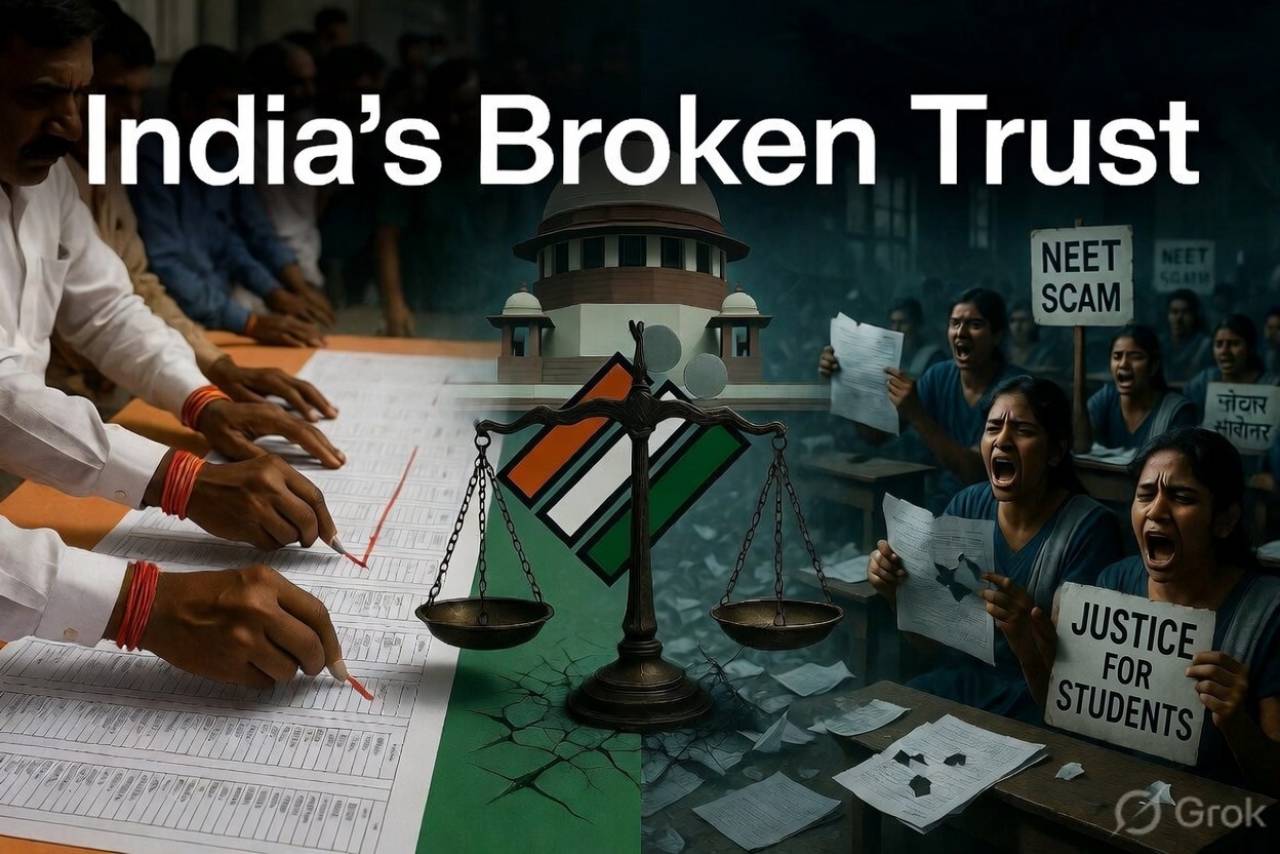
India can rapidly purge millions of voter names with precision — but still cannot stop repeated NEET paper leaks destroying student futures. This widening institutional gap is raising dangerous questions about trust, accountability, and governance.
In the world’s largest democracy, two major developments in May 2026 revealed a troubling contradiction at the heart of India’s governance system. On one hand, the Election Commission of India (ECI), backed by the Supreme Court, aggressively pushed ahead with the Special Intensive Revision (SIR) of electoral rolls — a nationwide exercise that led to the deletion of millions of names across states. On the other, the National Testing Agency (NTA) once again failed to secure the integrity of the NEET-UG examination, forcing the cancellation of a test taken by more than 23 lakh students after another devastating paper leak.
The contrast is impossible to ignore. One institution demonstrated extraordinary administrative speed and coordination to cleanse voter databases. Another repeatedly collapsed while safeguarding the futures of aspiring students. Together, these events expose a deeper and increasingly dangerous problem: India’s growing culture of selective institutional competence.
The Massive Voter Roll Cleanup
The SIR exercise, first intensified in Bihar in 2025 before expanding nationwide, became one of the largest electoral verification drives in recent decades. Booth Level Officers conducted door-to-door checks, demanding documentation and identifying duplicate, deceased, migrated, or allegedly ineligible voters.
The ECI defended the process as necessary and overdue. Years of migration, urban expansion, and outdated revisions had bloated voter rolls with inaccuracies. In sensitive border regions, concerns over illegal immigration and fraudulent voting added urgency to the exercise. The Supreme Court, invoking the ECI’s constitutional powers under Article 324, upheld the drive, emphasizing that clean electoral rolls are fundamental to free and fair elections.
Technically, the argument was sound.
Yet the scale and execution of the operation triggered widespread alarm. Bihar alone reportedly witnessed the deletion of over 47 lakh names, while national figures ran into crores. Critics, including civil society groups and election reform activists, warned that the burden of proof disproportionately fell on the poor, migrants, women, elderly citizens, and minorities — precisely those least likely to possess complete documentation at short notice.
In a country where birth records remain inconsistent and internal migration is a survival necessity for millions, the risk of genuine voters being excluded is very real. Reports from the ground pointed to rushed verification, inadequate outreach, confusion over documentation, and arbitrary deletions. The timing of the exercise ahead of key elections further intensified suspicions that political calculations may have influenced administrative urgency.
The NEET Collapse Repeats Itself
If the state could mobilize such efficiency for voter verification, why has it repeatedly failed to secure one of the country’s most important examinations?
On May 3, nearly 23 lakh students appeared for NEET-UG 2026, India’s gateway to medical education. Within days, reports of paper leaks surfaced from multiple regions, with investigations again pointing toward organized networks linked to coaching centres, compromised logistics chains, and corrupt intermediaries.
By mid-May, the NTA cancelled the examination entirely and scheduled a re-test for June 21.
This was not an isolated failure. The 2024 NEET controversy had already exposed major vulnerabilities in the examination system — from compromised printing facilities and transport routes to collusion involving centre staff and coaching mafias promising “guaranteed papers” for lakhs of rupees. At the time, even the Supreme Court sharply criticized the NTA for systemic negligence.
Yet two years later, the same weaknesses resurfaced almost unchanged.
The government responded predictably: CBI raids, arrests of alleged masterminds, and renewed promises of technological reforms. But the repetition of the scandal is precisely what has shattered public confidence. Securing an examination paper in 2026 should not be an impossible task for a modern state apparatus.
Compared to a nationwide voter verification exercise involving over 100 crore citizens, protecting an examination process with far fewer operational layers should be significantly easier. And yet, one system appears capable of decisive execution while the other repeatedly crumbles under pressure.
That disparity is what troubles millions of Indians today.
A Dangerous Pattern of Selective Efficiency
The issue is no longer limited to voter rolls or examination leaks. What citizens increasingly see is a broader pattern: institutions functioning with urgency and discipline when political power or electoral legitimacy is involved, but displaying paralysis, delay, or incompetence in matters affecting ordinary lives.
The ECI remains a constitutionally empowered body with significant institutional authority and public visibility. The NTA, by contrast, operates as an executive agency under the education ministry, often criticized for outsourcing vulnerabilities, weak oversight, and insufficient accountability.
But institutional design alone cannot fully explain the difference in outcomes.
What fuels public anger is the perception that state capacity in India is unevenly distributed. Systems can move with astonishing speed when political stakes are high, yet repeatedly fail in sectors where the victims are students, job-seekers, or ordinary citizens without influence.
This perception extends beyond these two controversies. Indians routinely witness delayed justice, regulatory failures, bureaucratic inefficiency, and selective accountability. Over time, such experiences erode trust not merely in individual agencies, but in the democratic system itself.
The Judiciary’s Credibility Challenge
The Supreme Court’s endorsement of the SIR process may be legally defensible. Electoral integrity is undeniably essential to democracy. However, the Court now faces a wider credibility challenge.
Citizens observe that politically sensitive matters often move swiftly, while countless cases affecting everyday justice remain trapped in years — sometimes decades — of delay. This inconsistency deepens cynicism. Many now ask why similar institutional urgency cannot be directed toward examination reforms, administrative accountability, or systemic corruption.
Public frustration is not born from abstract political debate alone. It emerges from lived experience — from students repeatedly forced to retake career-defining exams, from citizens struggling with documentation hurdles, and from communities that increasingly feel vulnerable before opaque systems.
What Real Reform Requires
India undeniably needs clean electoral rolls. Electoral fraud undermines democratic legitimacy. But voter verification must be transparent, humane, and carefully monitored to prevent wrongful exclusion. Longer verification windows, broader documentation flexibility, digital grievance systems, and independent oversight mechanisms are essential safeguards.
Similarly, examination reforms can no longer remain reactive. The transition toward secure computer-based testing must accelerate rapidly. Coaching mafias and paper leak networks require aggressive legal dismantling. Most importantly, the NTA itself needs structural reform, genuine autonomy, and enforceable accountability standards.
More broadly, India’s institutions require depoliticized appointments, stronger staffing, technological modernization, and consistent standards of governance across sectors.
Without that consistency, public trust will continue to deteriorate.
A Democracy Cannot Afford Selective Trust
As fresh elections approach and millions of young Indians confront shrinking educational and economic opportunities, the gap between institutional efficiency and institutional failure cannot continue widening.
The Supreme Court may have been correct in prioritizing accurate voter rolls. But democratic legitimacy depends not only on protecting ballots — it also depends on protecting aspirations.
If institutions display strength only where political power is concerned while remaining weak against exam mafias, corruption networks, and repeated administrative collapse, citizens will inevitably lose faith in the fairness of the system itself.
India’s democracy cannot survive on procedural efficiency alone. It also requires moral consistency.
Right now, too many Indians see a system capable of rapidly purging names from lists, yet incapable of protecting the futures written on answer sheets.
That contradiction is becoming one of the greatest threats to public trust in modern India.
In the world’s largest democracy, two major developments in May 2026 revealed a troubling contradiction at the heart of India’s governance system. On one hand, the Election Commission of India (ECI), backed by the Supreme Court, aggressively pushed ahead with the Special Intensive Revision (SIR) of electoral rolls — a nationwide exercise that led to the deletion of millions of names across states. On the other, the National Testing Agency (NTA) once again failed to secure the integrity of the NEET-UG examination, forcing the cancellation of a test taken by more than 23 lakh students after another devastating paper leak.
The contrast is impossible to ignore. One institution demonstrated extraordinary administrative speed and coordination to cleanse voter databases. Another repeatedly collapsed while safeguarding the futures of aspiring students. Together, these events expose a deeper and increasingly dangerous problem: India’s growing culture of selective institutional competence.
The Massive Voter Roll Cleanup
The SIR exercise, first intensified in Bihar in 2025 before expanding nationwide, became one of the largest electoral verification drives in recent decades. Booth Level Officers conducted door-to-door checks, demanding documentation and identifying duplicate, deceased, migrated, or allegedly ineligible voters.
The ECI defended the process as necessary and overdue. Years of migration, urban expansion, and outdated revisions had bloated voter rolls with inaccuracies. In sensitive border regions, concerns over illegal immigration and fraudulent voting added urgency to the exercise. The Supreme Court, invoking the ECI’s constitutional powers under Article 324, upheld the drive, emphasizing that clean electoral rolls are fundamental to free and fair elections.
Technically, the argument was sound.
Yet the scale and execution of the operation triggered widespread alarm. Bihar alone reportedly witnessed the deletion of over 47 lakh names, while national figures ran into crores. Critics, including civil society groups and election reform activists, warned that the burden of proof disproportionately fell on the poor, migrants, women, elderly citizens, and minorities — precisely those least likely to possess complete documentation at short notice.
In a country where birth records remain inconsistent and internal migration is a survival necessity for millions, the risk of genuine voters being excluded is very real. Reports from the ground pointed to rushed verification, inadequate outreach, confusion over documentation, and arbitrary deletions. The timing of the exercise ahead of key elections further intensified suspicions that political calculations may have influenced administrative urgency.
The NEET Collapse Repeats Itself
If the state could mobilize such efficiency for voter verification, why has it repeatedly failed to secure one of the country’s most important examinations?
On May 3, nearly 23 lakh students appeared for NEET-UG 2026, India’s gateway to medical education. Within days, reports of paper leaks surfaced from multiple regions, with investigations again pointing toward organized networks linked to coaching centres, compromised logistics chains, and corrupt intermediaries.
By mid-May, the NTA cancelled the examination entirely and scheduled a re-test for June 21.
This was not an isolated failure. The 2024 NEET controversy had already exposed major vulnerabilities in the examination system — from compromised printing facilities and transport routes to collusion involving centre staff and coaching mafias promising “guaranteed papers” for lakhs of rupees. At the time, even the Supreme Court sharply criticized the NTA for systemic negligence.
Yet two years later, the same weaknesses resurfaced almost unchanged.
The government responded predictably: CBI raids, arrests of alleged masterminds, and renewed promises of technological reforms. But the repetition of the scandal is precisely what has shattered public confidence. Securing an examination paper in 2026 should not be an impossible task for a modern state apparatus.
Compared to a nationwide voter verification exercise involving over 100 crore citizens, protecting an examination process with far fewer operational layers should be significantly easier. And yet, one system appears capable of decisive execution while the other repeatedly crumbles under pressure.
That disparity is what troubles millions of Indians today.
A Dangerous Pattern of Selective Efficiency
The issue is no longer limited to voter rolls or examination leaks. What citizens increasingly see is a broader pattern: institutions functioning with urgency and discipline when political power or electoral legitimacy is involved, but displaying paralysis, delay, or incompetence in matters affecting ordinary lives.
The ECI remains a constitutionally empowered body with significant institutional authority and public visibility. The NTA, by contrast, operates as an executive agency under the education ministry, often criticized for outsourcing vulnerabilities, weak oversight, and insufficient accountability.
But institutional design alone cannot fully explain the difference in outcomes.
What fuels public anger is the perception that state capacity in India is unevenly distributed. Systems can move with astonishing speed when political stakes are high, yet repeatedly fail in sectors where the victims are students, job-seekers, or ordinary citizens without influence.
This perception extends beyond these two controversies. Indians routinely witness delayed justice, regulatory failures, bureaucratic inefficiency, and selective accountability. Over time, such experiences erode trust not merely in individual agencies, but in the democratic system itself.
The Judiciary’s Credibility Challenge
The Supreme Court’s endorsement of the SIR process may be legally defensible. Electoral integrity is undeniably essential to democracy. However, the Court now faces a wider credibility challenge.
Citizens observe that politically sensitive matters often move swiftly, while countless cases affecting everyday justice remain trapped in years — sometimes decades — of delay. This inconsistency deepens cynicism. Many now ask why similar institutional urgency cannot be directed toward examination reforms, administrative accountability, or systemic corruption.
Public frustration is not born from abstract political debate alone. It emerges from lived experience — from students repeatedly forced to retake career-defining exams, from citizens struggling with documentation hurdles, and from communities that increasingly feel vulnerable before opaque systems.
What Real Reform Requires
India undeniably needs clean electoral rolls. Electoral fraud undermines democratic legitimacy. But voter verification must be transparent, humane, and carefully monitored to prevent wrongful exclusion. Longer verification windows, broader documentation flexibility, digital grievance systems, and independent oversight mechanisms are essential safeguards.
Similarly, examination reforms can no longer remain reactive. The transition toward secure computer-based testing must accelerate rapidly. Coaching mafias and paper leak networks require aggressive legal dismantling. Most importantly, the NTA itself needs structural reform, genuine autonomy, and enforceable accountability standards.
More broadly, India’s institutions require depoliticized appointments, stronger staffing, technological modernization, and consistent standards of governance across sectors.
Without that consistency, public trust will continue to deteriorate.
A Democracy Cannot Afford Selective Trust
As fresh elections approach and millions of young Indians confront shrinking educational and economic opportunities, the gap between institutional efficiency and institutional failure cannot continue widening.
The Supreme Court may have been correct in prioritizing accurate voter rolls. But democratic legitimacy depends not only on protecting ballots — it also depends on protecting aspirations.
If institutions display strength only where political power is concerned while remaining weak against exam mafias, corruption networks, and repeated administrative collapse, citizens will inevitably lose faith in the fairness of the system itself.
India’s democracy cannot survive on procedural efficiency alone. It also requires moral consistency.
Right now, too many Indians see a system capable of rapidly purging names from lists, yet incapable of protecting the futures written on answer sheets.
That contradiction is becoming one of the greatest threats to public trust in modern India.















Leave a Comment