
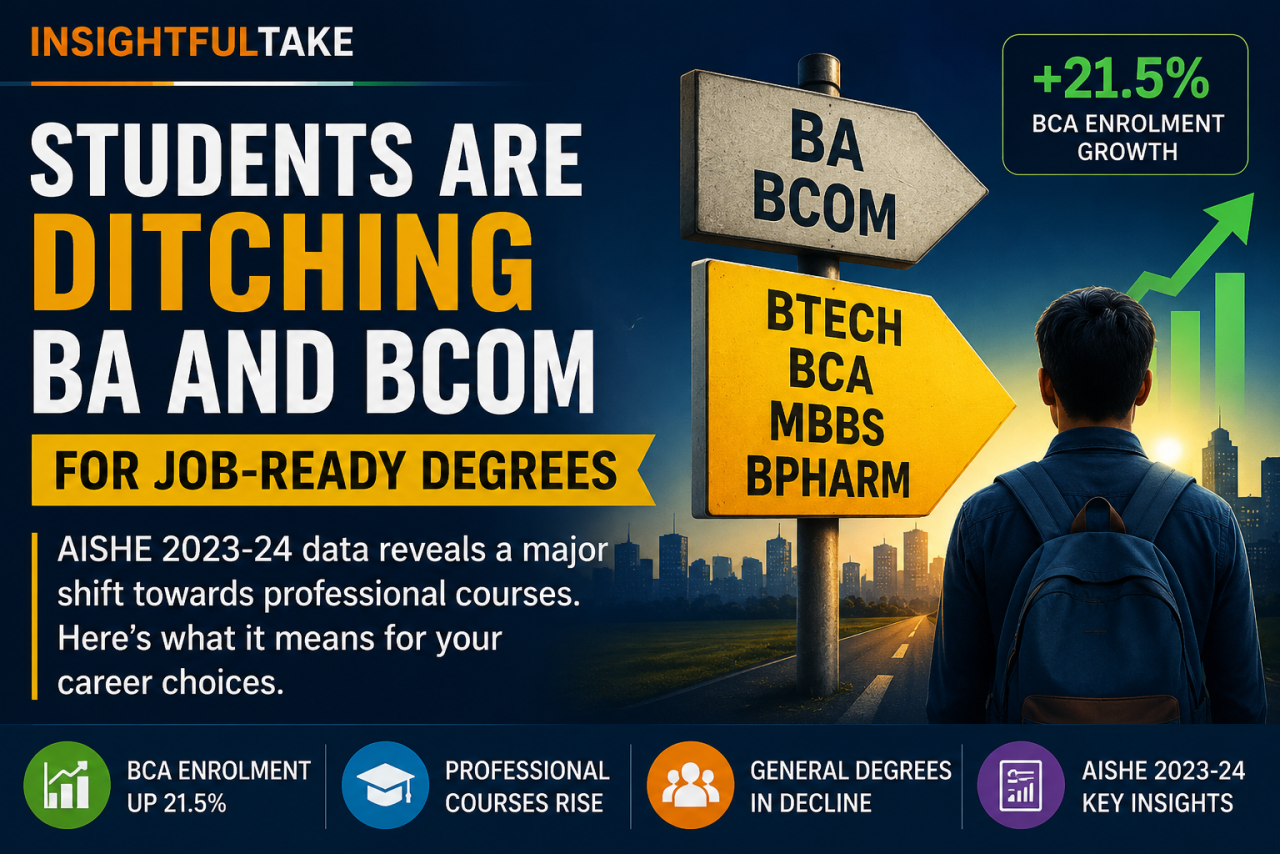
The latest AISHE data shows students are increasingly choosing professional courses over traditional degrees, reflecting changing career aspirations and a more competitive job market.
India's higher education numbers for 2023-24 are finally out, and the Union Education Ministry's All India Survey on Higher Education (AISHE) confirms something students have already been sensing on campuses across the country. General degree programmes are steadily losing their appeal, while professional and career-oriented courses are attracting more students.
The data covers the academic years 2022-23 and 2023-24 and was released after nearly a two-year gap since the previous report. For students choosing a college course today, the numbers offer an important reality check.
The Undergraduate Slowdown Is Real
Total higher education enrolment reached 45 million in 2023-24, just 0.8 percent higher than the previous year. However, undergraduate enrolment actually declined by 0.3 percent, falling to 34.6 million.
The slowdown has been building for several years. Undergraduate enrolment had grown by 6.6 percent, then 4.5 percent, and then 1.6 percent in the previous three years before finally slipping into negative territory.
But this is not a sign that students are abandoning higher education. Instead, they are changing what they choose to study.
Professional and technical programmes recorded strong growth:
- BTech/BE: up 10 percent
- BCA: up 21.5 percent
- MBBS: up 9.9 percent
- BPharm: up 11.7 percent
- BSc Nursing: up 12 percent
- BBA: up 6.3 percent
- LLB: up 5.7 percent
Meanwhile, traditional degree programmes continued to lose students:
- BCom: down 8.8 percent
- BA: down 4.5 percent
- BSc: down 3.4 percent
- BEd: down 2.7 percent
BSc enrolment has declined every year since 2021-22, while BCom has now registered declines for two consecutive years.
The message is becoming increasingly clear. Students are not leaving college. They are leaving courses that appear to offer fewer direct employment opportunities.
PhD Enrolment Has Surged, but There's a Reason
One of the most striking changes in the survey is at the doctoral level.
PhD enrolment rose to 233,422 in 2023-24, an increase of 47.2 percent compared with the previous year, adding more than 1.1 lakh students.
This does not necessarily indicate a sudden explosion in research interest. A significant reason is the UGC's decision to discontinue the MPhil programme in 2022. Students who might previously have pursued an MPhil are now moving directly into PhD programmes.
As a result, MPhil enrolment fell by 35.5 percent as the degree continued to be phased out.
Why This Matters for Students Choosing a Course
India's Gross Enrolment Ratio (GER), which measures the share of college-age youth enrolled in higher education, reached 30 percent in 2023-24. That is only 0.5 percentage points higher than the previous year.
In each of the previous three years, GER had increased by more than one percentage point annually. The slower growth, combined with the movement away from traditional degrees, suggests that students and families are becoming more selective about where they invest their time and money.
A degree without a clear career pathway is no longer viewed as the obvious default option.
Importantly, this shift is visible across Scheduled Caste (SC), Scheduled Tribe (ST), Other Backward Classes (OBC), and General categories, indicating that it cuts across social and economic groups.
What Students Should Learn From These Numbers
Choosing a degree today means looking beyond the course title.
Students should ask what practical skills, professional qualification, or recognised career pathway the programme provides. Degrees such as BTech, BCA, MBBS, BPharm, and LLB are closely linked to specific professions. Traditional degrees such as BA and BCom often require students to build additional skills before they become competitive in the job market.
That does not mean humanities or commerce degrees have lost their value. Rather, they increasingly need to be supported by certifications, internships, project portfolios, digital skills, language proficiency, or specialised technical knowledge.
Employers hiring fresh graduates are placing greater emphasis on demonstrated abilities than on degree titles alone.
Students should also avoid assuming that today's most popular courses automatically guarantee employment. A 21.5 percent surge in BCA enrolment means significantly more graduates will compete for entry-level technology jobs in the coming years. Popular courses can quickly become crowded.
The AISHE report itself also deserves to be interpreted carefully. It is a self-reported, voluntary survey, with responses from 59,533 institutions this year compared with 56,180 the previous year. Higher participation can itself influence year-to-year comparisons, so individual annual changes should not be viewed in isolation.
The Bottom Line
The latest AISHE data reflects a changing reality in India's higher education landscape. Students are increasingly choosing courses that appear to offer clearer employment opportunities, while traditional general degrees continue to lose enrolment.
Yet the bigger lesson extends beyond selecting the "right" course. In today's job market, a degree is only the starting point. The skills you develop, the experience you gain, and the evidence you can show of your capabilities will ultimately matter far more than the name printed on your certificate.
Source: Based on the All India Survey on Higher Education (AISHE) 2022-23 and 2023-24 data released by the Union Education Ministry.
India's higher education numbers for 2023-24 are finally out, and the Union Education Ministry's All India Survey on Higher Education (AISHE) confirms something students have already been sensing on campuses across the country. General degree programmes are steadily losing their appeal, while professional and career-oriented courses are attracting more students.
The data covers the academic years 2022-23 and 2023-24 and was released after nearly a two-year gap since the previous report. For students choosing a college course today, the numbers offer an important reality check.
The Undergraduate Slowdown Is Real
Total higher education enrolment reached 45 million in 2023-24, just 0.8 percent higher than the previous year. However, undergraduate enrolment actually declined by 0.3 percent, falling to 34.6 million.
The slowdown has been building for several years. Undergraduate enrolment had grown by 6.6 percent, then 4.5 percent, and then 1.6 percent in the previous three years before finally slipping into negative territory.
But this is not a sign that students are abandoning higher education. Instead, they are changing what they choose to study.
Professional and technical programmes recorded strong growth:
- BTech/BE: up 10 percent
- BCA: up 21.5 percent
- MBBS: up 9.9 percent
- BPharm: up 11.7 percent
- BSc Nursing: up 12 percent
- BBA: up 6.3 percent
- LLB: up 5.7 percent
Meanwhile, traditional degree programmes continued to lose students:
- BCom: down 8.8 percent
- BA: down 4.5 percent
- BSc: down 3.4 percent
- BEd: down 2.7 percent
BSc enrolment has declined every year since 2021-22, while BCom has now registered declines for two consecutive years.
The message is becoming increasingly clear. Students are not leaving college. They are leaving courses that appear to offer fewer direct employment opportunities.
PhD Enrolment Has Surged, but There's a Reason
One of the most striking changes in the survey is at the doctoral level.
PhD enrolment rose to 233,422 in 2023-24, an increase of 47.2 percent compared with the previous year, adding more than 1.1 lakh students.
This does not necessarily indicate a sudden explosion in research interest. A significant reason is the UGC's decision to discontinue the MPhil programme in 2022. Students who might previously have pursued an MPhil are now moving directly into PhD programmes.
As a result, MPhil enrolment fell by 35.5 percent as the degree continued to be phased out.
Why This Matters for Students Choosing a Course
India's Gross Enrolment Ratio (GER), which measures the share of college-age youth enrolled in higher education, reached 30 percent in 2023-24. That is only 0.5 percentage points higher than the previous year.
In each of the previous three years, GER had increased by more than one percentage point annually. The slower growth, combined with the movement away from traditional degrees, suggests that students and families are becoming more selective about where they invest their time and money.
A degree without a clear career pathway is no longer viewed as the obvious default option.
Importantly, this shift is visible across Scheduled Caste (SC), Scheduled Tribe (ST), Other Backward Classes (OBC), and General categories, indicating that it cuts across social and economic groups.
What Students Should Learn From These Numbers
Choosing a degree today means looking beyond the course title.
Students should ask what practical skills, professional qualification, or recognised career pathway the programme provides. Degrees such as BTech, BCA, MBBS, BPharm, and LLB are closely linked to specific professions. Traditional degrees such as BA and BCom often require students to build additional skills before they become competitive in the job market.
That does not mean humanities or commerce degrees have lost their value. Rather, they increasingly need to be supported by certifications, internships, project portfolios, digital skills, language proficiency, or specialised technical knowledge.
Employers hiring fresh graduates are placing greater emphasis on demonstrated abilities than on degree titles alone.
Students should also avoid assuming that today's most popular courses automatically guarantee employment. A 21.5 percent surge in BCA enrolment means significantly more graduates will compete for entry-level technology jobs in the coming years. Popular courses can quickly become crowded.
The AISHE report itself also deserves to be interpreted carefully. It is a self-reported, voluntary survey, with responses from 59,533 institutions this year compared with 56,180 the previous year. Higher participation can itself influence year-to-year comparisons, so individual annual changes should not be viewed in isolation.
The Bottom Line
The latest AISHE data reflects a changing reality in India's higher education landscape. Students are increasingly choosing courses that appear to offer clearer employment opportunities, while traditional general degrees continue to lose enrolment.
Yet the bigger lesson extends beyond selecting the "right" course. In today's job market, a degree is only the starting point. The skills you develop, the experience you gain, and the evidence you can show of your capabilities will ultimately matter far more than the name printed on your certificate.
Source: Based on the All India Survey on Higher Education (AISHE) 2022-23 and 2023-24 data released by the Union Education Ministry.











Leave a Comment