
One in five people will face cancer. In India, survival often depends not just on medicine, but on whether patients can access screening, diagnosis and affordable treatment in time.
One in five people alive today will be diagnosed with cancer at some point in their lives. Whether that diagnosis becomes a death sentence or a survivable illness depends less on the tumour itself and more on where the patient happens to live. That is the central conclusion of the World Health Organization's first-ever Global Status Report on Cancer 2026, prepared jointly with the International Agency for Research on Cancer (IARC).
The global numbers are sobering. Around 20.6 million people are diagnosed with cancer every year, while nearly 10 million die from the disease, making cancer the world's second leading cause of death after cardiovascular diseases. By 2050, annual cancer cases are projected to reach 35 million. The report further estimates that 92 percent of the global population will be affected by cancer in some way during their lifetime, either through their own diagnosis or that of a family member or someone close to them.
Survival Depends More on Income Than Biology
Perhaps the report's most striking finding is that survival rates are determined less by biology than by the strength of a country's healthcare system.
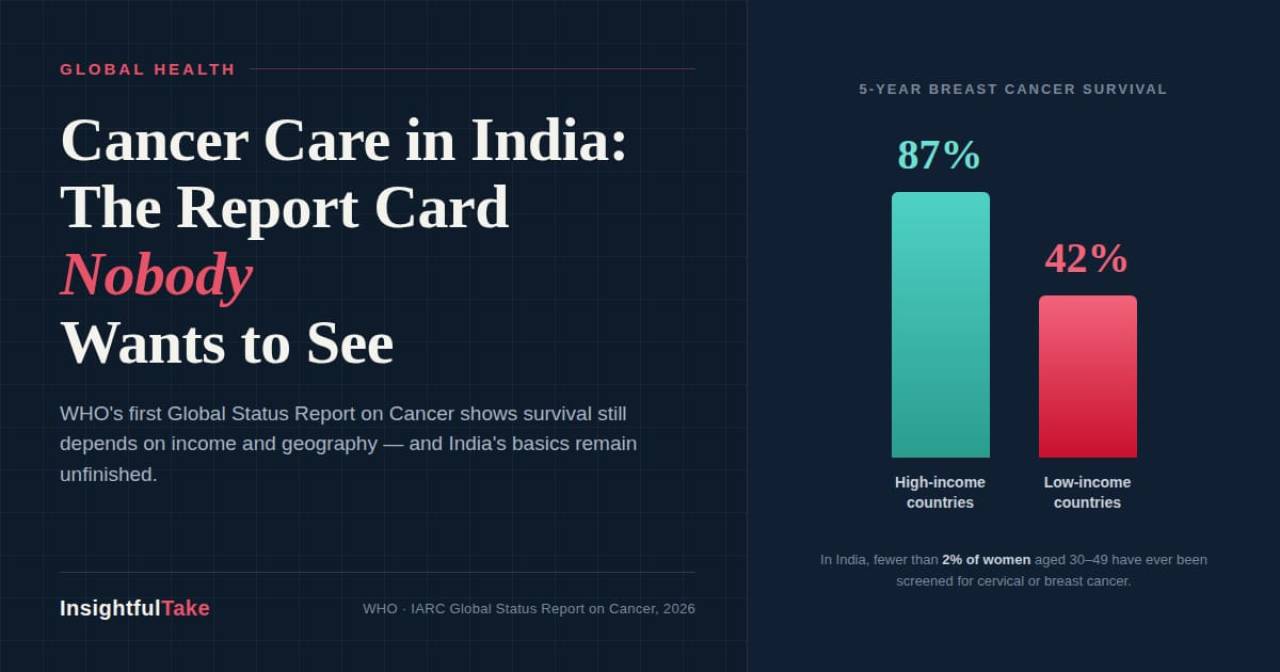
Breast cancer illustrates this inequality clearly. The five-year survival rate is 87 percent in high-income countries, but falls to around 42 percent in low-income nations. The difference is not in the disease itself but in timely diagnosis, treatment and access to healthcare.
The availability of essential cancer medicines reflects the same disparity. These medicines are available in only 9 to 54 percent of hospitals in low- and lower-middle-income countries, compared with 68 to 94 percent in high-income nations.
The report also highlights the gap in HPV vaccination, the most effective defence against cervical cancer. While 85 percent of countries have included the vaccine in their national immunisation programmes, only 31 percent of eligible girls worldwide have actually received it.
There has been progress in some areas. National cancer control plans are now in place in 82 percent of countries, up from around half in 2010. Global tobacco consumption has also declined by 27 percent since 2010, helping reduce the burden of lung cancer in several regions.
Yet progress remains uneven. Only 12 countries are currently on track to achieve the WHO's target of reducing premature cancer deaths by one-third by 2030, while 48 countries are moving in the opposite direction.
Where India Stands
India launched its National Cancer Control Programme in 1975, and cancer care has gradually improved over the past five decades. However, the WHO report, supported by national data, suggests that fundamental gaps remain.
Government survey data shows that fewer than 2 percent of women aged 30 to 49 have ever been screened for cervical cancer, while less than 1 percent have undergone breast cancer screening. This is despite breast and cervical cancers together accounting for more than one-third of all cancers among Indian women.
Screening rates are even lower among rural and economically weaker populations. Researchers attribute much of this to competing public health priorities, as many states continue to focus primarily on maternal and child health, leaving cancer screening with limited attention and resources.
The report also identifies India among six countries—alongside China, Nigeria, Indonesia, Ethiopia and Pakistan—that together account for nearly 40 percent of children worldwide who lose their mothers to cancer, with breast and cervical cancers contributing significantly to these deaths.
The Financial Burden of Cancer
The cost of treatment remains one of India's biggest challenges.
Out-of-pocket expenditure still accounts for around two-thirds of total healthcare spending in the country. As a result, families are about six times more likely to be pushed into poverty by cancer treatment than by infectious diseases.
One hospital-based study cited in the report found that the average monthly household income of cancer patients was around Rs 11,000, while treatment expenses could reach Rs 93,000 for a single hospital visit.
The Ayushman Bharat health insurance scheme has expanded access to cashless cancer treatment through more than 28,000 empanelled hospitals since its launch in 2018. Several studies suggest that enrolled patients often experience little or no out-of-pocket expenditure for treatment.
However, an important gap remains. Insurance coverage usually begins only after a confirmed cancer diagnosis. The earlier and often expensive process of investigations, imaging, biopsies and staging frequently has to be paid for by patients themselves. According to available estimates, diagnostic tests alone account for more than one-third of out-of-pocket spending among non-hospitalised cancer patients.
A Choice, Not an Inevitability
The WHO report makes one point unmistakably clear. The challenge is no longer scientific.
The vaccines already exist. Screening methods are well established. Effective treatments are available.
What remains missing is investment, access and delivery—the less visible but essential machinery required to ensure that these tools reach every patient who needs them.
For India, where cancer cases are expected to rise sharply between 2020 and 2025 and continue increasing through 2050, the greatest challenge is no longer designing national programmes but ensuring they function effectively on the ground.
The country has had a national cancer control programme on paper for half a century. Turning that policy into universal screening, early diagnosis and affordable treatment remains the unfinished task.
Whether India's growing cancer burden is met with stronger healthcare systems or merely recorded in future statistics is, as the WHO report argues, ultimately a matter of policy choice rather than medical inevitability.
One in five people alive today will be diagnosed with cancer at some point in their lives. Whether that diagnosis becomes a death sentence or a survivable illness depends less on the tumour itself and more on where the patient happens to live. That is the central conclusion of the World Health Organization's first-ever Global Status Report on Cancer 2026, prepared jointly with the International Agency for Research on Cancer (IARC).
The global numbers are sobering. Around 20.6 million people are diagnosed with cancer every year, while nearly 10 million die from the disease, making cancer the world's second leading cause of death after cardiovascular diseases. By 2050, annual cancer cases are projected to reach 35 million. The report further estimates that 92 percent of the global population will be affected by cancer in some way during their lifetime, either through their own diagnosis or that of a family member or someone close to them.
Survival Depends More on Income Than Biology
Perhaps the report's most striking finding is that survival rates are determined less by biology than by the strength of a country's healthcare system.
Breast cancer illustrates this inequality clearly. The five-year survival rate is 87 percent in high-income countries, but falls to around 42 percent in low-income nations. The difference is not in the disease itself but in timely diagnosis, treatment and access to healthcare.
The availability of essential cancer medicines reflects the same disparity. These medicines are available in only 9 to 54 percent of hospitals in low- and lower-middle-income countries, compared with 68 to 94 percent in high-income nations.
The report also highlights the gap in HPV vaccination, the most effective defence against cervical cancer. While 85 percent of countries have included the vaccine in their national immunisation programmes, only 31 percent of eligible girls worldwide have actually received it.
There has been progress in some areas. National cancer control plans are now in place in 82 percent of countries, up from around half in 2010. Global tobacco consumption has also declined by 27 percent since 2010, helping reduce the burden of lung cancer in several regions.
Yet progress remains uneven. Only 12 countries are currently on track to achieve the WHO's target of reducing premature cancer deaths by one-third by 2030, while 48 countries are moving in the opposite direction.
Where India Stands
India launched its National Cancer Control Programme in 1975, and cancer care has gradually improved over the past five decades. However, the WHO report, supported by national data, suggests that fundamental gaps remain.
Government survey data shows that fewer than 2 percent of women aged 30 to 49 have ever been screened for cervical cancer, while less than 1 percent have undergone breast cancer screening. This is despite breast and cervical cancers together accounting for more than one-third of all cancers among Indian women.
Screening rates are even lower among rural and economically weaker populations. Researchers attribute much of this to competing public health priorities, as many states continue to focus primarily on maternal and child health, leaving cancer screening with limited attention and resources.
The report also identifies India among six countries—alongside China, Nigeria, Indonesia, Ethiopia and Pakistan—that together account for nearly 40 percent of children worldwide who lose their mothers to cancer, with breast and cervical cancers contributing significantly to these deaths.
The Financial Burden of Cancer
The cost of treatment remains one of India's biggest challenges.
Out-of-pocket expenditure still accounts for around two-thirds of total healthcare spending in the country. As a result, families are about six times more likely to be pushed into poverty by cancer treatment than by infectious diseases.
One hospital-based study cited in the report found that the average monthly household income of cancer patients was around Rs 11,000, while treatment expenses could reach Rs 93,000 for a single hospital visit.
The Ayushman Bharat health insurance scheme has expanded access to cashless cancer treatment through more than 28,000 empanelled hospitals since its launch in 2018. Several studies suggest that enrolled patients often experience little or no out-of-pocket expenditure for treatment.
However, an important gap remains. Insurance coverage usually begins only after a confirmed cancer diagnosis. The earlier and often expensive process of investigations, imaging, biopsies and staging frequently has to be paid for by patients themselves. According to available estimates, diagnostic tests alone account for more than one-third of out-of-pocket spending among non-hospitalised cancer patients.
A Choice, Not an Inevitability
The WHO report makes one point unmistakably clear. The challenge is no longer scientific.
The vaccines already exist. Screening methods are well established. Effective treatments are available.
What remains missing is investment, access and delivery—the less visible but essential machinery required to ensure that these tools reach every patient who needs them.
For India, where cancer cases are expected to rise sharply between 2020 and 2025 and continue increasing through 2050, the greatest challenge is no longer designing national programmes but ensuring they function effectively on the ground.
The country has had a national cancer control programme on paper for half a century. Turning that policy into universal screening, early diagnosis and affordable treatment remains the unfinished task.
Whether India's growing cancer burden is met with stronger healthcare systems or merely recorded in future statistics is, as the WHO report argues, ultimately a matter of policy choice rather than medical inevitability.












Leave a Comment