
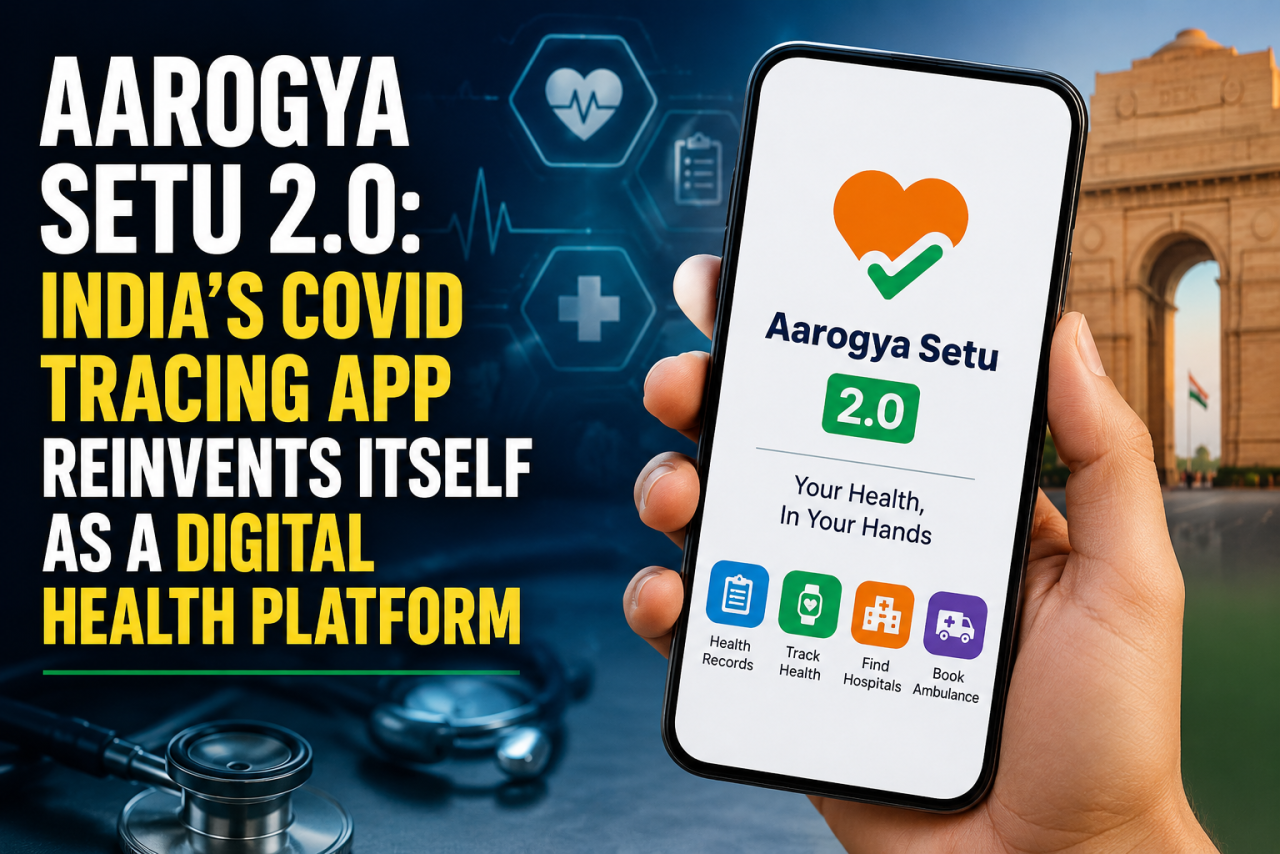
India has relaunched Aarogya Setu as a comprehensive digital health platform featuring ABHA integration, AI-powered medical records, PM-JAY services, and new health tools.
For most of 2020 and 2021, Aarogya Setu served one purpose on millions of Indian smartphones: alerting users if they had come into contact with someone who tested positive for Covid-19. Nearly six years later, the government has quietly redefined the app. On June 29, at Vigyan Bhawan in New Delhi, Union Health Minister JP Nadda launched Aarogya Setu 2.0, transforming the former contact-tracing app into a personal health record platform designed to help Indians store, access and share their medical records digitally.
The numbers behind the initiative are significant. With nearly 20 crore downloads already, Aarogya Setu gives the government a user base that few digital health platforms worldwide can match. At the launch, Nadda highlighted the broader digital health ecosystem: over 90 crore Ayushman Bharat Health Accounts (ABHA) have been created, while more than 100 crore health records are linked under the Ayushman Bharat Digital Mission. As of late June, the network included over 4.8 lakh registered health facilities and more than 9.5 lakh registered doctors, making India's digital health infrastructure one of the world's largest.
The app itself has also undergone a major overhaul. Users can now digitise prescriptions and lab reports, create a health dashboard from their medical history, and connect wearable devices to monitor steps, heart rate, calories and glucose levels. A PM-JAY Wallet displays healthcare coverage and family-wise utilisation. Other features allow users to locate nearby health facilities, book ambulances, set medication reminders and search for hospitals empanelled under the Ayushman Bharat insurance scheme.
Alongside the app, Nadda also launched the Unified Health Interface (UHI), an open digital network that allows patients and healthcare providers to interact across different platforms without using the same application, similar to the interoperability model behind UPI. The government also introduced a National Drug Registry to standardise medicine identification across prescriptions, e-pharmacies and supply chains, addressing the long-standing problem of the same medicine being listed under different names across healthcare systems.
The relaunch also includes a significant technological upgrade. Aarogya Setu 2.0 uses Google's Gemma AI model along with an open-source Medical Data Toolkit that converts scanned prescriptions, lab reports and other unstructured medical documents into structured electronic records using the internationally recognised HL7 FHIR standard. For a healthcare system that still depends heavily on paper records, this could make digitising handwritten prescriptions and medical documents far more practical. At the same time, it also means that an AI model developed by a US technology company forms part of the system processing highly sensitive personal health information.
That raises questions that have followed Aarogya Setu since its launch. Introduced in 2020 through a public-private partnership under the National Informatics Centre, the government never disclosed all the private companies involved in developing the app. During the pandemic, Aarogya Setu was made mandatory for accessing certain services, prompting criticism from digital rights groups. In 2022, an RTI filed by the Internet Freedom Foundation revealed that the government's "Data Access and Knowledge Sharing Protocol" for the app had been discontinued, raising fresh questions about the framework governing user data. None of this history featured during the latest launch, where the focus remained on download numbers, digital registries and the vision of a "Digital India" by 2047.
The Health Ministry has since introduced safeguards aimed at addressing some of these concerns. In February, it released a national AI strategy for healthcare, followed in March by a benchmarking framework to evaluate AI-based health tools before large-scale deployment. The Central Drugs Standard Control Organisation has also issued draft regulations for licensing medical device software, with a 30-day consultation period. Whether these measures are robust enough to govern a platform that already reaches nearly 20 crore users—or merely catch up after deployment—will determine whether Aarogya Setu 2.0 succeeds as India's trusted digital health record platform or continues to face the trust challenges that marked its first chapter.
For most of 2020 and 2021, Aarogya Setu served one purpose on millions of Indian smartphones: alerting users if they had come into contact with someone who tested positive for Covid-19. Nearly six years later, the government has quietly redefined the app. On June 29, at Vigyan Bhawan in New Delhi, Union Health Minister JP Nadda launched Aarogya Setu 2.0, transforming the former contact-tracing app into a personal health record platform designed to help Indians store, access and share their medical records digitally.
The numbers behind the initiative are significant. With nearly 20 crore downloads already, Aarogya Setu gives the government a user base that few digital health platforms worldwide can match. At the launch, Nadda highlighted the broader digital health ecosystem: over 90 crore Ayushman Bharat Health Accounts (ABHA) have been created, while more than 100 crore health records are linked under the Ayushman Bharat Digital Mission. As of late June, the network included over 4.8 lakh registered health facilities and more than 9.5 lakh registered doctors, making India's digital health infrastructure one of the world's largest.
The app itself has also undergone a major overhaul. Users can now digitise prescriptions and lab reports, create a health dashboard from their medical history, and connect wearable devices to monitor steps, heart rate, calories and glucose levels. A PM-JAY Wallet displays healthcare coverage and family-wise utilisation. Other features allow users to locate nearby health facilities, book ambulances, set medication reminders and search for hospitals empanelled under the Ayushman Bharat insurance scheme.
Alongside the app, Nadda also launched the Unified Health Interface (UHI), an open digital network that allows patients and healthcare providers to interact across different platforms without using the same application, similar to the interoperability model behind UPI. The government also introduced a National Drug Registry to standardise medicine identification across prescriptions, e-pharmacies and supply chains, addressing the long-standing problem of the same medicine being listed under different names across healthcare systems.
The relaunch also includes a significant technological upgrade. Aarogya Setu 2.0 uses Google's Gemma AI model along with an open-source Medical Data Toolkit that converts scanned prescriptions, lab reports and other unstructured medical documents into structured electronic records using the internationally recognised HL7 FHIR standard. For a healthcare system that still depends heavily on paper records, this could make digitising handwritten prescriptions and medical documents far more practical. At the same time, it also means that an AI model developed by a US technology company forms part of the system processing highly sensitive personal health information.
That raises questions that have followed Aarogya Setu since its launch. Introduced in 2020 through a public-private partnership under the National Informatics Centre, the government never disclosed all the private companies involved in developing the app. During the pandemic, Aarogya Setu was made mandatory for accessing certain services, prompting criticism from digital rights groups. In 2022, an RTI filed by the Internet Freedom Foundation revealed that the government's "Data Access and Knowledge Sharing Protocol" for the app had been discontinued, raising fresh questions about the framework governing user data. None of this history featured during the latest launch, where the focus remained on download numbers, digital registries and the vision of a "Digital India" by 2047.
The Health Ministry has since introduced safeguards aimed at addressing some of these concerns. In February, it released a national AI strategy for healthcare, followed in March by a benchmarking framework to evaluate AI-based health tools before large-scale deployment. The Central Drugs Standard Control Organisation has also issued draft regulations for licensing medical device software, with a 30-day consultation period. Whether these measures are robust enough to govern a platform that already reaches nearly 20 crore users—or merely catch up after deployment—will determine whether Aarogya Setu 2.0 succeeds as India's trusted digital health record platform or continues to face the trust challenges that marked its first chapter.




















Leave a Comment