
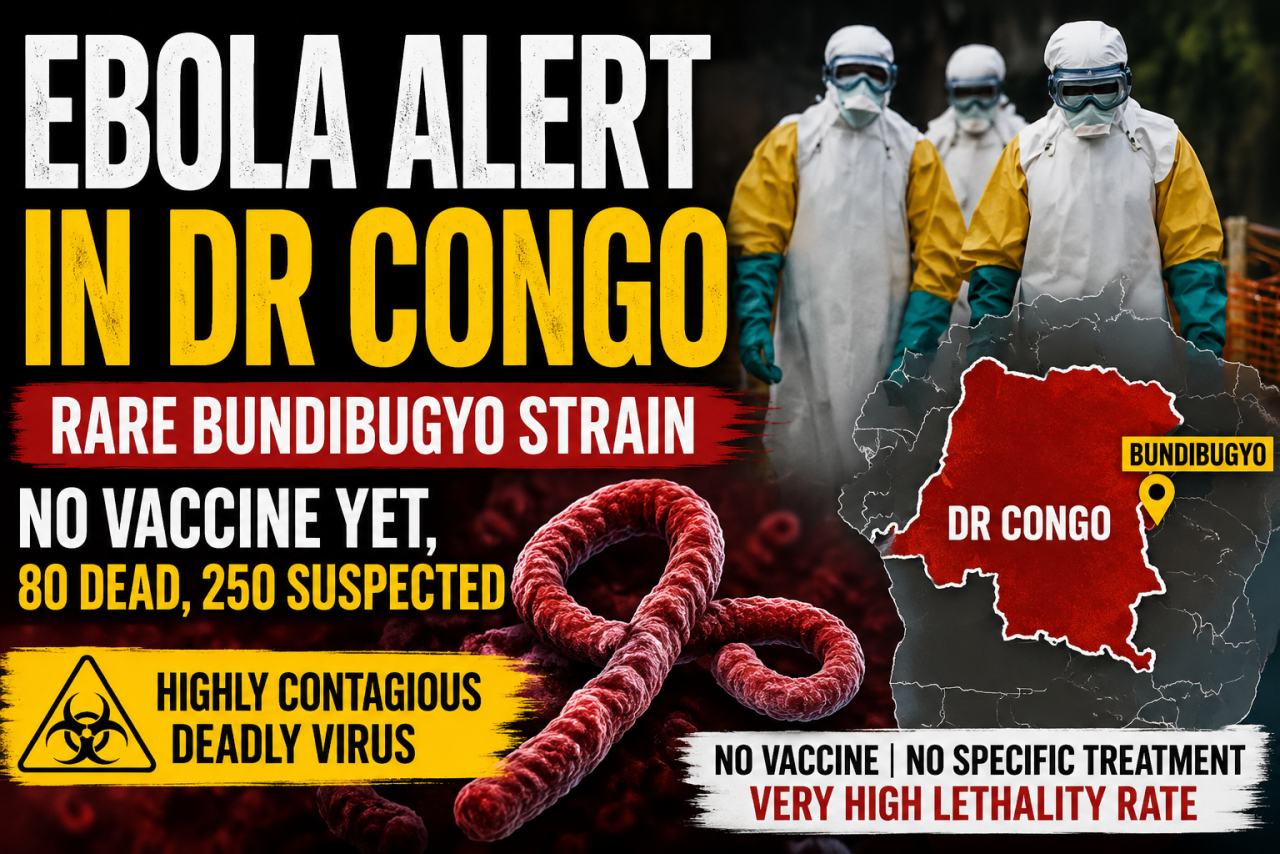
A rare and deadly Ebola strain with no available vaccine is spreading rapidly through DR Congo, raising fears of another major African health crisis as fatalities climb and suspected cases surge.
A fresh Ebola outbreak in the Democratic Republic of Congo (DR Congo) has triggered growing concern among global health authorities after officials confirmed that the virus strain involved — the rare Bundibugyo variant — currently has no approved vaccine or specific treatment.
The outbreak, centered in northeastern DR Congo, has already claimed at least 80 lives, according to the country’s health ministry. Nearly 250 suspected cases of the highly contagious haemorrhagic fever have also been reported, raising fears of a wider regional health emergency.
Unlike the more common Zaire strain of Ebola, for which vaccines and response systems exist, the Bundibugyo strain remains far less understood. First identified in Uganda in 2007, the variant is considered rare but highly dangerous due to its severe symptoms and the lack of medical tools available to fight it effectively.
DR Congo’s Health Minister Samuel-Roger Kamba warned that the outbreak carries a “very high lethality rate,” with estimates suggesting mortality could reach nearly 50 percent in severe cases. Officials also noted that the death toll had risen sharply within a day, increasing from 65 to 80 fatalities, signaling the rapid pace at which the disease is spreading.
The outbreak has already crossed borders. Authorities in neighboring Uganda confirmed the death of a Congolese national infected with the Bundibugyo strain after he traveled into the country for treatment. Health officials there fear that increased movement across porous borders could accelerate regional transmission.
Medical humanitarian organization Doctors Without Borders (MSF) has described the situation as “extremely concerning.” The group announced preparations for a “large-scale response,” emphasizing that the combination of rapid transmission, limited healthcare infrastructure, and the absence of vaccines creates a particularly dangerous scenario.
Ebola is one of the world’s deadliest viral diseases. It spreads through direct contact with infected bodily fluids and can cause severe fever, bleeding, organ failure, and death. Outbreaks often become difficult to contain in regions with weak health systems, poor sanitation, and ongoing conflict — conditions that have long affected parts of eastern DR Congo.
The current crisis highlights a major challenge in global epidemic preparedness: while scientific progress has produced vaccines against certain Ebola strains, protection is not universal. Existing vaccines mainly target the Zaire strain, identified in 1976, which historically recorded fatality rates as high as 90 percent. However, experts warn that less common strains like Bundibugyo continue to expose dangerous gaps in medical research and international preparedness.
Health authorities are now focusing on containment strategies, including contact tracing, isolation of suspected patients, border monitoring, and public awareness campaigns. International health agencies are also expected to increase surveillance efforts to prevent the outbreak from expanding further into Central and East Africa.
The Africa Centres for Disease Control and Prevention (Africa CDC) has reportedly begun coordinating regional monitoring efforts, especially in border regions connecting DR Congo with Uganda and South Sudan. Public health experts say early intervention will be critical in preventing a repeat of the devastating Ebola epidemics that have previously swept across parts of Africa.
Beyond the immediate humanitarian crisis, the outbreak also serves as a reminder of how vulnerable the world remains to emerging infectious diseases. While global attention in recent years focused heavily on the COVID-19 pandemic, diseases like Ebola continue to pose serious threats in regions where healthcare systems remain fragile.
For communities living near the outbreak zones, fear and uncertainty are growing rapidly. With no vaccine available for the Bundibugyo strain and infections continuing to rise, health workers now face a race against time to contain one of the world’s most feared viruses before it spreads further across the region.
A fresh Ebola outbreak in the Democratic Republic of Congo (DR Congo) has triggered growing concern among global health authorities after officials confirmed that the virus strain involved — the rare Bundibugyo variant — currently has no approved vaccine or specific treatment.
The outbreak, centered in northeastern DR Congo, has already claimed at least 80 lives, according to the country’s health ministry. Nearly 250 suspected cases of the highly contagious haemorrhagic fever have also been reported, raising fears of a wider regional health emergency.
Unlike the more common Zaire strain of Ebola, for which vaccines and response systems exist, the Bundibugyo strain remains far less understood. First identified in Uganda in 2007, the variant is considered rare but highly dangerous due to its severe symptoms and the lack of medical tools available to fight it effectively.
DR Congo’s Health Minister Samuel-Roger Kamba warned that the outbreak carries a “very high lethality rate,” with estimates suggesting mortality could reach nearly 50 percent in severe cases. Officials also noted that the death toll had risen sharply within a day, increasing from 65 to 80 fatalities, signaling the rapid pace at which the disease is spreading.
The outbreak has already crossed borders. Authorities in neighboring Uganda confirmed the death of a Congolese national infected with the Bundibugyo strain after he traveled into the country for treatment. Health officials there fear that increased movement across porous borders could accelerate regional transmission.
Medical humanitarian organization Doctors Without Borders (MSF) has described the situation as “extremely concerning.” The group announced preparations for a “large-scale response,” emphasizing that the combination of rapid transmission, limited healthcare infrastructure, and the absence of vaccines creates a particularly dangerous scenario.
Ebola is one of the world’s deadliest viral diseases. It spreads through direct contact with infected bodily fluids and can cause severe fever, bleeding, organ failure, and death. Outbreaks often become difficult to contain in regions with weak health systems, poor sanitation, and ongoing conflict — conditions that have long affected parts of eastern DR Congo.
The current crisis highlights a major challenge in global epidemic preparedness: while scientific progress has produced vaccines against certain Ebola strains, protection is not universal. Existing vaccines mainly target the Zaire strain, identified in 1976, which historically recorded fatality rates as high as 90 percent. However, experts warn that less common strains like Bundibugyo continue to expose dangerous gaps in medical research and international preparedness.
Health authorities are now focusing on containment strategies, including contact tracing, isolation of suspected patients, border monitoring, and public awareness campaigns. International health agencies are also expected to increase surveillance efforts to prevent the outbreak from expanding further into Central and East Africa.
The Africa Centres for Disease Control and Prevention (Africa CDC) has reportedly begun coordinating regional monitoring efforts, especially in border regions connecting DR Congo with Uganda and South Sudan. Public health experts say early intervention will be critical in preventing a repeat of the devastating Ebola epidemics that have previously swept across parts of Africa.
Beyond the immediate humanitarian crisis, the outbreak also serves as a reminder of how vulnerable the world remains to emerging infectious diseases. While global attention in recent years focused heavily on the COVID-19 pandemic, diseases like Ebola continue to pose serious threats in regions where healthcare systems remain fragile.
For communities living near the outbreak zones, fear and uncertainty are growing rapidly. With no vaccine available for the Bundibugyo strain and infections continuing to rise, health workers now face a race against time to contain one of the world’s most feared viruses before it spreads further across the region.






















Leave a Comment