
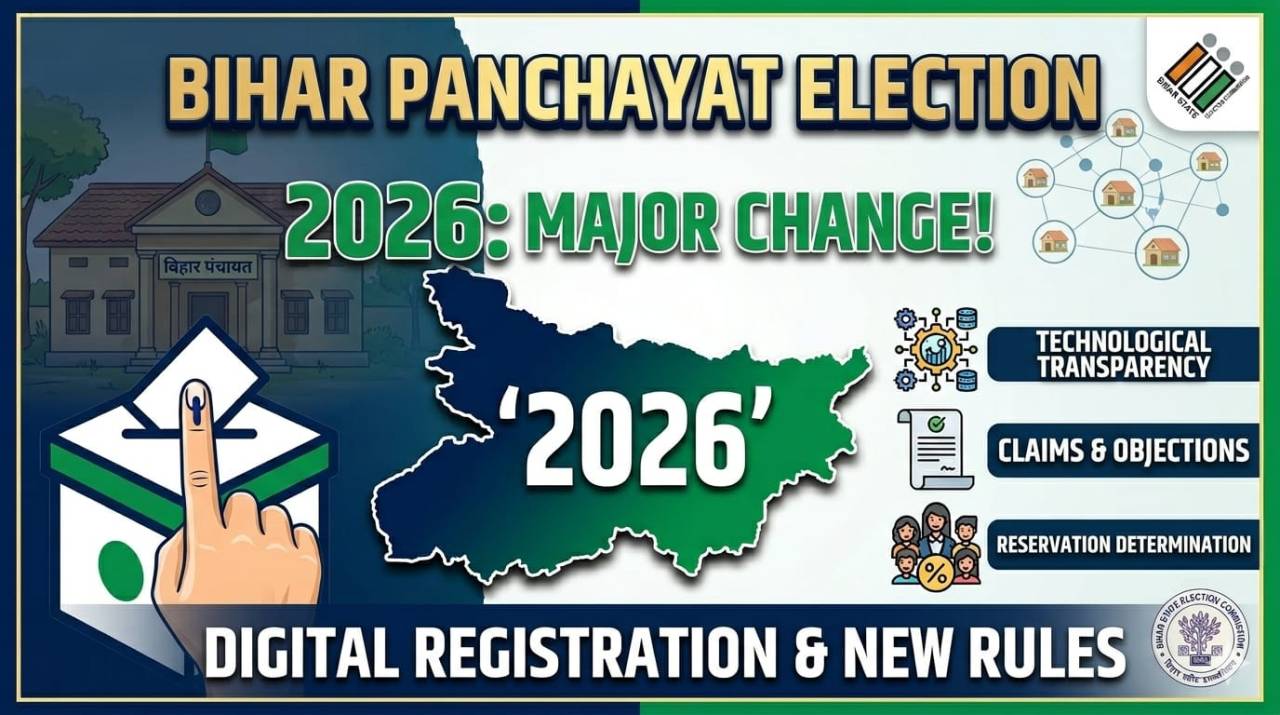
As Bihar redraws village boundaries and digitizes reservation systems ahead of the 2026 Panchayat Elections, the battle for grassroots power is quietly transforming into one of the state’s biggest political turning points in years.
Bihar’s villages are once again preparing for one of the largest democratic exercises in the world. But the Bihar Panchayat Elections 2026 are not shaping up to be a routine local body poll. This time, the elections are arriving with sweeping administrative restructuring, digital oversight mechanisms, and renewed debates around representation, transparency, and grassroots governance.
With the State Election Commission, Bihar formally initiating the groundwork for the elections, the process has already begun to reshape the political landscape of rural Bihar months before the first vote is cast.
The commission’s recent publication of “Prapatra-1” — the foundational demographic and territorial framework used for reservation and constituency determination — marks the beginning of a politically sensitive and administratively massive exercise.
Why the 2026 Panchayat Elections Matter More Than Ever
Panchayat elections in Bihar are not merely local governance contests. They are often the first indicators of shifting caste alliances, emerging regional leadership, and rural voter sentiment ahead of larger assembly battles.
This year’s election carries additional significance because Bihar’s rural geography itself has changed dramatically over the past decade.
Rapid urban expansion has resulted in several villages being absorbed into municipal bodies and Nagar Nikays. As a result, electoral boundaries that were used in the 2016 and 2021 Panchayat polls no longer accurately reflect present demographic realities.
To address this, the State Election Commission undertook a comprehensive re-verification of territorial divisions and population data using the 2011 Census as the legal basis for recalibration. The revised framework affects thousands of electoral positions across Gram Panchayats, Panchayat Samitis, and Zila Parishads.
In districts such as Vaishali, the revised Prapatra-1 publication has already outlined electoral structures covering thousands of local seats, including Mukhiya, Ward Member, Sarpanch, and District Council positions.
The New Electoral Timeline
The SEC has adopted a tightly monitored schedule for the preparatory phase of the elections:
Draft Publication of Prapatra-1: May 4, 2026
Claims and Objections Window: May 4–18, 2026
Verification and Disposal Process: Late May 2026
Final Publication of Prapatra-1: June 15, 2026
The revised timeline was formally issued by the commission earlier this month.
The June 15 final publication will become the legally binding framework for reservation allocation and territorial mapping in the Panchayat elections.
Technology Takes Center Stage
One of the most notable aspects of Bihar’s 2026 Panchayat election preparation is the commission’s growing reliance on digital infrastructure.
Traditionally, Panchayat elections across India have faced allegations of clerical errors, faulty ward mapping, and reservation discrepancies. Bihar’s SEC is attempting to reduce those risks through software-driven verification systems and online monitoring mechanisms.
The commission has integrated digital portals for population entry, claim filing, objection tracking, and reservation calculations. Historical reservation data dating back to 2006 is reportedly being digitized to minimize human interference in the sensitive process of seat allotment for Women, Scheduled Castes (SCs), Scheduled Tribes (STs), and Extremely Backward Classes (EBCs).
Officials believe that the digital architecture could reduce litigation and disputes that frequently delay local elections in India.
At the same time, Bihar’s increasing experimentation with election technology has also generated public debate. Civil society groups and digital rights advocates have previously raised concerns regarding transparency, data safeguards, and digital accessibility in election-related platforms.
Public Participation and the Objection Process
The SEC has attempted to make the process participatory rather than purely bureaucratic.
Citizens have been given a formal window to file claims and objections regarding territorial boundaries, population data, and reservation calculations until May 18.
To ensure awareness in rural areas, authorities are combining traditional and modern outreach methods. In several districts, public announcements through drum-beating campaigns (“dugdugi”) are being supplemented with television notices and digital portals.
Residents can also use the SEC’s “Samadhan” grievance platform to register complaints and track their resolution status online.
Administrative accountability has been layered into the system:
- Block Development Officers (BDOs) are handling preliminary scrutiny.
- Sub-Divisional Officers (SDOs) are conducting verification.
- District Magistrates are serving as appellate authorities for unresolved disputes.
The multi-tier structure is designed to reduce arbitrary decision-making and improve institutional credibility.
Representation at the Core
The stakes surrounding Prapatra-1 extend far beyond technical boundaries.
The finalized demographic matrix will directly determine reservation patterns for women and marginalized communities across Bihar’s rural governance structure.
Bihar has long been viewed as a national example in women’s participation in local governance after implementing 50 percent reservation for women in Panchayati Raj institutions. The 2026 elections are expected to further test how effectively representation translates into political empowerment.
Simultaneously, reservation allocation among SCs, STs, and EBCs remains politically sensitive in a state where caste continues to influence electoral behavior at every level.
A Political Litmus Test Before Bigger Battles
Though Panchayat elections are officially non-party contests in many respects, political parties closely monitor them as indicators of rural mood.
With Bihar expected to witness intense political mobilization in the coming years, the Panchayat elections may serve as an early testing ground for emerging alliances, caste equations, and grassroots organizational strength.
Local leadership networks built during Panchayat elections often evolve into assembly-level political machinery later.
That is why the ongoing administrative process — from delimitation to reservation mapping — is already attracting enormous political attention.
Beyond Elections: A Test of Democratic Modernization
The Bihar Panchayat Elections 2026 represent more than a contest for village-level offices. They are becoming a test case for whether India’s grassroots democracy can modernize without sacrificing accessibility, inclusion, or public trust.
By combining digital governance tools with public participation mechanisms, Bihar is attempting to create a more transparent electoral framework at the local level. Yet the success of that experiment will ultimately depend on execution, fairness, and the confidence of ordinary rural voters.
For now, as villages across Bihar begin preparing for another electoral season, the state is once again reminding the country that democracy in India does not begin in Parliament — it begins in the Panchayat.
Bihar’s villages are once again preparing for one of the largest democratic exercises in the world. But the Bihar Panchayat Elections 2026 are not shaping up to be a routine local body poll. This time, the elections are arriving with sweeping administrative restructuring, digital oversight mechanisms, and renewed debates around representation, transparency, and grassroots governance.
With the State Election Commission, Bihar formally initiating the groundwork for the elections, the process has already begun to reshape the political landscape of rural Bihar months before the first vote is cast.
The commission’s recent publication of “Prapatra-1” — the foundational demographic and territorial framework used for reservation and constituency determination — marks the beginning of a politically sensitive and administratively massive exercise.
Why the 2026 Panchayat Elections Matter More Than Ever
Panchayat elections in Bihar are not merely local governance contests. They are often the first indicators of shifting caste alliances, emerging regional leadership, and rural voter sentiment ahead of larger assembly battles.
This year’s election carries additional significance because Bihar’s rural geography itself has changed dramatically over the past decade.
Rapid urban expansion has resulted in several villages being absorbed into municipal bodies and Nagar Nikays. As a result, electoral boundaries that were used in the 2016 and 2021 Panchayat polls no longer accurately reflect present demographic realities.
To address this, the State Election Commission undertook a comprehensive re-verification of territorial divisions and population data using the 2011 Census as the legal basis for recalibration. The revised framework affects thousands of electoral positions across Gram Panchayats, Panchayat Samitis, and Zila Parishads.
In districts such as Vaishali, the revised Prapatra-1 publication has already outlined electoral structures covering thousands of local seats, including Mukhiya, Ward Member, Sarpanch, and District Council positions.
The New Electoral Timeline
The SEC has adopted a tightly monitored schedule for the preparatory phase of the elections:
Draft Publication of Prapatra-1: May 4, 2026
Claims and Objections Window: May 4–18, 2026
Verification and Disposal Process: Late May 2026
Final Publication of Prapatra-1: June 15, 2026
The revised timeline was formally issued by the commission earlier this month.
The June 15 final publication will become the legally binding framework for reservation allocation and territorial mapping in the Panchayat elections.
Technology Takes Center Stage
One of the most notable aspects of Bihar’s 2026 Panchayat election preparation is the commission’s growing reliance on digital infrastructure.
Traditionally, Panchayat elections across India have faced allegations of clerical errors, faulty ward mapping, and reservation discrepancies. Bihar’s SEC is attempting to reduce those risks through software-driven verification systems and online monitoring mechanisms.
The commission has integrated digital portals for population entry, claim filing, objection tracking, and reservation calculations. Historical reservation data dating back to 2006 is reportedly being digitized to minimize human interference in the sensitive process of seat allotment for Women, Scheduled Castes (SCs), Scheduled Tribes (STs), and Extremely Backward Classes (EBCs).
Officials believe that the digital architecture could reduce litigation and disputes that frequently delay local elections in India.
At the same time, Bihar’s increasing experimentation with election technology has also generated public debate. Civil society groups and digital rights advocates have previously raised concerns regarding transparency, data safeguards, and digital accessibility in election-related platforms.
Public Participation and the Objection Process
The SEC has attempted to make the process participatory rather than purely bureaucratic.
Citizens have been given a formal window to file claims and objections regarding territorial boundaries, population data, and reservation calculations until May 18.
To ensure awareness in rural areas, authorities are combining traditional and modern outreach methods. In several districts, public announcements through drum-beating campaigns (“dugdugi”) are being supplemented with television notices and digital portals.
Residents can also use the SEC’s “Samadhan” grievance platform to register complaints and track their resolution status online.
Administrative accountability has been layered into the system:
- Block Development Officers (BDOs) are handling preliminary scrutiny.
- Sub-Divisional Officers (SDOs) are conducting verification.
- District Magistrates are serving as appellate authorities for unresolved disputes.
The multi-tier structure is designed to reduce arbitrary decision-making and improve institutional credibility.
Representation at the Core
The stakes surrounding Prapatra-1 extend far beyond technical boundaries.
The finalized demographic matrix will directly determine reservation patterns for women and marginalized communities across Bihar’s rural governance structure.
Bihar has long been viewed as a national example in women’s participation in local governance after implementing 50 percent reservation for women in Panchayati Raj institutions. The 2026 elections are expected to further test how effectively representation translates into political empowerment.
Simultaneously, reservation allocation among SCs, STs, and EBCs remains politically sensitive in a state where caste continues to influence electoral behavior at every level.
A Political Litmus Test Before Bigger Battles
Though Panchayat elections are officially non-party contests in many respects, political parties closely monitor them as indicators of rural mood.
With Bihar expected to witness intense political mobilization in the coming years, the Panchayat elections may serve as an early testing ground for emerging alliances, caste equations, and grassroots organizational strength.
Local leadership networks built during Panchayat elections often evolve into assembly-level political machinery later.
That is why the ongoing administrative process — from delimitation to reservation mapping — is already attracting enormous political attention.
Beyond Elections: A Test of Democratic Modernization
The Bihar Panchayat Elections 2026 represent more than a contest for village-level offices. They are becoming a test case for whether India’s grassroots democracy can modernize without sacrificing accessibility, inclusion, or public trust.
By combining digital governance tools with public participation mechanisms, Bihar is attempting to create a more transparent electoral framework at the local level. Yet the success of that experiment will ultimately depend on execution, fairness, and the confidence of ordinary rural voters.
For now, as villages across Bihar begin preparing for another electoral season, the state is once again reminding the country that democracy in India does not begin in Parliament — it begins in the Panchayat.


















Leave a Comment