
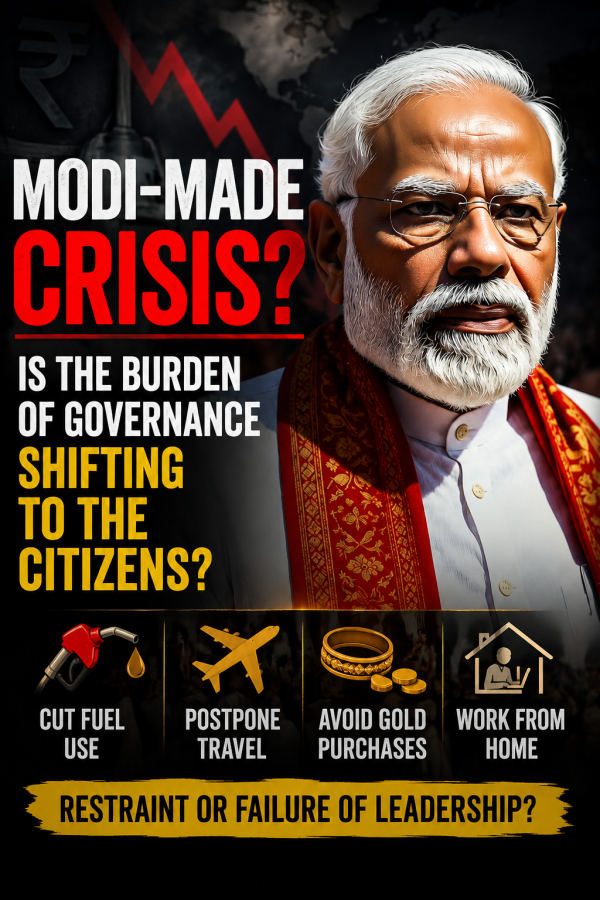
As global tensions pressure India’s economy, PM Narendra Modi’s call for public restraint has ignited a fierce debate: national duty or governance failure?
In moments of global instability, governments are often judged not only by how they respond to crises abroad, but by how effectively they shield citizens at home from the economic fallout. As tensions in West Asia continue to rattle global oil markets and pressure emerging economies, Prime Minister Narendra Modi has urged Indians to embrace a year of restraint — cutting fuel consumption, postponing foreign travel, avoiding unnecessary imports, and reducing gold purchases.
The appeal, framed by the government as a patriotic effort to protect India’s economy from external shocks, has triggered an intense political debate. While the ruling establishment portrays the measures as responsible economic nationalism, the Opposition has sharply criticized them as evidence of policy failure and delayed governance.
At the heart of the controversy lies a larger question: should citizens be expected to absorb the consequences of economic stress that critics say the government failed to anticipate?
A Call for Economic Restraint
The Prime Minister’s message draws heavily from the language of collective responsibility that defined the COVID-19 years. Citizens have been encouraged to work from home where possible, reduce fuel consumption, prioritize domestic goods, and avoid luxury spending that could increase pressure on India’s foreign exchange reserves.
The government argues that these measures are necessary at a time when crude oil prices remain volatile and the Indian Rupee faces pressure from a strengthening US dollar. As one of the world’s largest oil importers, India remains vulnerable to disruptions in West Asia, making economic caution a strategic necessity.
Officials supporting the appeal say temporary restraint today could help India avoid deeper inflationary shocks tomorrow.
Yet the timing of the announcement has intensified political suspicion. The appeal came immediately after assembly elections in several states and one Union Territory, allowing the Opposition to accuse the government of withholding the severity of the situation until after voting concluded.
Opposition Frames It as Governance Failure
The Congress party has led the attack, arguing that asking citizens to alter personal spending habits reflects a failure of economic management rather than responsible leadership.
Rahul Gandhi and other Opposition leaders have questioned why ordinary citizens are being asked to shoulder the burden of economic uncertainty while structural policy measures remain unclear. Their criticism centers on accountability: if a government must ask people to decide “what to buy and where to go,” they argue, it signals weaknesses in planning and preparedness.
The Opposition has also revived accusations that the government prioritizes political messaging over institutional readiness. Critics describe the Prime Minister as more focused on image management than long-term economic resilience, accusing the administration of reacting to crises rather than preparing for them.
Comparisons with neighboring countries facing economic turbulence have further sharpened the rhetoric. Opposition leaders claim India should have strengthened energy security and fiscal buffers earlier instead of depending on public austerity during periods of global instability.
The Debate Over Responsibility
Beyond partisan politics, the controversy raises a deeper philosophical issue about the role of the state during economic crises.
Governments are generally expected to manage inflation, trade deficits, currency pressures, and energy security through policy decisions, strategic reserves, and diplomatic engagement. Critics argue that when citizens are asked to reduce daily consumption to stabilize macroeconomic conditions, the line between governance responsibility and public sacrifice begins to blur.
Supporters of the government, however, counter that extraordinary global conditions require collective national participation. They argue that economic resilience is not the responsibility of governments alone and that public cooperation becomes essential during periods of international uncertainty.
The debate reflects two competing visions of governance: one where the state acts as the primary shield against economic disruption, and another where citizens are expected to become active participants in national economic defense.
Optics and Political Messaging
The Opposition has also targeted what it calls a contradiction between the austerity message delivered to citizens and the functioning of political elites.
Critics point to the continued scale of government events, international diplomacy, and political campaigning while citizens are being advised to reduce travel and consumption. This perceived disconnect has allowed opponents to frame the situation as one where sacrifice is expected primarily from the middle class and ordinary households.
The ruling party rejects these accusations, insisting that diplomatic engagement and international outreach remain essential for protecting India’s strategic and economic interests during a volatile geopolitical phase.
Government supporters further argue that the call for restraint aligns with the broader vision of “Atmanirbhar Bharat,” or self-reliant India, which emphasizes reducing dependence on imports and strengthening domestic production.
A Test of Public Trust
As economic uncertainty deepens globally, the political battle over austerity is likely to intensify. The government will continue framing restraint as an act of national solidarity during an international crisis. The Opposition, meanwhile, is expected to amplify claims that the burden of economic management is being transferred from policymakers to ordinary citizens.
Ultimately, the success of the government’s appeal may depend less on economic indicators and more on public perception. If citizens believe the sacrifices are temporary, necessary, and fairly shared, the call for restraint could strengthen political trust. But if voters begin to view austerity as a substitute for governance, the political costs could grow significantly.
In the coming months, India’s economic debate may no longer revolve solely around oil prices, inflation, or foreign exchange reserves. It may instead center on a more politically sensitive question: when crises emerge, how much responsibility should governments carry and how much should be passed on to the people?
In moments of global instability, governments are often judged not only by how they respond to crises abroad, but by how effectively they shield citizens at home from the economic fallout. As tensions in West Asia continue to rattle global oil markets and pressure emerging economies, Prime Minister Narendra Modi has urged Indians to embrace a year of restraint — cutting fuel consumption, postponing foreign travel, avoiding unnecessary imports, and reducing gold purchases.
The appeal, framed by the government as a patriotic effort to protect India’s economy from external shocks, has triggered an intense political debate. While the ruling establishment portrays the measures as responsible economic nationalism, the Opposition has sharply criticized them as evidence of policy failure and delayed governance.
At the heart of the controversy lies a larger question: should citizens be expected to absorb the consequences of economic stress that critics say the government failed to anticipate?
A Call for Economic Restraint
The Prime Minister’s message draws heavily from the language of collective responsibility that defined the COVID-19 years. Citizens have been encouraged to work from home where possible, reduce fuel consumption, prioritize domestic goods, and avoid luxury spending that could increase pressure on India’s foreign exchange reserves.
The government argues that these measures are necessary at a time when crude oil prices remain volatile and the Indian Rupee faces pressure from a strengthening US dollar. As one of the world’s largest oil importers, India remains vulnerable to disruptions in West Asia, making economic caution a strategic necessity.
Officials supporting the appeal say temporary restraint today could help India avoid deeper inflationary shocks tomorrow.
Yet the timing of the announcement has intensified political suspicion. The appeal came immediately after assembly elections in several states and one Union Territory, allowing the Opposition to accuse the government of withholding the severity of the situation until after voting concluded.
Opposition Frames It as Governance Failure
The Congress party has led the attack, arguing that asking citizens to alter personal spending habits reflects a failure of economic management rather than responsible leadership.
Rahul Gandhi and other Opposition leaders have questioned why ordinary citizens are being asked to shoulder the burden of economic uncertainty while structural policy measures remain unclear. Their criticism centers on accountability: if a government must ask people to decide “what to buy and where to go,” they argue, it signals weaknesses in planning and preparedness.
The Opposition has also revived accusations that the government prioritizes political messaging over institutional readiness. Critics describe the Prime Minister as more focused on image management than long-term economic resilience, accusing the administration of reacting to crises rather than preparing for them.
Comparisons with neighboring countries facing economic turbulence have further sharpened the rhetoric. Opposition leaders claim India should have strengthened energy security and fiscal buffers earlier instead of depending on public austerity during periods of global instability.
The Debate Over Responsibility
Beyond partisan politics, the controversy raises a deeper philosophical issue about the role of the state during economic crises.
Governments are generally expected to manage inflation, trade deficits, currency pressures, and energy security through policy decisions, strategic reserves, and diplomatic engagement. Critics argue that when citizens are asked to reduce daily consumption to stabilize macroeconomic conditions, the line between governance responsibility and public sacrifice begins to blur.
Supporters of the government, however, counter that extraordinary global conditions require collective national participation. They argue that economic resilience is not the responsibility of governments alone and that public cooperation becomes essential during periods of international uncertainty.
The debate reflects two competing visions of governance: one where the state acts as the primary shield against economic disruption, and another where citizens are expected to become active participants in national economic defense.
Optics and Political Messaging
The Opposition has also targeted what it calls a contradiction between the austerity message delivered to citizens and the functioning of political elites.
Critics point to the continued scale of government events, international diplomacy, and political campaigning while citizens are being advised to reduce travel and consumption. This perceived disconnect has allowed opponents to frame the situation as one where sacrifice is expected primarily from the middle class and ordinary households.
The ruling party rejects these accusations, insisting that diplomatic engagement and international outreach remain essential for protecting India’s strategic and economic interests during a volatile geopolitical phase.
Government supporters further argue that the call for restraint aligns with the broader vision of “Atmanirbhar Bharat,” or self-reliant India, which emphasizes reducing dependence on imports and strengthening domestic production.
A Test of Public Trust
As economic uncertainty deepens globally, the political battle over austerity is likely to intensify. The government will continue framing restraint as an act of national solidarity during an international crisis. The Opposition, meanwhile, is expected to amplify claims that the burden of economic management is being transferred from policymakers to ordinary citizens.
Ultimately, the success of the government’s appeal may depend less on economic indicators and more on public perception. If citizens believe the sacrifices are temporary, necessary, and fairly shared, the call for restraint could strengthen political trust. But if voters begin to view austerity as a substitute for governance, the political costs could grow significantly.
In the coming months, India’s economic debate may no longer revolve solely around oil prices, inflation, or foreign exchange reserves. It may instead center on a more politically sensitive question: when crises emerge, how much responsibility should governments carry and how much should be passed on to the people?


















Leave a Comment