
A classroom map has sparked a courtroom battle. As descendants of Maratha royal families challenge NCERT’s decision to remove a map of the Maratha Empire from school textbooks, the dispute has reopened a larger national debate.
A dispute over a school textbook map has reached the Bombay High Court, turning a debate about history education into a larger conversation about identity, regional memory, and historical interpretation. Descendants of prominent Maratha royal families have challenged a recent decision by the National Council of Educational Research and Training (NCERT) to remove a historical map from a Class 8 Social Science textbook, arguing that the move sidelines an important chapter of India’s past.
The Core of the Dispute
The legal challenge, filed as a Public Interest Litigation (PIL), describes NCERT’s decision as “unilateral, arbitrary, and non-transparent.” The petitioners — including Raje Mudhojiraje Ajitsinghrao Bhonsle of Nagpur and Shivaji Dattatray Raje Jadhav of the Jijau family — contend that the map was removed without adequate consultation with historians or a detailed review of historical evidence.
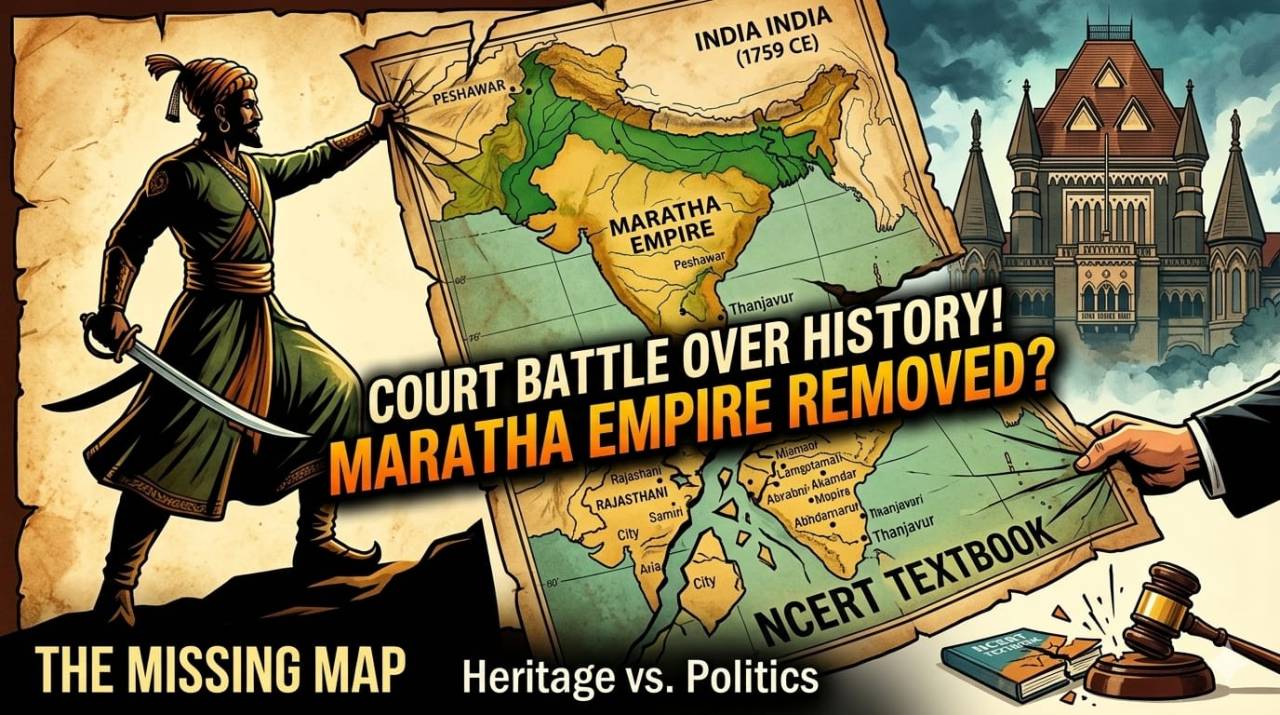
The disputed map, previously identified as Figure 3.11, depicted the Maratha Empire at its territorial peak in 1759 CE. It illustrated a sphere of influence extending from Thanjavur in present-day Tamil Nadu to Peshawar in present-day Pakistan. For the petitioners, the map represented more than geography; it symbolized the political and military influence of the Marathas during a defining period in Indian history.
A Clash of Regional Narratives
The controversy appears to stem from disagreements over the portrayal of regional power structures in the 18th century. Between October 2025 and April 2026, NCERT removed the map from Hindi, English, and Urdu editions of the textbook after objections were reportedly raised by royal families in Rajasthan, who disputed the depiction of certain Rajasthani regions as falling under Maratha control.
Maratha historians and the petitioners, however, argue that the decision oversimplifies a complex historical reality. Historian Indrajeet Sawant has stated that between 1707 and 1788, significant parts of the Rajputana region experienced varying degrees of Maratha influence and control. Critics of the removal argue that instead of revising the map with additional context or explanatory notes, NCERT chose to eliminate it altogether, potentially weakening students’ understanding of the era.
Why the Map Matters
For students studying history, maps often provide context that text alone cannot fully capture. The disputed illustration highlighted the rapid rise of the Marathas during the decline of the Mughal Empire and demonstrated how political authority shifted across the subcontinent in the 18th century.
- Geopolitical Understanding: The map portrayed the Marathas as one of the dominant powers of their time, helping students visualize the changing political landscape of pre-colonial India.
- Historical Representation: The petitioners argue that educational content shapes public memory, and that removing such material can affect how communities perceive their own historical legacy.
- Academic Transparency: The PIL also raises broader concerns about whether revisions to school curricula should involve greater transparency, scholarly review, and public explanation.
The Legal and Educational Implications
The Bombay High Court will now examine whether NCERT’s decision falls within its academic and administrative authority or whether the removal compromised fair historical representation. According to Shivaji Dattatray Raje Jadhav, the petitioners believe that NCERT chose to withdraw the map rather than conduct a deeper historical review addressing the concerns raised by Rajasthan’s royal families.
The case also reflects a broader national debate over textbook revisions and the interpretation of Indian history. Educational content has increasingly become a site of political and cultural contestation, with competing groups seeking recognition of their historical narratives. Supporters of curriculum changes often describe them as necessary rationalization, while critics warn that selective omissions may leave students with an incomplete understanding of the past.
Final Take
As the Bombay High Court prepares to hear the matter, the case is likely to influence future debates over how history is represented in Indian classrooms. Whether the disputed map is restored, revised, or permanently removed, the controversy underscores how deeply historical narratives remain connected to identity, memory, and regional pride.
The challenge for educational institutions lies not only in presenting history accurately, but also in acknowledging its complexity without reducing it to competing political claims.
A dispute over a school textbook map has reached the Bombay High Court, turning a debate about history education into a larger conversation about identity, regional memory, and historical interpretation. Descendants of prominent Maratha royal families have challenged a recent decision by the National Council of Educational Research and Training (NCERT) to remove a historical map from a Class 8 Social Science textbook, arguing that the move sidelines an important chapter of India’s past.
The Core of the Dispute
The legal challenge, filed as a Public Interest Litigation (PIL), describes NCERT’s decision as “unilateral, arbitrary, and non-transparent.” The petitioners — including Raje Mudhojiraje Ajitsinghrao Bhonsle of Nagpur and Shivaji Dattatray Raje Jadhav of the Jijau family — contend that the map was removed without adequate consultation with historians or a detailed review of historical evidence.
The disputed map, previously identified as Figure 3.11, depicted the Maratha Empire at its territorial peak in 1759 CE. It illustrated a sphere of influence extending from Thanjavur in present-day Tamil Nadu to Peshawar in present-day Pakistan. For the petitioners, the map represented more than geography; it symbolized the political and military influence of the Marathas during a defining period in Indian history.
A Clash of Regional Narratives
The controversy appears to stem from disagreements over the portrayal of regional power structures in the 18th century. Between October 2025 and April 2026, NCERT removed the map from Hindi, English, and Urdu editions of the textbook after objections were reportedly raised by royal families in Rajasthan, who disputed the depiction of certain Rajasthani regions as falling under Maratha control.
Maratha historians and the petitioners, however, argue that the decision oversimplifies a complex historical reality. Historian Indrajeet Sawant has stated that between 1707 and 1788, significant parts of the Rajputana region experienced varying degrees of Maratha influence and control. Critics of the removal argue that instead of revising the map with additional context or explanatory notes, NCERT chose to eliminate it altogether, potentially weakening students’ understanding of the era.
Why the Map Matters
For students studying history, maps often provide context that text alone cannot fully capture. The disputed illustration highlighted the rapid rise of the Marathas during the decline of the Mughal Empire and demonstrated how political authority shifted across the subcontinent in the 18th century.
- Geopolitical Understanding: The map portrayed the Marathas as one of the dominant powers of their time, helping students visualize the changing political landscape of pre-colonial India.
- Historical Representation: The petitioners argue that educational content shapes public memory, and that removing such material can affect how communities perceive their own historical legacy.
- Academic Transparency: The PIL also raises broader concerns about whether revisions to school curricula should involve greater transparency, scholarly review, and public explanation.
The Legal and Educational Implications
The Bombay High Court will now examine whether NCERT’s decision falls within its academic and administrative authority or whether the removal compromised fair historical representation. According to Shivaji Dattatray Raje Jadhav, the petitioners believe that NCERT chose to withdraw the map rather than conduct a deeper historical review addressing the concerns raised by Rajasthan’s royal families.
The case also reflects a broader national debate over textbook revisions and the interpretation of Indian history. Educational content has increasingly become a site of political and cultural contestation, with competing groups seeking recognition of their historical narratives. Supporters of curriculum changes often describe them as necessary rationalization, while critics warn that selective omissions may leave students with an incomplete understanding of the past.
Final Take
As the Bombay High Court prepares to hear the matter, the case is likely to influence future debates over how history is represented in Indian classrooms. Whether the disputed map is restored, revised, or permanently removed, the controversy underscores how deeply historical narratives remain connected to identity, memory, and regional pride.
The challenge for educational institutions lies not only in presenting history accurately, but also in acknowledging its complexity without reducing it to competing political claims.


















Leave a Comment