
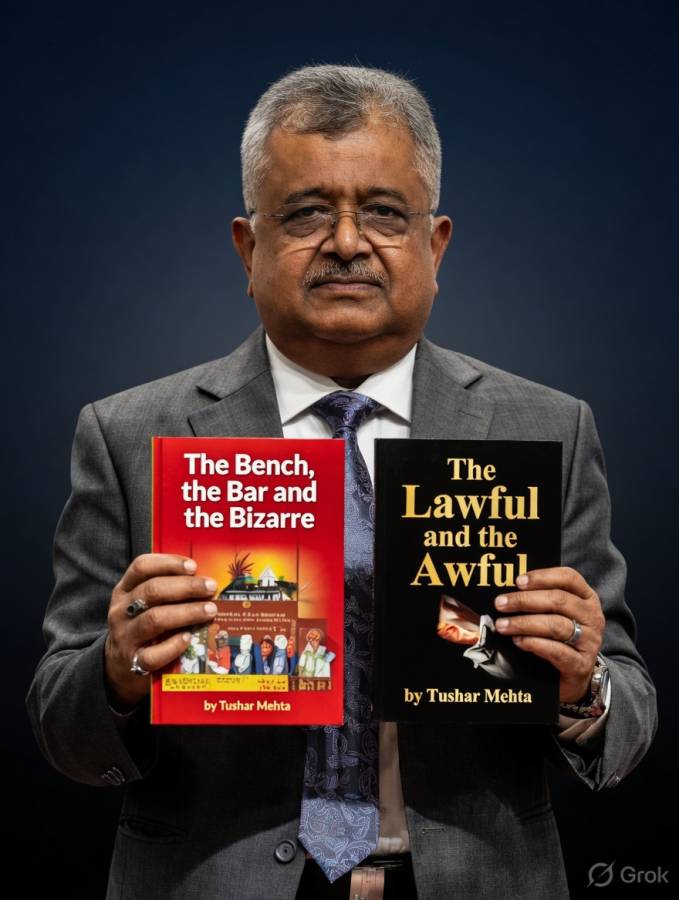
Behind the gravity of India’s highest courtrooms lies a world of humor, chaos, and human absurdity and Solicitor General Tushar Mehta is now bringing those hidden stories to life through sharp, witty legal literature.
In India’s legal imagination, the office of the Solicitor General is associated with constitutional gravity, intense courtroom battles, and the weight of national interest. Yet Tushar Mehta has stepped beyond the stern confines of legal advocacy to reveal another dimension of his personality — that of a sharp observer of human behavior and an engaging storyteller.
With his two non-fiction works, The Bench, the Bar and the Bizarre and The Lawful and the Awful, Mehta offers readers a rare glimpse into the strange, humorous, and deeply human world hidden beneath courtroom formalities. Rather than presenting law as a cold and mechanical institution, he portrays it as a living theatre shaped by personalities, contradictions, errors, wit, and unpredictability.
Breaking the Myth of Courtroom Perfection
Courtrooms are often perceived as spaces governed solely by logic, precision, and procedural discipline. Mehta’s writing dismantles this carefully constructed image by exposing the absurdity and unpredictability that coexist within the legal ecosystem.
Through anecdotes, observations, and carefully curated incidents, he punctures what many describe as the “intellectual arrogance” surrounding the legal profession. His books suggest that behind every intimidating legal argument lies a deeply human environment where confusion, comedy, misunderstanding, and emotion frequently surface.
This perspective is particularly striking because it comes from a man who regularly handles some of India’s most consequential legal matters. Instead of reinforcing institutional stiffness, Mehta chooses to celebrate the imperfections and eccentricities that make the justice system relatable.
His literary voice demonstrates that seriousness in public duty does not require the abandonment of humor or self-awareness.
Using Global Anecdotes to Reflect Universal Truths
One of the most notable features of Mehta’s writing is his preference for drawing upon international legal anecdotes instead of directly referencing domestic courtroom personalities.
This strategy serves multiple purposes.
First, it allows him to preserve professional dignity while still engaging in satire. By avoiding pointed commentary on contemporary Indian legal figures, the books maintain a tone that is humorous without becoming controversial or personal.
Second, the global references reinforce a broader truth — that courtroom absurdity is universal. Whether in London, New York, or elsewhere, the legal profession shares common patterns of dramatic lawyers, confused witnesses, procedural mishaps, and unexpected moments of comedy.
The result is that the books transcend the category of simple legal humor. They become reflections on the universal human condition operating within institutions that are often mistaken for purely rational systems.
Humanizing the Judiciary
The enthusiastic reception from senior members of the Indian judiciary highlights the cultural significance of these works. Members of the legal fraternity have acknowledged that the books succeed in making courtroom life accessible and entertaining without diminishing the dignity of the institution itself.
Surya Kant reportedly described reading the works as an experience comparable to “binge-watching a courtroom drama,” except one filled with laughter instead of stress. Such praise underlines Mehta’s ability to transform legal settings into compelling narratives for a wider audience.
The books also arrive at a time when public conversations around law and justice are often highly polarized, technical, and emotionally charged. In that climate, Mehta’s writing provides a softer lens through which ordinary readers can engage with the judiciary.
Instead of viewing courts as inaccessible centers of authority, readers encounter them as spaces inhabited by flawed yet relatable human beings.
Beyond the Courtroom Persona
The emotional context surrounding the launch of the books also contributed to public interest. Their release on Mother’s Day introduced a more personal and grounded aspect of Mehta’s public image.
That symbolism mattered. It subtly reflected the balance between professional rigor and personal values — a balance that also shapes the tone of his writing. Beneath the humor lies empathy, restraint, and an understanding that institutions ultimately derive meaning from the people who serve within them.
Final Verdict: Literature as Institutional Self-Reflection
Tushar Mehta’s literary venture is more than an intellectual side project. It is an exercise in institutional self-reflection.
Book Title
Core Theme
Broader Impact
The Bench, the Bar and the Bizarre
Humor, unpredictability, and courtroom eccentricities
Humanizes legal institutions for ordinary readers
The Lawful and the Awful
The intersection of logic, ethics, and human fallibility
Challenges legal pomposity with wit and satire
In an age where legal debates frequently descend into ideological confrontation and technical jargon, Mehta’s books remind readers of a simple truth: the law is ultimately a human enterprise.
By combining the authority of the courtroom with the accessibility of storytelling, he has softened the image of the gavel with the elegance of the quill. In doing so, he has shown that even the most serious institutions benefit from the ability to laugh at themselves.
In India’s legal imagination, the office of the Solicitor General is associated with constitutional gravity, intense courtroom battles, and the weight of national interest. Yet Tushar Mehta has stepped beyond the stern confines of legal advocacy to reveal another dimension of his personality — that of a sharp observer of human behavior and an engaging storyteller.
With his two non-fiction works, The Bench, the Bar and the Bizarre and The Lawful and the Awful, Mehta offers readers a rare glimpse into the strange, humorous, and deeply human world hidden beneath courtroom formalities. Rather than presenting law as a cold and mechanical institution, he portrays it as a living theatre shaped by personalities, contradictions, errors, wit, and unpredictability.
Breaking the Myth of Courtroom Perfection
Courtrooms are often perceived as spaces governed solely by logic, precision, and procedural discipline. Mehta’s writing dismantles this carefully constructed image by exposing the absurdity and unpredictability that coexist within the legal ecosystem.
Through anecdotes, observations, and carefully curated incidents, he punctures what many describe as the “intellectual arrogance” surrounding the legal profession. His books suggest that behind every intimidating legal argument lies a deeply human environment where confusion, comedy, misunderstanding, and emotion frequently surface.
This perspective is particularly striking because it comes from a man who regularly handles some of India’s most consequential legal matters. Instead of reinforcing institutional stiffness, Mehta chooses to celebrate the imperfections and eccentricities that make the justice system relatable.
His literary voice demonstrates that seriousness in public duty does not require the abandonment of humor or self-awareness.
Using Global Anecdotes to Reflect Universal Truths
One of the most notable features of Mehta’s writing is his preference for drawing upon international legal anecdotes instead of directly referencing domestic courtroom personalities.
This strategy serves multiple purposes.
First, it allows him to preserve professional dignity while still engaging in satire. By avoiding pointed commentary on contemporary Indian legal figures, the books maintain a tone that is humorous without becoming controversial or personal.
Second, the global references reinforce a broader truth — that courtroom absurdity is universal. Whether in London, New York, or elsewhere, the legal profession shares common patterns of dramatic lawyers, confused witnesses, procedural mishaps, and unexpected moments of comedy.
The result is that the books transcend the category of simple legal humor. They become reflections on the universal human condition operating within institutions that are often mistaken for purely rational systems.
Humanizing the Judiciary
The enthusiastic reception from senior members of the Indian judiciary highlights the cultural significance of these works. Members of the legal fraternity have acknowledged that the books succeed in making courtroom life accessible and entertaining without diminishing the dignity of the institution itself.
Surya Kant reportedly described reading the works as an experience comparable to “binge-watching a courtroom drama,” except one filled with laughter instead of stress. Such praise underlines Mehta’s ability to transform legal settings into compelling narratives for a wider audience.
The books also arrive at a time when public conversations around law and justice are often highly polarized, technical, and emotionally charged. In that climate, Mehta’s writing provides a softer lens through which ordinary readers can engage with the judiciary.
Instead of viewing courts as inaccessible centers of authority, readers encounter them as spaces inhabited by flawed yet relatable human beings.
Beyond the Courtroom Persona
The emotional context surrounding the launch of the books also contributed to public interest. Their release on Mother’s Day introduced a more personal and grounded aspect of Mehta’s public image.
That symbolism mattered. It subtly reflected the balance between professional rigor and personal values — a balance that also shapes the tone of his writing. Beneath the humor lies empathy, restraint, and an understanding that institutions ultimately derive meaning from the people who serve within them.
Final Verdict: Literature as Institutional Self-Reflection
Tushar Mehta’s literary venture is more than an intellectual side project. It is an exercise in institutional self-reflection.
|
Book Title |
Core Theme |
Broader Impact |
|
The Bench, the Bar and the Bizarre |
Humor, unpredictability, and courtroom eccentricities |
Humanizes legal institutions for ordinary readers |
|
The Lawful and the Awful |
The intersection of logic, ethics, and human fallibility |
Challenges legal pomposity with wit and satire |
In an age where legal debates frequently descend into ideological confrontation and technical jargon, Mehta’s books remind readers of a simple truth: the law is ultimately a human enterprise.
By combining the authority of the courtroom with the accessibility of storytelling, he has softened the image of the gavel with the elegance of the quill. In doing so, he has shown that even the most serious institutions benefit from the ability to laugh at themselves.





















Leave a Comment