
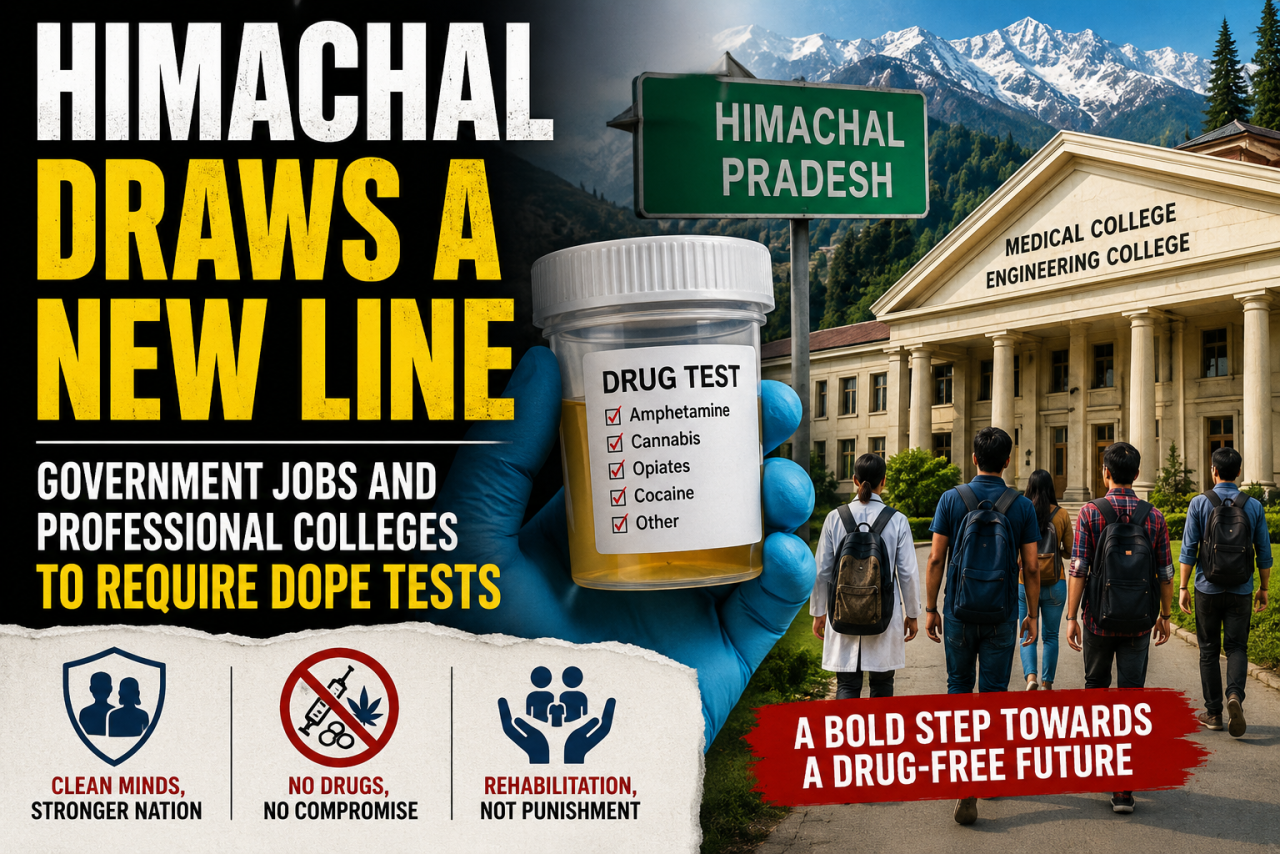
As drug abuse tightens its grip on India’s youth, Himachal Pradesh has drawn a hard line by making dope tests mandatory for government jobs and professional college admissions.
Himachal Pradesh has stepped into a sensitive but increasingly unavoidable national conversation. The state government, led by Chief Minister Sukhvinder Singh Sukhu, has announced that candidates seeking government jobs and students applying to professional institutions such as medical and engineering colleges will now have to undergo mandatory dope testing.
The move marks one of the strongest anti-drug policy interventions by any Indian state in recent years. At a time when drug abuse among young people has become a growing concern across northern India, Himachal Pradesh is attempting to send a clear message that academic achievement and professional ambition cannot be separated from personal responsibility and public health.
The policy is primarily aimed at tackling the spread of heroin, locally known as chitta, which has become a major social challenge in several parts of the state. Officials believe the problem has moved far beyond isolated criminal activity and now threatens families, campuses, and local communities alike.
What makes the Himachal model different, however, is that the government is not framing the issue only through punishment. Students who test positive for substance abuse will not automatically lose their educational opportunities. Instead, the state plans to provide rehabilitation, counselling, and medical treatment while allowing them to continue their studies. The government’s approach attempts to distinguish between drug traffickers and young people struggling with addiction.
That distinction is politically and socially significant.
Across India, anti-drug campaigns are often associated with raids, arrests, and criminal cases. Himachal Pradesh is trying to combine strict enforcement against smugglers with a rehabilitation-oriented approach for students and first-time users. The state government has also announced stronger monitoring mechanisms at the administrative level. Anti-drug performance indicators are expected to become part of the Annual Confidential Reports (ACRs) of senior district officials, including Deputy Commissioners and Superintendents of Police.
The numbers behind the decision reveal why the government considers the situation serious. Since 2023, the state has recorded a sharp rise in cases registered under the Narcotic Drugs and Psychotropic Substances (NDPS) Act. Thousands of arrests and large-scale narcotics seizures have highlighted how deeply the problem has spread into both urban and rural areas.
For students preparing for competitive examinations or aspiring to enter professions such as medicine, engineering, teaching, or policing, the policy introduces a new layer to the idea of eligibility. Traditionally, recruitment and admissions in India have focused almost entirely on academic scores, entrance examinations, and physical fitness. Himachal’s decision suggests that governments may increasingly treat substance abuse as a matter directly linked to professional competence and public trust.
The logic behind the move is straightforward. A doctor under the influence of narcotics can endanger patients. An engineer handling critical infrastructure cannot afford impaired judgement. A police officer battling addiction faces obvious ethical and operational concerns. In that sense, the state government argues that drug testing is not simply a moral exercise but a safeguard linked to public safety.
Still, the policy is likely to trigger debate beyond Himachal Pradesh.
Critics may raise questions about privacy, misuse of testing procedures, and the possibility of stigmatizing young people. Others may argue that addiction is fundamentally a health issue and should not become a gatekeeping mechanism for education or employment. There will also be concerns about implementation, transparency, and the standards used during testing.
These are legitimate concerns, especially in a country where institutional safeguards often remain uneven.
Yet supporters of the policy argue that ignoring the scale of the drug crisis would be a greater mistake. They see the measure as an attempt to intervene early before addiction destroys careers, families, and communities. Many parents and educators are likely to view the announcement as a necessary response to a problem that has steadily moved from the margins into the mainstream.
The state government is also preparing a wider awareness campaign across schools and colleges between June and August to educate students about the dangers of narcotics. Officials have described chitta as a “slow poison” eating into the social fabric of the region.
Whether the Himachal model succeeds or not, it has already pushed an uncomfortable issue into the national spotlight. The state has effectively asked a question that other governments may soon confront as well: should professional merit in modern India include freedom from substance abuse?
For now, Himachal Pradesh has drawn its line clearly. The message coming from the hills is simple — academic degrees and government jobs carry public responsibility, and the state believes that responsibility begins with a clear mind.
Himachal Pradesh has stepped into a sensitive but increasingly unavoidable national conversation. The state government, led by Chief Minister Sukhvinder Singh Sukhu, has announced that candidates seeking government jobs and students applying to professional institutions such as medical and engineering colleges will now have to undergo mandatory dope testing.
The move marks one of the strongest anti-drug policy interventions by any Indian state in recent years. At a time when drug abuse among young people has become a growing concern across northern India, Himachal Pradesh is attempting to send a clear message that academic achievement and professional ambition cannot be separated from personal responsibility and public health.
The policy is primarily aimed at tackling the spread of heroin, locally known as chitta, which has become a major social challenge in several parts of the state. Officials believe the problem has moved far beyond isolated criminal activity and now threatens families, campuses, and local communities alike.
What makes the Himachal model different, however, is that the government is not framing the issue only through punishment. Students who test positive for substance abuse will not automatically lose their educational opportunities. Instead, the state plans to provide rehabilitation, counselling, and medical treatment while allowing them to continue their studies. The government’s approach attempts to distinguish between drug traffickers and young people struggling with addiction.
That distinction is politically and socially significant.
Across India, anti-drug campaigns are often associated with raids, arrests, and criminal cases. Himachal Pradesh is trying to combine strict enforcement against smugglers with a rehabilitation-oriented approach for students and first-time users. The state government has also announced stronger monitoring mechanisms at the administrative level. Anti-drug performance indicators are expected to become part of the Annual Confidential Reports (ACRs) of senior district officials, including Deputy Commissioners and Superintendents of Police.
The numbers behind the decision reveal why the government considers the situation serious. Since 2023, the state has recorded a sharp rise in cases registered under the Narcotic Drugs and Psychotropic Substances (NDPS) Act. Thousands of arrests and large-scale narcotics seizures have highlighted how deeply the problem has spread into both urban and rural areas.
For students preparing for competitive examinations or aspiring to enter professions such as medicine, engineering, teaching, or policing, the policy introduces a new layer to the idea of eligibility. Traditionally, recruitment and admissions in India have focused almost entirely on academic scores, entrance examinations, and physical fitness. Himachal’s decision suggests that governments may increasingly treat substance abuse as a matter directly linked to professional competence and public trust.
The logic behind the move is straightforward. A doctor under the influence of narcotics can endanger patients. An engineer handling critical infrastructure cannot afford impaired judgement. A police officer battling addiction faces obvious ethical and operational concerns. In that sense, the state government argues that drug testing is not simply a moral exercise but a safeguard linked to public safety.
Still, the policy is likely to trigger debate beyond Himachal Pradesh.
Critics may raise questions about privacy, misuse of testing procedures, and the possibility of stigmatizing young people. Others may argue that addiction is fundamentally a health issue and should not become a gatekeeping mechanism for education or employment. There will also be concerns about implementation, transparency, and the standards used during testing.
These are legitimate concerns, especially in a country where institutional safeguards often remain uneven.
Yet supporters of the policy argue that ignoring the scale of the drug crisis would be a greater mistake. They see the measure as an attempt to intervene early before addiction destroys careers, families, and communities. Many parents and educators are likely to view the announcement as a necessary response to a problem that has steadily moved from the margins into the mainstream.
The state government is also preparing a wider awareness campaign across schools and colleges between June and August to educate students about the dangers of narcotics. Officials have described chitta as a “slow poison” eating into the social fabric of the region.
Whether the Himachal model succeeds or not, it has already pushed an uncomfortable issue into the national spotlight. The state has effectively asked a question that other governments may soon confront as well: should professional merit in modern India include freedom from substance abuse?
For now, Himachal Pradesh has drawn its line clearly. The message coming from the hills is simple — academic degrees and government jobs carry public responsibility, and the state believes that responsibility begins with a clear mind.





















Leave a Comment