
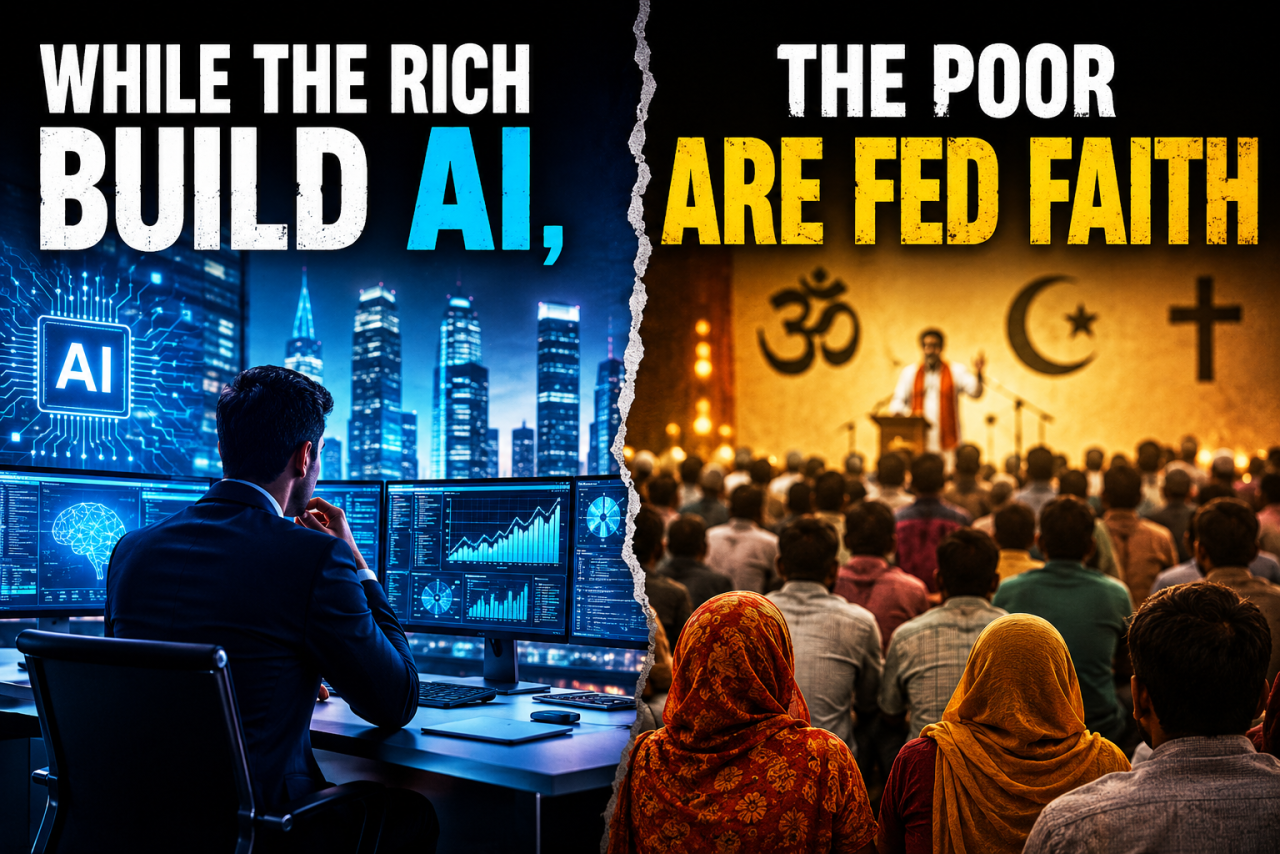
As elites build AI and technological power, millions remain trapped in emotional politics and religious distraction. Is the future being designed only for the powerful?
As the world rushes into the age of artificial intelligence, robotics, biotechnology, and space innovation, a disturbing divide is becoming increasingly visible across societies: the powerful are preparing for the future, while ordinary people are often trapped in endless battles over religion, identity, and emotion.
The imbalance is impossible to ignore.
The wealthiest corporations and nations are investing trillions into AI systems, semiconductor manufacturing, quantum computing, surveillance infrastructure, and automation. Elite universities are producing the next generation of coders, engineers, scientists, and tech entrepreneurs. Global leaders openly describe artificial intelligence as the defining power struggle of the century.
Yet for millions of ordinary people, especially in politically polarized societies, public discourse is moving in the opposite direction. Instead of conversations about scientific literacy, industrial competitiveness, educational reform, or technological preparedness, large sections of society are consumed by cultural outrage, religious mobilization, and symbolic political conflicts.
One class is building the future.
Another is being emotionally occupied by the past.
This is not an attack on religion. Faith has long provided people with moral structure, emotional resilience, and community belonging. Throughout history, religion has inspired charity, philosophy, discipline, and social harmony. But the problem begins when religion stops being a personal spiritual force and becomes a political distraction.
That distinction matters.
Because modern power is increasingly determined not by religious dominance, but by technological capability.
The nations shaping the future are not leading because they pray harder. They lead because they innovate faster. Their power comes from laboratories, research centers, data infrastructure, advanced manufacturing, and control over digital ecosystems.
No country can spiritually chant its way into semiconductor leadership.
No economy can emotionally slogan itself into AI dominance.
No society can defeat technological dependence through symbolic politics alone.
Development requires difficult work: scientific education, institutional reform, long-term planning, investment in research, freedom of inquiry, and economic discipline. These are slow, expensive, and politically demanding processes. Emotional mobilization, on the other hand, is cheap, fast, and electorally effective.
This is where the danger emerges.
When governments fail to generate enough jobs, improve education systems, strengthen healthcare, or reduce inequality, emotional politics often becomes the easiest substitute. Public frustration that should challenge economic failures gets redirected toward identity conflicts and ideological battles.
An unemployed young citizen asking about inflation, wages, or opportunity can quickly be absorbed into emotionally charged debates over religion, nationalism, or cultural identity. The anger remains alive, but its direction changes.
The result is a distracted society.
This pattern is visible globally in different forms. In some places, religion dominates public life while scientific investment remains weak. In others, hyper-nationalism replaces rational policymaking. Elsewhere, mass entertainment and digital outrage cycles serve the same function. The methods differ, but the effect is similar: populations focused on emotional conflict are less likely to demand structural transformation.
Meanwhile, the world’s elite continue accelerating into a technological future most ordinary people are not fully prepared for.
Artificial intelligence is already reshaping industries. Automation threatens millions of traditional jobs. Big tech companies now control enormous amounts of personal data, public attention, and digital infrastructure. The coming decades will likely be defined by those who own algorithms, computing power, and advanced technology.
Yet many education systems still fail to prepare students for this reality.
Instead of building scientific temper and technological adaptability, many societies reward conformity, emotional loyalty, and ideological obedience. Critical thinking is often discouraged more than misinformation. Scientific curiosity loses ground to sensationalism.
This creates a dangerous imbalance between power and awareness.
The irony is striking. People arguing endlessly over ancient identities do so using smartphones, internet systems, satellites, GPS networks, and social media platforms created through science, engineering, and technological investment. Modern civilization itself runs on innovation, not emotion.
And still, public debate often prioritizes symbolic victories over material progress.
History offers a warning here. Societies that fail to adapt technologically eventually become dependent on those that do. Colonial eras were not driven only by military power, but by technological superiority. Industrial revolutions reshaped global hierarchies because some nations embraced scientific advancement while others remained trapped in outdated systems.
The same principle applies today.
The future will likely belong to societies that dominate artificial intelligence, biotechnology, renewable energy, cybersecurity, and digital infrastructure. Countries that fail to invest deeply in these sectors risk becoming consumers of foreign technology rather than creators of their own destiny.
Religion itself is not the enemy. Blind faith without critical thinking is.
A healthy society can balance spirituality with scientific ambition. Some of the world’s most advanced nations maintain strong cultural and religious traditions while aggressively investing in research, innovation, and education. The problem arises when faith becomes a replacement for progress instead of a companion to it.
Because spirituality may comfort societies.
But technology ultimately empowers them.
The harsh truth of the modern era is that emotional narratives alone cannot build economic strength. Nations rise through productivity, innovation, institutional competence, and scientific advancement. Citizens who are emotionally energized but economically stagnant remain vulnerable in a world increasingly controlled by technology.
And if the elites continue mastering artificial intelligence while the masses remain trapped in manufactured outrage and ideological distraction, the inequality of the future may become deeper than anything the modern world has witnessed.
As the world rushes into the age of artificial intelligence, robotics, biotechnology, and space innovation, a disturbing divide is becoming increasingly visible across societies: the powerful are preparing for the future, while ordinary people are often trapped in endless battles over religion, identity, and emotion.
The imbalance is impossible to ignore.
The wealthiest corporations and nations are investing trillions into AI systems, semiconductor manufacturing, quantum computing, surveillance infrastructure, and automation. Elite universities are producing the next generation of coders, engineers, scientists, and tech entrepreneurs. Global leaders openly describe artificial intelligence as the defining power struggle of the century.
Yet for millions of ordinary people, especially in politically polarized societies, public discourse is moving in the opposite direction. Instead of conversations about scientific literacy, industrial competitiveness, educational reform, or technological preparedness, large sections of society are consumed by cultural outrage, religious mobilization, and symbolic political conflicts.
One class is building the future.
Another is being emotionally occupied by the past.
This is not an attack on religion. Faith has long provided people with moral structure, emotional resilience, and community belonging. Throughout history, religion has inspired charity, philosophy, discipline, and social harmony. But the problem begins when religion stops being a personal spiritual force and becomes a political distraction.
That distinction matters.
Because modern power is increasingly determined not by religious dominance, but by technological capability.
The nations shaping the future are not leading because they pray harder. They lead because they innovate faster. Their power comes from laboratories, research centers, data infrastructure, advanced manufacturing, and control over digital ecosystems.
No country can spiritually chant its way into semiconductor leadership.
No economy can emotionally slogan itself into AI dominance.
No society can defeat technological dependence through symbolic politics alone.
Development requires difficult work: scientific education, institutional reform, long-term planning, investment in research, freedom of inquiry, and economic discipline. These are slow, expensive, and politically demanding processes. Emotional mobilization, on the other hand, is cheap, fast, and electorally effective.
This is where the danger emerges.
When governments fail to generate enough jobs, improve education systems, strengthen healthcare, or reduce inequality, emotional politics often becomes the easiest substitute. Public frustration that should challenge economic failures gets redirected toward identity conflicts and ideological battles.
An unemployed young citizen asking about inflation, wages, or opportunity can quickly be absorbed into emotionally charged debates over religion, nationalism, or cultural identity. The anger remains alive, but its direction changes.
The result is a distracted society.
This pattern is visible globally in different forms. In some places, religion dominates public life while scientific investment remains weak. In others, hyper-nationalism replaces rational policymaking. Elsewhere, mass entertainment and digital outrage cycles serve the same function. The methods differ, but the effect is similar: populations focused on emotional conflict are less likely to demand structural transformation.
Meanwhile, the world’s elite continue accelerating into a technological future most ordinary people are not fully prepared for.
Artificial intelligence is already reshaping industries. Automation threatens millions of traditional jobs. Big tech companies now control enormous amounts of personal data, public attention, and digital infrastructure. The coming decades will likely be defined by those who own algorithms, computing power, and advanced technology.
Yet many education systems still fail to prepare students for this reality.
Instead of building scientific temper and technological adaptability, many societies reward conformity, emotional loyalty, and ideological obedience. Critical thinking is often discouraged more than misinformation. Scientific curiosity loses ground to sensationalism.
This creates a dangerous imbalance between power and awareness.
The irony is striking. People arguing endlessly over ancient identities do so using smartphones, internet systems, satellites, GPS networks, and social media platforms created through science, engineering, and technological investment. Modern civilization itself runs on innovation, not emotion.
And still, public debate often prioritizes symbolic victories over material progress.
History offers a warning here. Societies that fail to adapt technologically eventually become dependent on those that do. Colonial eras were not driven only by military power, but by technological superiority. Industrial revolutions reshaped global hierarchies because some nations embraced scientific advancement while others remained trapped in outdated systems.
The same principle applies today.
The future will likely belong to societies that dominate artificial intelligence, biotechnology, renewable energy, cybersecurity, and digital infrastructure. Countries that fail to invest deeply in these sectors risk becoming consumers of foreign technology rather than creators of their own destiny.
Religion itself is not the enemy. Blind faith without critical thinking is.
A healthy society can balance spirituality with scientific ambition. Some of the world’s most advanced nations maintain strong cultural and religious traditions while aggressively investing in research, innovation, and education. The problem arises when faith becomes a replacement for progress instead of a companion to it.
Because spirituality may comfort societies.
But technology ultimately empowers them.
The harsh truth of the modern era is that emotional narratives alone cannot build economic strength. Nations rise through productivity, innovation, institutional competence, and scientific advancement. Citizens who are emotionally energized but economically stagnant remain vulnerable in a world increasingly controlled by technology.
And if the elites continue mastering artificial intelligence while the masses remain trapped in manufactured outrage and ideological distraction, the inequality of the future may become deeper than anything the modern world has witnessed.

























Leave a Comment