
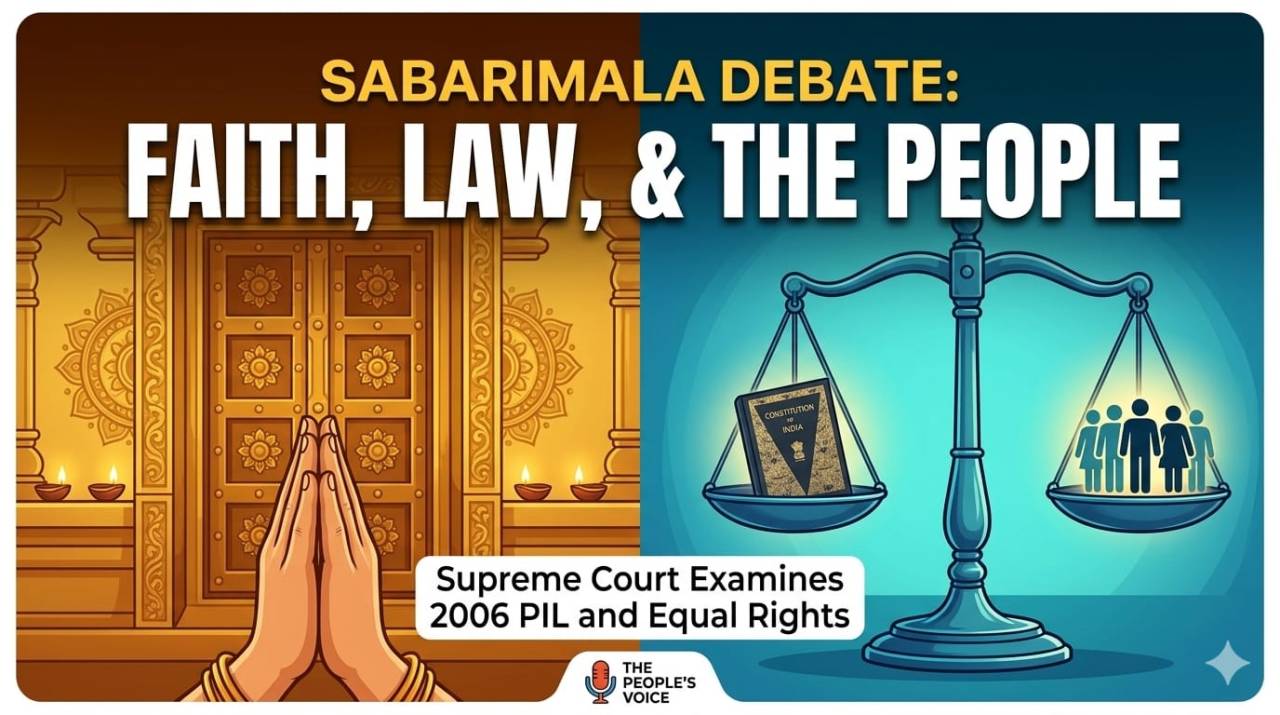
The Supreme Court’s renewed scrutiny of the Sabarimala case has reopened one of India’s most sensitive constitutional debates — how should a democracy balance gender equality, religious freedom, and centuries-old sacred traditions?
The Sabarimala temple debate has once again returned to the national spotlight, not merely as a dispute over temple entry, but as a larger constitutional question about the relationship between faith, equality, and judicial intervention in India’s democracy.
In recent hearings, the Supreme Court of India raised serious concerns about the origins of the 2006 Public Interest Litigation (PIL) that eventually led to the landmark 2018 verdict permitting women of all age groups to enter the revered Sabarimala temple in Kerala. While the earlier judgment was widely celebrated by many as a victory for gender equality, the court is now examining whether the legal process that triggered the verdict itself met the standards expected in constitutional litigation.
At the heart of the renewed debate lies a difficult but important question: How should a constitutional democracy balance individual rights with deeply rooted religious traditions?
Why the Supreme Court Is Re-examining the Case
A nine-judge Constitution Bench is currently hearing broader issues connected to religious freedom and the scope of constitutional protections under Articles 25 and 26 of the Indian Constitution.
During the hearings, members of the bench reportedly questioned the evidentiary basis of the original PIL. The judges observed that portions of the petition appeared to rely heavily on newspaper reports and unverified claims rather than concrete evidence. The Chief Justice remarked that such material may not ordinarily satisfy the threshold required for constitutional adjudication.
The court’s observations do not automatically overturn the 2018 verdict, but they signal growing judicial concern over how PILs are increasingly being used in matters involving religion and social policy.
The Debate Over “Who Can Challenge Tradition?”
One of the most significant issues raised by the bench concerns locus standi — the legal principle determining who has the right to approach the court.
The original petition was filed by the Indian Young Lawyers’ Association rather than by devotees directly associated with the temple tradition. This prompted the court to ask whether individuals who may not themselves practice or believe in a particular religious custom should be entitled to challenge the internal traditions of a faith community.
Supporters of the 2018 judgment argue that constitutional morality and equality cannot be limited by religious customs. They maintain that excluding women based on age violates the principles of dignity and equal access guaranteed under the Constitution.
At the same time, some members of the bench emphasized that religious freedom is not solely an individual right; it also includes the collective rights of worshippers and religious denominations to preserve practices they consider essential to their faith.
The court appeared cautious about allowing what it described as “publicity-oriented” litigation to interfere with long-standing religious traditions without sufficient grounding in faith-based concerns.
Why the Issue Matters Beyond Sabarimala
The ongoing hearings are not just about one temple in Kerala. The outcome could shape the future relationship between constitutional courts and religious institutions across India.
1. The Future of Public Interest Litigation
The judiciary has repeatedly described PILs as a powerful democratic tool designed to help marginalized individuals seek justice. However, the court is now signaling concern that PILs may sometimes be used for political visibility, ideological battles, or media attention rather than genuine public welfare.
A stricter approach toward PILs in religious matters could redefine how future constitutional challenges are brought before the courts.
2. The Broader Meaning of Equality
India’s constitutional framework protects both individual liberty and cultural diversity. The challenge lies in reconciling these values when they appear to conflict.
The Sabarimala debate reflects a larger national conversation: Where should the line be drawn between personal rights and a community’s right to preserve its traditions?
For many citizens, this is not merely a legal question but a deeply emotional and philosophical one.
A Debate That Reflects India’s Complexity
India’s democracy operates within extraordinary diversity — religiously, culturally, and socially. Cases like Sabarimala demonstrate how difficult it can be to apply universal constitutional principles within communities that possess centuries-old customs and spiritual practices.
The Supreme Court now appears focused not only on the outcome of the dispute but also on the integrity of the legal process itself. By scrutinizing the foundations of the original PIL, the court is signaling that constitutional litigation must rest on credible evidence, clear legal standing, and genuine public interest.
Final Take
The Constitution Bench is expected to continue examining broader questions involving religious freedom, denominational rights, and gender justice, with implications extending far beyond Sabarimala.
Whatever the final outcome, the case serves as a reminder that constitutional rights and religious traditions are often not easily separated in a society as diverse as India’s.
The challenge before the judiciary is not simply choosing between faith and equality, but finding a framework where both constitutional dignity and religious freedom can coexist without undermining one another.
The Sabarimala temple debate has once again returned to the national spotlight, not merely as a dispute over temple entry, but as a larger constitutional question about the relationship between faith, equality, and judicial intervention in India’s democracy.
In recent hearings, the Supreme Court of India raised serious concerns about the origins of the 2006 Public Interest Litigation (PIL) that eventually led to the landmark 2018 verdict permitting women of all age groups to enter the revered Sabarimala temple in Kerala. While the earlier judgment was widely celebrated by many as a victory for gender equality, the court is now examining whether the legal process that triggered the verdict itself met the standards expected in constitutional litigation.
At the heart of the renewed debate lies a difficult but important question: How should a constitutional democracy balance individual rights with deeply rooted religious traditions?
Why the Supreme Court Is Re-examining the Case
A nine-judge Constitution Bench is currently hearing broader issues connected to religious freedom and the scope of constitutional protections under Articles 25 and 26 of the Indian Constitution.
During the hearings, members of the bench reportedly questioned the evidentiary basis of the original PIL. The judges observed that portions of the petition appeared to rely heavily on newspaper reports and unverified claims rather than concrete evidence. The Chief Justice remarked that such material may not ordinarily satisfy the threshold required for constitutional adjudication.
The court’s observations do not automatically overturn the 2018 verdict, but they signal growing judicial concern over how PILs are increasingly being used in matters involving religion and social policy.
The Debate Over “Who Can Challenge Tradition?”
One of the most significant issues raised by the bench concerns locus standi — the legal principle determining who has the right to approach the court.
The original petition was filed by the Indian Young Lawyers’ Association rather than by devotees directly associated with the temple tradition. This prompted the court to ask whether individuals who may not themselves practice or believe in a particular religious custom should be entitled to challenge the internal traditions of a faith community.
Supporters of the 2018 judgment argue that constitutional morality and equality cannot be limited by religious customs. They maintain that excluding women based on age violates the principles of dignity and equal access guaranteed under the Constitution.
At the same time, some members of the bench emphasized that religious freedom is not solely an individual right; it also includes the collective rights of worshippers and religious denominations to preserve practices they consider essential to their faith.
The court appeared cautious about allowing what it described as “publicity-oriented” litigation to interfere with long-standing religious traditions without sufficient grounding in faith-based concerns.
Why the Issue Matters Beyond Sabarimala
The ongoing hearings are not just about one temple in Kerala. The outcome could shape the future relationship between constitutional courts and religious institutions across India.
1. The Future of Public Interest Litigation
The judiciary has repeatedly described PILs as a powerful democratic tool designed to help marginalized individuals seek justice. However, the court is now signaling concern that PILs may sometimes be used for political visibility, ideological battles, or media attention rather than genuine public welfare.
A stricter approach toward PILs in religious matters could redefine how future constitutional challenges are brought before the courts.
2. The Broader Meaning of Equality
India’s constitutional framework protects both individual liberty and cultural diversity. The challenge lies in reconciling these values when they appear to conflict.
The Sabarimala debate reflects a larger national conversation: Where should the line be drawn between personal rights and a community’s right to preserve its traditions?
For many citizens, this is not merely a legal question but a deeply emotional and philosophical one.
A Debate That Reflects India’s Complexity
India’s democracy operates within extraordinary diversity — religiously, culturally, and socially. Cases like Sabarimala demonstrate how difficult it can be to apply universal constitutional principles within communities that possess centuries-old customs and spiritual practices.
The Supreme Court now appears focused not only on the outcome of the dispute but also on the integrity of the legal process itself. By scrutinizing the foundations of the original PIL, the court is signaling that constitutional litigation must rest on credible evidence, clear legal standing, and genuine public interest.
Final Take
The Constitution Bench is expected to continue examining broader questions involving religious freedom, denominational rights, and gender justice, with implications extending far beyond Sabarimala.
Whatever the final outcome, the case serves as a reminder that constitutional rights and religious traditions are often not easily separated in a society as diverse as India’s.
The challenge before the judiciary is not simply choosing between faith and equality, but finding a framework where both constitutional dignity and religious freedom can coexist without undermining one another.
























Leave a Comment