
When even court evidence can mysteriously disappear, the real crisis is no longer corruption alone — it is the collapse of public trust in the system itself.
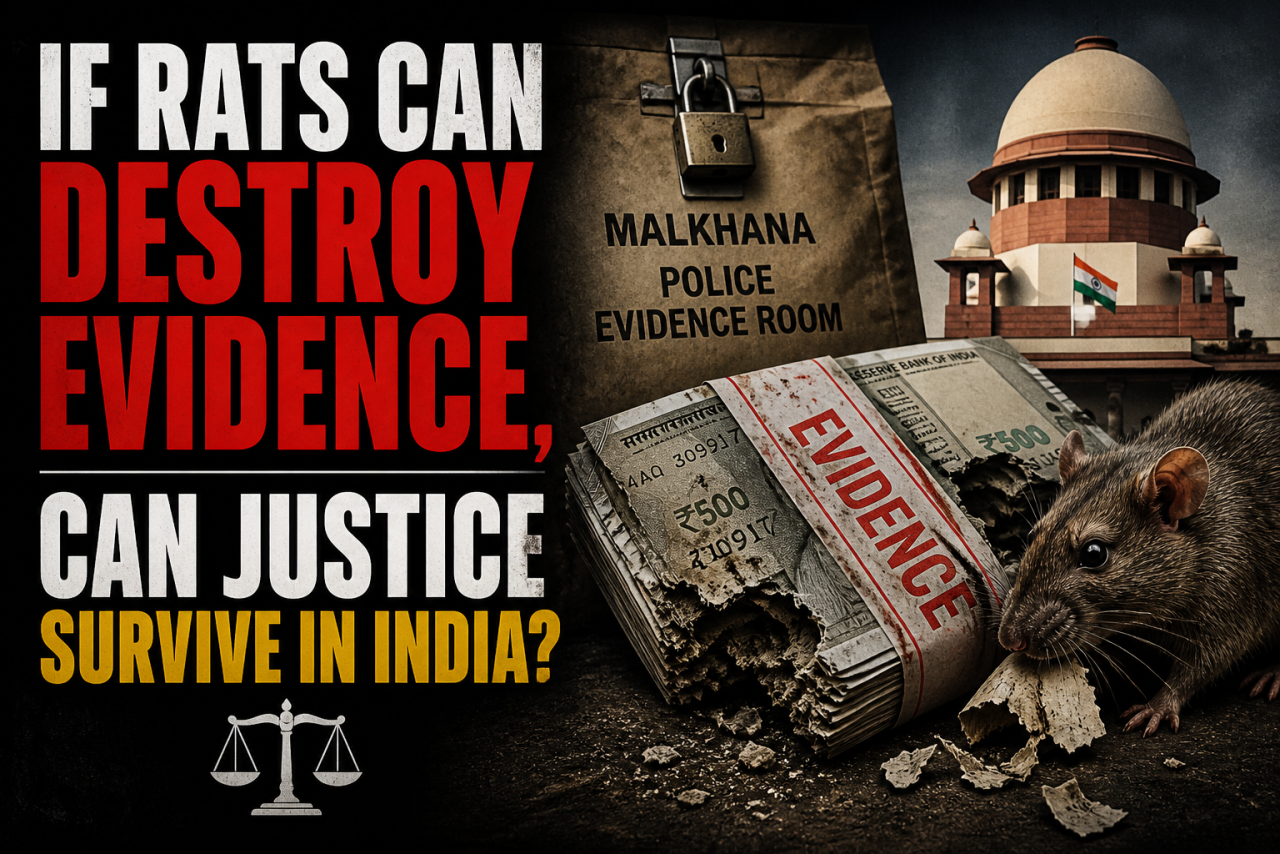
India has witnessed many corruption scandals over the decades, but some incidents shock the public not because of the amount of money involved, but because of what they reveal about the condition of the system itself. The recent Bihar case, where seized cash in a corruption investigation was allegedly destroyed by rats, is one such example.
The issue has now reached the Supreme Court, which openly questioned the explanation and expressed concern over how evidence is stored in police malkhanas (evidence rooms). While the case may sound bizarre, it highlights a much larger crisis — the weakening of public trust in institutions meant to deliver justice.
The case reportedly began in 2019 during a trap operation conducted by Bihar’s Economic Offences Unit. A government official was accused of accepting a bribe of ₹10,000. The cash was seized and stored as evidence. However, when the matter reached trial, the prosecution failed to produce the currency notes before the court. The explanation offered was startling: rodents had damaged the envelope containing the cash.
The Supreme Court was clearly unconvinced. The bench observed that such explanations raise serious concerns about how evidence is protected and whether similar incidents may have occurred in other cases as well. More importantly, the court hinted at a broader institutional problem that goes far beyond one missing envelope.
This is where the story becomes larger than Bihar or one corruption case.
Corruption in India is often discussed in terms of massive scams, political controversies, or high-profile arrests. Yet the real damage frequently happens at the everyday level — inside offices, police stations, public departments, and local administrations where ordinary citizens interact with the state. From paying bribes for documents to facing delays unless “extra money” is offered, many Indians encounter corruption not as headlines, but as routine reality.
The greater danger lies in a system where evidence can vanish more easily than wrongdoing. Courts depend on evidence. If evidence disappears, gets tampered with, or is poorly managed, justice becomes fragile. A criminal case can collapse not because the accused is innocent, but because the system failed to preserve proof.
That is why the “rats ate cash” explanation has triggered such widespread reaction. For many citizens, it symbolizes a culture where accountability is often replaced with excuses. When public institutions fail to protect even critical evidence, people begin questioning whether laws are equally applied to everyone.
The consequences of corruption extend far beyond financial loss. Corruption weakens public services, increases inequality, and slows development. Funds meant for schools, hospitals, roads, and welfare schemes often fail to fully reach the people they are intended to help. In the end, the poor suffer the most because they have the least power to fight the system.
India has certainly taken steps to reduce corruption over the years. Digital payments, online government services, direct benefit transfers, and transparency laws like the Right to Information (RTI) Act have improved accountability in many sectors. Technology has reduced human interference in several public services, limiting opportunities for bribery.
But technology alone cannot solve an institutional crisis.
India also needs stronger evidence management systems, independent investigations, faster judicial processes, and strict accountability for officials responsible for negligence. Police evidence rooms must be modernized with digital tracking, surveillance, and regular audits. If evidence disappears, responsibility should be fixed clearly and transparently.
Most importantly, institutions must rebuild public confidence. Citizens lose faith not only when corruption happens, but when they feel nobody is ultimately held accountable for it.
The Bihar case may eventually be resolved in court, but its larger message will remain relevant. A democracy survives not merely through elections or laws, but through public trust in the fairness of institutions. When evidence itself becomes unreliable, justice begins to look uncertain.
And that is the real danger India must confront.
India has witnessed many corruption scandals over the decades, but some incidents shock the public not because of the amount of money involved, but because of what they reveal about the condition of the system itself. The recent Bihar case, where seized cash in a corruption investigation was allegedly destroyed by rats, is one such example.
The issue has now reached the Supreme Court, which openly questioned the explanation and expressed concern over how evidence is stored in police malkhanas (evidence rooms). While the case may sound bizarre, it highlights a much larger crisis — the weakening of public trust in institutions meant to deliver justice.
The case reportedly began in 2019 during a trap operation conducted by Bihar’s Economic Offences Unit. A government official was accused of accepting a bribe of ₹10,000. The cash was seized and stored as evidence. However, when the matter reached trial, the prosecution failed to produce the currency notes before the court. The explanation offered was startling: rodents had damaged the envelope containing the cash.
The Supreme Court was clearly unconvinced. The bench observed that such explanations raise serious concerns about how evidence is protected and whether similar incidents may have occurred in other cases as well. More importantly, the court hinted at a broader institutional problem that goes far beyond one missing envelope.
This is where the story becomes larger than Bihar or one corruption case.
Corruption in India is often discussed in terms of massive scams, political controversies, or high-profile arrests. Yet the real damage frequently happens at the everyday level — inside offices, police stations, public departments, and local administrations where ordinary citizens interact with the state. From paying bribes for documents to facing delays unless “extra money” is offered, many Indians encounter corruption not as headlines, but as routine reality.
The greater danger lies in a system where evidence can vanish more easily than wrongdoing. Courts depend on evidence. If evidence disappears, gets tampered with, or is poorly managed, justice becomes fragile. A criminal case can collapse not because the accused is innocent, but because the system failed to preserve proof.
That is why the “rats ate cash” explanation has triggered such widespread reaction. For many citizens, it symbolizes a culture where accountability is often replaced with excuses. When public institutions fail to protect even critical evidence, people begin questioning whether laws are equally applied to everyone.
The consequences of corruption extend far beyond financial loss. Corruption weakens public services, increases inequality, and slows development. Funds meant for schools, hospitals, roads, and welfare schemes often fail to fully reach the people they are intended to help. In the end, the poor suffer the most because they have the least power to fight the system.
India has certainly taken steps to reduce corruption over the years. Digital payments, online government services, direct benefit transfers, and transparency laws like the Right to Information (RTI) Act have improved accountability in many sectors. Technology has reduced human interference in several public services, limiting opportunities for bribery.
But technology alone cannot solve an institutional crisis.
India also needs stronger evidence management systems, independent investigations, faster judicial processes, and strict accountability for officials responsible for negligence. Police evidence rooms must be modernized with digital tracking, surveillance, and regular audits. If evidence disappears, responsibility should be fixed clearly and transparently.
Most importantly, institutions must rebuild public confidence. Citizens lose faith not only when corruption happens, but when they feel nobody is ultimately held accountable for it.
The Bihar case may eventually be resolved in court, but its larger message will remain relevant. A democracy survives not merely through elections or laws, but through public trust in the fairness of institutions. When evidence itself becomes unreliable, justice begins to look uncertain.
And that is the real danger India must confront.


























Leave a Comment