
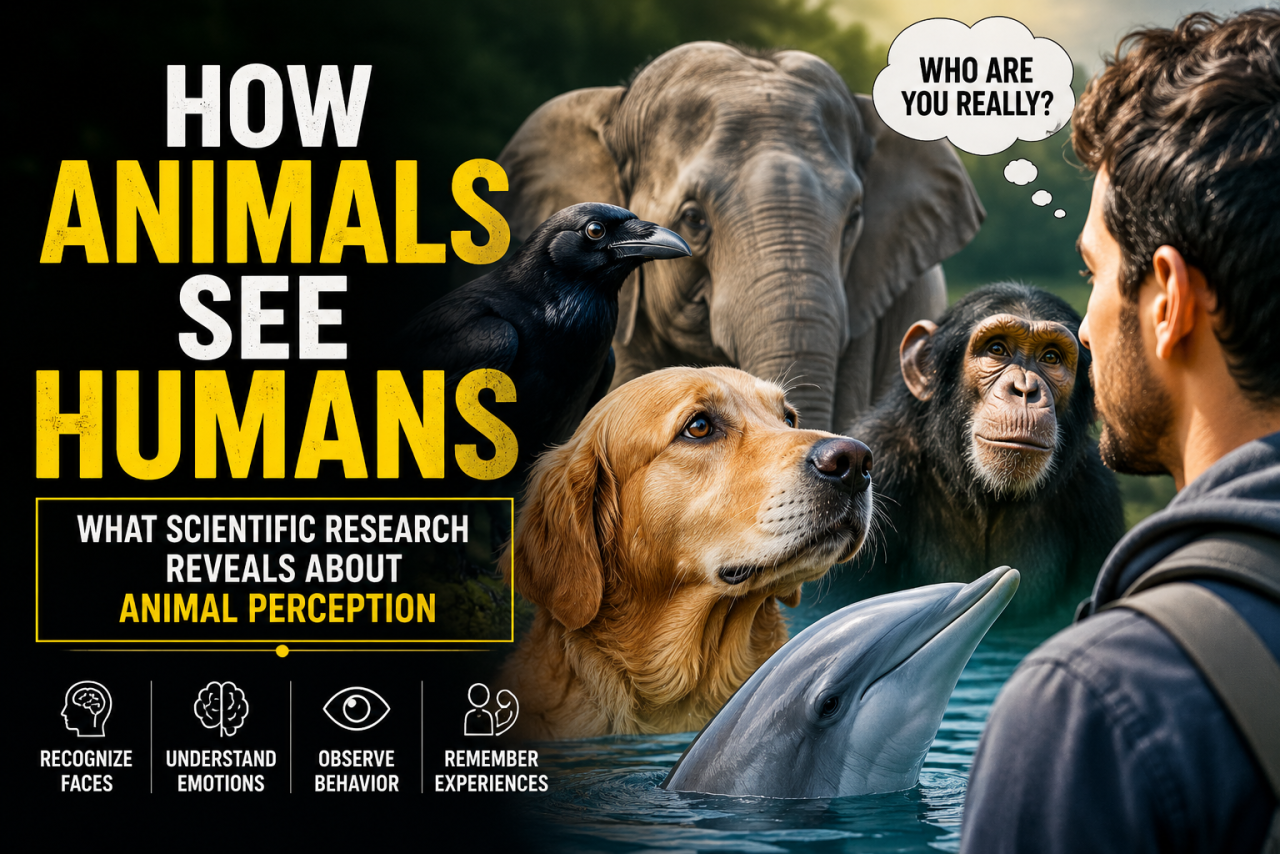
Animals may understand humans far better than we assume. Scientific research shows that dogs, crows, elephants, and marine animals can recognize faces, remember behavior, respond to emotions, and adapt to human activity in surprisingly complex ways.
Scientists have long studied how humans understand animals, but modern animal cognition research is increasingly asking a different question: how do animals see human beings? Studies on dogs, crows, elephants, dolphins, and urban wildlife suggest that many species can recognize human faces, remember behavior, respond to emotions, and classify humans as threats, companions, or sources of food.
Research from University of Washington and University of Cambridge has helped reshape scientific understanding of animal intelligence. Instead of acting purely on instinct, many animals appear to build mental impressions of the humans around them through memory, observation, and repeated interaction.
Can Animals Recognize Human Faces?
One of the strongest examples comes from crows. Researchers discovered that crows can recognize individual human faces and remember them for years. In one famous experiment, scientists wearing specific masks captured and tagged wild crows for research purposes. Long after the event, the birds continued reacting aggressively toward those same faces.
More importantly, younger crows that had never experienced the capture also learned to fear those faces by observing older birds. This suggested that crows not only identify humans individually but also communicate information about dangerous people socially.
The findings challenged the older assumption that only humans or primates possess advanced social memory.
How Dogs Understand Human Emotions
Dogs are perhaps the clearest example of animals adapting to human behavior. Scientific studies show dogs can respond to facial expressions, tone of voice, gestures, and emotional states.
Brain imaging research has found that dogs react differently to happy and angry human expressions. They also follow human pointing gestures extremely well — in some experiments even better than chimpanzees.
Researchers believe thousands of years of domestication shaped dogs to become highly sensitive to human social signals. A dog watching its owner may constantly interpret mood, attention, and emotional cues to predict safety, affection, or reward.
This ability helps explain why dogs often respond to stress, sadness, or excitement in humans even before words are spoken.
Why Wild Animals Often Fear Humans
Wild animals usually experience humans differently from domestic animals. For many species, humans are associated with danger because of hunting, deforestation, vehicles, pollution, and habitat destruction.
Studies on deer, elephants, and large predators show that many animals alter their movement patterns when humans are nearby. Some species become more active at night to avoid human contact. Others abandon feeding or nesting areas entirely.
Research on elephants in Kenya found that elephants could distinguish between different groups of humans based on voice, clothing color, and smell. They reacted more cautiously toward people associated with past threats.
These responses suggest that animals do not simply fear humans automatically. They learn from experience and adapt accordingly.
What Marine Animals Experience Around Humans
Human activity also affects marine life in major ways. Whales and dolphins depend heavily on sound for navigation and communication, but increasing ship traffic and underwater noise disrupt these systems.
Scientists have observed whales changing migration routes and communication patterns in noisy waters. Fish exposed to constant boat traffic often show signs of elevated stress.
In coastal tourist regions, some animals become dependent on humans for food, while others actively avoid human presence. Researchers describe this as behavioral adaptation — animals adjusting survival strategies around human behavior.
How Urban Animals Learn Human Behavior
Animals living in cities often develop surprisingly detailed understanding of human routines. Foxes, monkeys, pigeons, crows, and stray dogs learn traffic patterns, feeding schedules, and areas of safety or risk.
Some monkeys in Asian cities have learned which humans are likely to carry food and how to steal it effectively. Urban crows use vehicles to crack nuts on roads and wait for traffic lights before collecting them.
These behaviors involve memory, problem-solving, and observation rather than simple instinct.
Modern animal cognition research increasingly shows that many animals possess complex emotional and mental abilities. Studies have documented signs of empathy, grief, cooperation, and long-term memory in mammals and birds.
What Animals May Really Think About Humans
Science cannot fully explain what animals “think” about humans in the way humans think about each other. But research strongly suggests animals form lasting impressions based on experience.
To some animals, humans may represent food, safety, and companionship. To others, humans may represent danger, destruction, or disturbance.
From an animal’s perspective, humanity likely appears deeply contradictory. Humans rescue injured wildlife while also destroying forests and polluting oceans. We protect endangered species while exploiting others on an industrial scale.
The growing field of animal perception research is changing how scientists understand intelligence itself. Animals are no longer viewed as passive creatures reacting automatically to the world around them. Increasingly, evidence suggests they observe humans carefully, remember experiences, learn patterns, and adapt their behavior accordingly.
In many ways, animals may understand human behavior more clearly than humans understand theirs.
Scientists have long studied how humans understand animals, but modern animal cognition research is increasingly asking a different question: how do animals see human beings? Studies on dogs, crows, elephants, dolphins, and urban wildlife suggest that many species can recognize human faces, remember behavior, respond to emotions, and classify humans as threats, companions, or sources of food.
Research from University of Washington and University of Cambridge has helped reshape scientific understanding of animal intelligence. Instead of acting purely on instinct, many animals appear to build mental impressions of the humans around them through memory, observation, and repeated interaction.
Can Animals Recognize Human Faces?
One of the strongest examples comes from crows. Researchers discovered that crows can recognize individual human faces and remember them for years. In one famous experiment, scientists wearing specific masks captured and tagged wild crows for research purposes. Long after the event, the birds continued reacting aggressively toward those same faces.
More importantly, younger crows that had never experienced the capture also learned to fear those faces by observing older birds. This suggested that crows not only identify humans individually but also communicate information about dangerous people socially.
The findings challenged the older assumption that only humans or primates possess advanced social memory.
How Dogs Understand Human Emotions
Dogs are perhaps the clearest example of animals adapting to human behavior. Scientific studies show dogs can respond to facial expressions, tone of voice, gestures, and emotional states.
Brain imaging research has found that dogs react differently to happy and angry human expressions. They also follow human pointing gestures extremely well — in some experiments even better than chimpanzees.
Researchers believe thousands of years of domestication shaped dogs to become highly sensitive to human social signals. A dog watching its owner may constantly interpret mood, attention, and emotional cues to predict safety, affection, or reward.
This ability helps explain why dogs often respond to stress, sadness, or excitement in humans even before words are spoken.
Why Wild Animals Often Fear Humans
Wild animals usually experience humans differently from domestic animals. For many species, humans are associated with danger because of hunting, deforestation, vehicles, pollution, and habitat destruction.
Studies on deer, elephants, and large predators show that many animals alter their movement patterns when humans are nearby. Some species become more active at night to avoid human contact. Others abandon feeding or nesting areas entirely.
Research on elephants in Kenya found that elephants could distinguish between different groups of humans based on voice, clothing color, and smell. They reacted more cautiously toward people associated with past threats.
These responses suggest that animals do not simply fear humans automatically. They learn from experience and adapt accordingly.
What Marine Animals Experience Around Humans
Human activity also affects marine life in major ways. Whales and dolphins depend heavily on sound for navigation and communication, but increasing ship traffic and underwater noise disrupt these systems.
Scientists have observed whales changing migration routes and communication patterns in noisy waters. Fish exposed to constant boat traffic often show signs of elevated stress.
In coastal tourist regions, some animals become dependent on humans for food, while others actively avoid human presence. Researchers describe this as behavioral adaptation — animals adjusting survival strategies around human behavior.
How Urban Animals Learn Human Behavior
Animals living in cities often develop surprisingly detailed understanding of human routines. Foxes, monkeys, pigeons, crows, and stray dogs learn traffic patterns, feeding schedules, and areas of safety or risk.
Some monkeys in Asian cities have learned which humans are likely to carry food and how to steal it effectively. Urban crows use vehicles to crack nuts on roads and wait for traffic lights before collecting them.
These behaviors involve memory, problem-solving, and observation rather than simple instinct.
Modern animal cognition research increasingly shows that many animals possess complex emotional and mental abilities. Studies have documented signs of empathy, grief, cooperation, and long-term memory in mammals and birds.
What Animals May Really Think About Humans
Science cannot fully explain what animals “think” about humans in the way humans think about each other. But research strongly suggests animals form lasting impressions based on experience.
To some animals, humans may represent food, safety, and companionship. To others, humans may represent danger, destruction, or disturbance.
From an animal’s perspective, humanity likely appears deeply contradictory. Humans rescue injured wildlife while also destroying forests and polluting oceans. We protect endangered species while exploiting others on an industrial scale.
The growing field of animal perception research is changing how scientists understand intelligence itself. Animals are no longer viewed as passive creatures reacting automatically to the world around them. Increasingly, evidence suggests they observe humans carefully, remember experiences, learn patterns, and adapt their behavior accordingly.
In many ways, animals may understand human behavior more clearly than humans understand theirs.


























Leave a Comment