
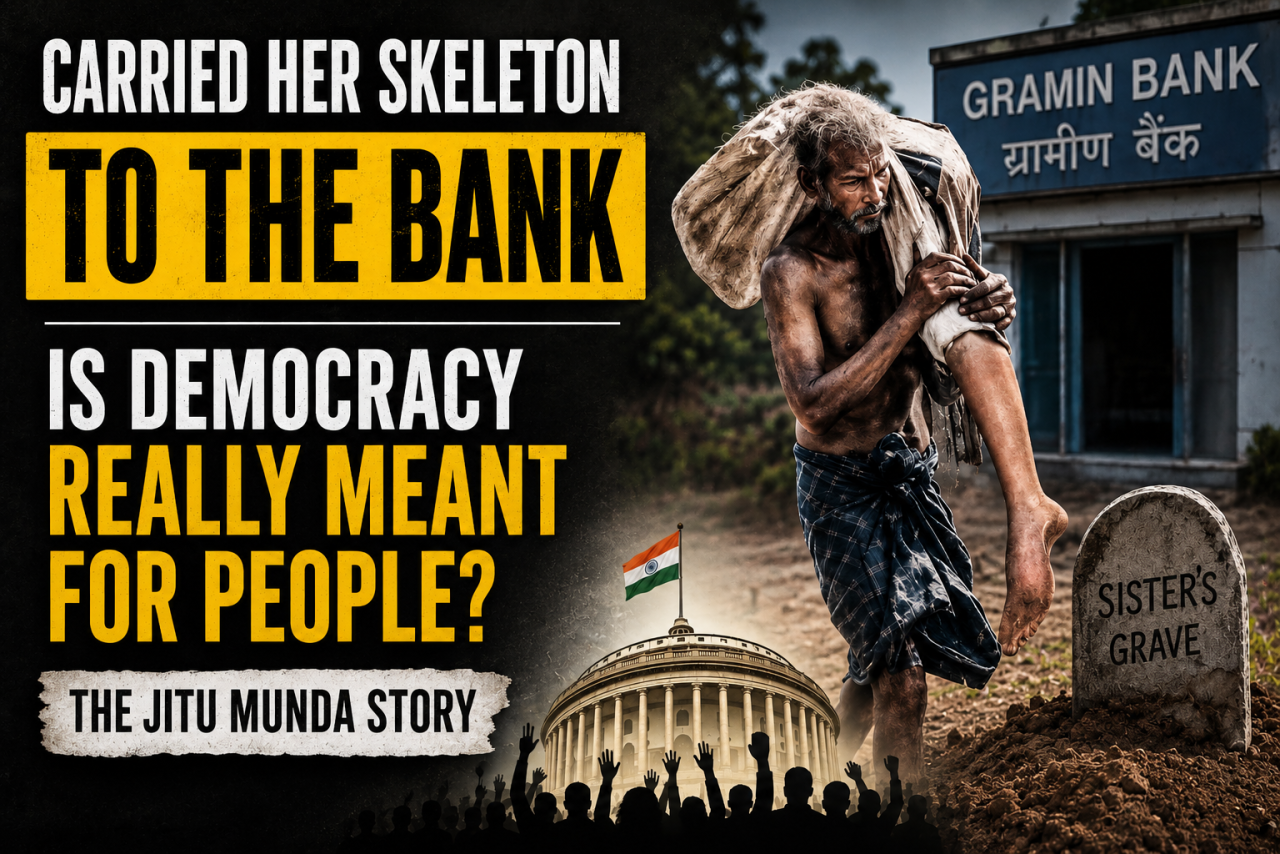
When an Odisha tribal man was forced to carry his sister’s skeletal remains to a bank to prove her death and withdraw her money, the incident exposed more than administrative failure. It revealed the harsh reality faced by India’s marginalized communities.
In a democracy, the State is expected to protect dignity before demanding documentation. Yet the story of Jitu Munda, a tribal man from Odisha who reportedly exhumed and carried his sister’s skeletal remains to a bank to prove her death and access her money, forces India to confront a painful question: when institutions stop trusting the poor, does democracy still remain people-centric?
The incident shocked the country not merely because of its disturbing imagery, but because it exposed a deeper truth about governance in India. A citizen who lacked political influence, literacy, financial awareness, and social capital was pushed to such an extreme that the dead had to physically “appear” before a system willing to acknowledge them only through procedural rigidity.
The issue here is not simply one bank official’s insensitivity. It is the architecture of governance that often treats poor citizens as suspects instead of stakeholders.
India proudly calls itself the world’s largest democracy. Elections are celebrated as festivals, welfare schemes are announced with great visibility, and digital governance is showcased as a symbol of modern India. But democracy cannot survive on electoral participation alone. Its real test lies in everyday interactions between citizens and institutions — the police station, the ration shop, the government office, and, in this case, the bank.
For the middle class, paperwork is inconvenience. For the poor, paperwork can become punishment.
Jitu Munda’s case reflects the brutal collision between bureaucratic procedure and human suffering. A tribal citizen living on the margins of society may not possess death certificates, legal awareness, internet access, or the ability to navigate administrative channels. Yet institutions continue to function as though every Indian has equal access to the same resources. This is where democracy quietly becomes exclusionary.
The tragedy also reveals a dangerous contradiction in India’s governance model. On one hand, the country speaks of Digital India, financial inclusion, and direct benefit transfers. On the other hand, millions still struggle to prove basic identity, death, land ownership, or entitlement. Technology may have modernized systems, but it has not necessarily humanized them.
The poor often experience the State not as a welfare provider, but as a maze of verification.
What makes the episode more troubling is the social invisibility of tribal communities. Indigenous populations in India frequently remain outside the mainstream discourse until a tragedy becomes visually shocking enough to go viral. Their suffering rarely enters national debate unless accompanied by humiliation dramatic enough for television screens and social media feeds.
This selective visibility is itself a democratic failure.
A healthy democracy does not wait for viral outrage to deliver justice. It builds systems that prevent humiliation in the first place.
The larger concern is institutional empathy — or the lack of it. Bureaucracies are designed to ensure accountability and prevent fraud, which is necessary. But when rules are enforced without context, they cease to serve justice. Democracies must operate not only through law, but through compassion. Procedure without humanity turns governance into mechanical authority.
The Constitution of India promises dignity, equality, and justice. Yet dignity is often the first casualty when poor citizens interact with public systems. The wealthy can hire lawyers, agents, consultants, and intermediaries. The poor carry documents in plastic bags from office to office, repeatedly proving their existence to a State that already possesses their biometric data, Aadhaar numbers, and welfare records.
The question, therefore, is not whether democracy exists in India. The question is: who gets to experience it fully?
For many marginalized citizens, democracy appears strongest during elections and weakest afterward. They are visible as voters, but invisible as human beings seeking institutional support.
Jitu Munda’s ordeal should not merely end with donations, compensation, or temporary sympathy. Charity cannot replace structural reform. India needs localized grievance systems, simplified procedures for death settlements, accountability mechanisms in public institutions, and officials trained in humanitarian administration. Governance must become accessible not just technologically, but emotionally and socially.
Most importantly, democracy must move beyond symbolism. A nation cannot celebrate economic growth and digital transformation while citizens are still forced into acts of desperation to access their rightful money.
The haunting image of a man carrying skeletal remains is not just a story of poverty. It is a mirror held up to Indian democracy itself. And the reflection is uncomfortable because it asks whether institutions are truly designed for citizens — or merely for compliance.
A democracy succeeds not when it builds grand narratives, but when its weakest citizen can access justice without losing dignity.
In a democracy, the State is expected to protect dignity before demanding documentation. Yet the story of Jitu Munda, a tribal man from Odisha who reportedly exhumed and carried his sister’s skeletal remains to a bank to prove her death and access her money, forces India to confront a painful question: when institutions stop trusting the poor, does democracy still remain people-centric?
The incident shocked the country not merely because of its disturbing imagery, but because it exposed a deeper truth about governance in India. A citizen who lacked political influence, literacy, financial awareness, and social capital was pushed to such an extreme that the dead had to physically “appear” before a system willing to acknowledge them only through procedural rigidity.
The issue here is not simply one bank official’s insensitivity. It is the architecture of governance that often treats poor citizens as suspects instead of stakeholders.
India proudly calls itself the world’s largest democracy. Elections are celebrated as festivals, welfare schemes are announced with great visibility, and digital governance is showcased as a symbol of modern India. But democracy cannot survive on electoral participation alone. Its real test lies in everyday interactions between citizens and institutions — the police station, the ration shop, the government office, and, in this case, the bank.
For the middle class, paperwork is inconvenience. For the poor, paperwork can become punishment.
Jitu Munda’s case reflects the brutal collision between bureaucratic procedure and human suffering. A tribal citizen living on the margins of society may not possess death certificates, legal awareness, internet access, or the ability to navigate administrative channels. Yet institutions continue to function as though every Indian has equal access to the same resources. This is where democracy quietly becomes exclusionary.
The tragedy also reveals a dangerous contradiction in India’s governance model. On one hand, the country speaks of Digital India, financial inclusion, and direct benefit transfers. On the other hand, millions still struggle to prove basic identity, death, land ownership, or entitlement. Technology may have modernized systems, but it has not necessarily humanized them.
The poor often experience the State not as a welfare provider, but as a maze of verification.
What makes the episode more troubling is the social invisibility of tribal communities. Indigenous populations in India frequently remain outside the mainstream discourse until a tragedy becomes visually shocking enough to go viral. Their suffering rarely enters national debate unless accompanied by humiliation dramatic enough for television screens and social media feeds.
This selective visibility is itself a democratic failure.
A healthy democracy does not wait for viral outrage to deliver justice. It builds systems that prevent humiliation in the first place.
The larger concern is institutional empathy — or the lack of it. Bureaucracies are designed to ensure accountability and prevent fraud, which is necessary. But when rules are enforced without context, they cease to serve justice. Democracies must operate not only through law, but through compassion. Procedure without humanity turns governance into mechanical authority.
The Constitution of India promises dignity, equality, and justice. Yet dignity is often the first casualty when poor citizens interact with public systems. The wealthy can hire lawyers, agents, consultants, and intermediaries. The poor carry documents in plastic bags from office to office, repeatedly proving their existence to a State that already possesses their biometric data, Aadhaar numbers, and welfare records.
The question, therefore, is not whether democracy exists in India. The question is: who gets to experience it fully?
For many marginalized citizens, democracy appears strongest during elections and weakest afterward. They are visible as voters, but invisible as human beings seeking institutional support.
Jitu Munda’s ordeal should not merely end with donations, compensation, or temporary sympathy. Charity cannot replace structural reform. India needs localized grievance systems, simplified procedures for death settlements, accountability mechanisms in public institutions, and officials trained in humanitarian administration. Governance must become accessible not just technologically, but emotionally and socially.
Most importantly, democracy must move beyond symbolism. A nation cannot celebrate economic growth and digital transformation while citizens are still forced into acts of desperation to access their rightful money.
The haunting image of a man carrying skeletal remains is not just a story of poverty. It is a mirror held up to Indian democracy itself. And the reflection is uncomfortable because it asks whether institutions are truly designed for citizens — or merely for compliance.
A democracy succeeds not when it builds grand narratives, but when its weakest citizen can access justice without losing dignity.


















Leave a Comment