
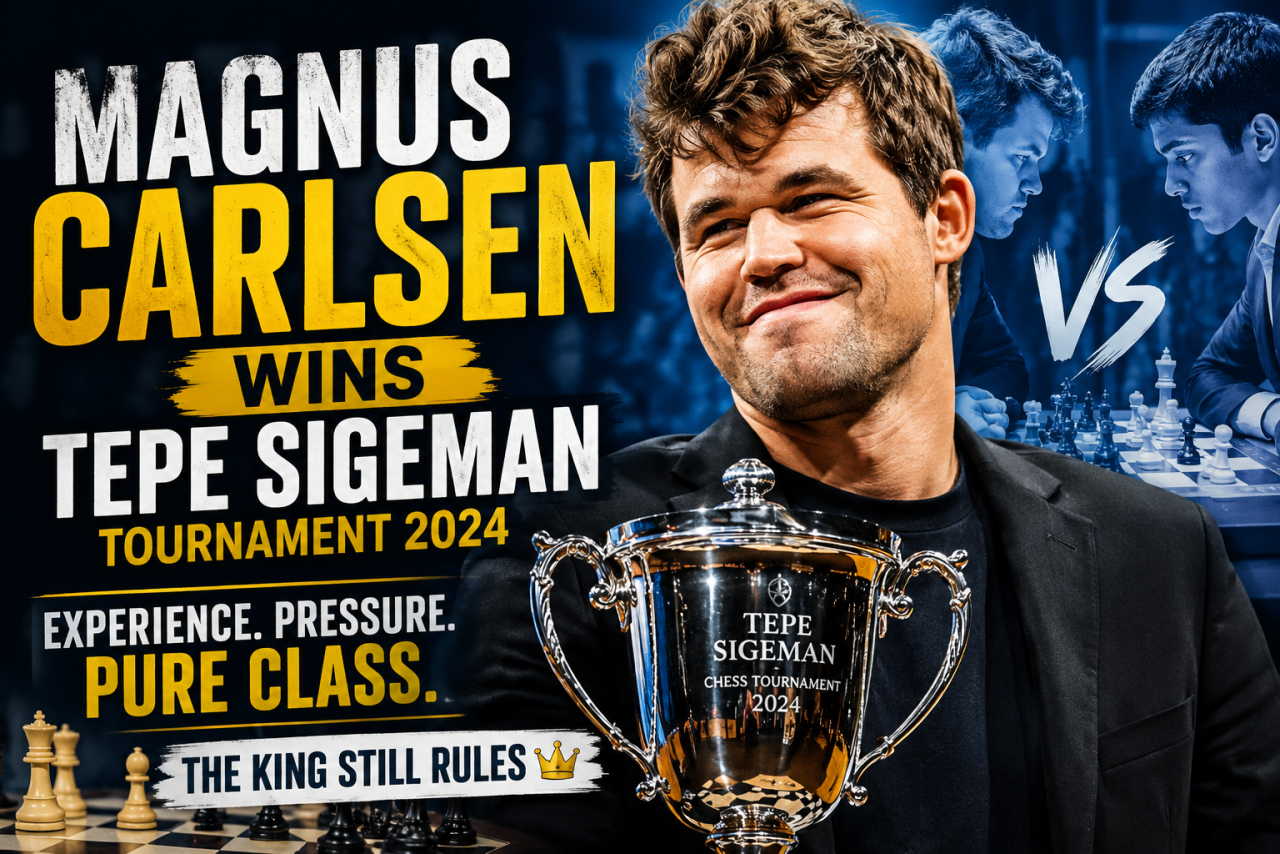
He no longer holds the classical world title — yet Magnus Carlsen still walks into elite tournaments and leaves as champion. His latest triumph over Arjun Erigaisi shows why the king of modern chess remains impossible to dethrone.
When people talk about dominance in modern chess, one name still stands above the rest — Magnus Carlsen. Even after stepping away from the classical world championship title, Carlsen continues to remind the chess world why he remains one of the most feared and respected players in the game.
His recent victory at the TePe Sigeman tournament in Malmö, Sweden, was not just another trophy added to his cabinet. It was a statement. A reminder that experience, patience, and deep understanding of chess can still overpower youth, speed, and rising talent.
The tournament itself carried a symbolic touch. Carlsen had first played in the same event as a 13-year-old prodigy back in 2004. More than two decades later, he returned and walked away as champion once again. Very few athletes in any sport can remain relevant for that long, especially in a mentally demanding game like chess.
One of the most talked-about moments of the tournament came in Carlsen’s intense clash against Turkish teenage sensation Yagiz Kaan Erdogmus. The youngster had already made headlines by crossing the 2700 Elo rating mark at an incredibly young age and defeating elite grandmasters. Many saw the match as a symbolic battle between generations.
For several hours, the game remained balanced. The queens disappeared early, and the position looked equal on paper. But chess is rarely only about the computer’s evaluation bar. Carlsen slowly transformed a level position into a psychological battle. He kept pressing, kept asking questions, and forced the teenager to defend accurately move after move.
This is where Carlsen’s greatness truly lies.
Modern chess fans often focus on flashy sacrifices, opening preparation, or computer-generated brilliance. But Carlsen’s strength has always been different. He wins positions that seem impossible to win. He creates pressure where others see calmness. Against young players especially, his ability to stretch games into exhausting endgame marathons becomes a weapon.
Eventually, under time pressure, Erdogmus cracked. One mistake was enough. Carlsen converted the advantage with clinical precision.
The tournament also featured India’s rising star Arjun Erigaisi, who entered the final round as the sole leader. Indian chess fans had every reason to dream of another major title. Arjun has rapidly become one of the strongest attacking players in the world and represents the fearless new generation of Indian chess.
However, the final round brought unexpected drama. Arjun managed to escape with a draw from a difficult position against Andy Woodward, leading to a blitz playoff against Carlsen. In fast time controls, experience often becomes decisive, and Carlsen showed exactly why he remains the king of practical chess.
In the first blitz game, Arjun made a costly error under pressure, allowing Carlsen to take control. The second game saw Arjun fighting aggressively with black pieces, refusing passive play and trying to unsettle the Norwegian legend. But Carlsen stayed composed and eventually sealed the tournament victory.
For Indian chess fans, the result should not be viewed as disappointment. If anything, it highlights how close India’s new generation is to competing with the very best. Players like Arjun Erigaisi, Praggnanandhaa, and Gukesh are no longer outsiders in elite events. They are genuine contenders challenging established giants.
Yet Carlsen’s victory also teaches another lesson: talent alone is not enough at the highest level. Elite chess demands emotional control, stamina, resilience, and the ability to survive pressure-filled moments. These are qualities Carlsen has mastered over years of battles against the world’s strongest minds.
What makes this story special is not merely that Magnus Carlsen won another tournament. It is the way he won it — through patience, precision, and psychological strength. In an era obsessed with speed and instant brilliance, Carlsen continues to prove that chess is still deeply human.
And perhaps that is why, even today, every tournament he enters still feels larger than life.
When people talk about dominance in modern chess, one name still stands above the rest — Magnus Carlsen. Even after stepping away from the classical world championship title, Carlsen continues to remind the chess world why he remains one of the most feared and respected players in the game.
His recent victory at the TePe Sigeman tournament in Malmö, Sweden, was not just another trophy added to his cabinet. It was a statement. A reminder that experience, patience, and deep understanding of chess can still overpower youth, speed, and rising talent.
The tournament itself carried a symbolic touch. Carlsen had first played in the same event as a 13-year-old prodigy back in 2004. More than two decades later, he returned and walked away as champion once again. Very few athletes in any sport can remain relevant for that long, especially in a mentally demanding game like chess.
One of the most talked-about moments of the tournament came in Carlsen’s intense clash against Turkish teenage sensation Yagiz Kaan Erdogmus. The youngster had already made headlines by crossing the 2700 Elo rating mark at an incredibly young age and defeating elite grandmasters. Many saw the match as a symbolic battle between generations.
For several hours, the game remained balanced. The queens disappeared early, and the position looked equal on paper. But chess is rarely only about the computer’s evaluation bar. Carlsen slowly transformed a level position into a psychological battle. He kept pressing, kept asking questions, and forced the teenager to defend accurately move after move.
This is where Carlsen’s greatness truly lies.
Modern chess fans often focus on flashy sacrifices, opening preparation, or computer-generated brilliance. But Carlsen’s strength has always been different. He wins positions that seem impossible to win. He creates pressure where others see calmness. Against young players especially, his ability to stretch games into exhausting endgame marathons becomes a weapon.
Eventually, under time pressure, Erdogmus cracked. One mistake was enough. Carlsen converted the advantage with clinical precision.
The tournament also featured India’s rising star Arjun Erigaisi, who entered the final round as the sole leader. Indian chess fans had every reason to dream of another major title. Arjun has rapidly become one of the strongest attacking players in the world and represents the fearless new generation of Indian chess.
However, the final round brought unexpected drama. Arjun managed to escape with a draw from a difficult position against Andy Woodward, leading to a blitz playoff against Carlsen. In fast time controls, experience often becomes decisive, and Carlsen showed exactly why he remains the king of practical chess.
In the first blitz game, Arjun made a costly error under pressure, allowing Carlsen to take control. The second game saw Arjun fighting aggressively with black pieces, refusing passive play and trying to unsettle the Norwegian legend. But Carlsen stayed composed and eventually sealed the tournament victory.
For Indian chess fans, the result should not be viewed as disappointment. If anything, it highlights how close India’s new generation is to competing with the very best. Players like Arjun Erigaisi, Praggnanandhaa, and Gukesh are no longer outsiders in elite events. They are genuine contenders challenging established giants.
Yet Carlsen’s victory also teaches another lesson: talent alone is not enough at the highest level. Elite chess demands emotional control, stamina, resilience, and the ability to survive pressure-filled moments. These are qualities Carlsen has mastered over years of battles against the world’s strongest minds.
What makes this story special is not merely that Magnus Carlsen won another tournament. It is the way he won it — through patience, precision, and psychological strength. In an era obsessed with speed and instant brilliance, Carlsen continues to prove that chess is still deeply human.
And perhaps that is why, even today, every tournament he enters still feels larger than life.

























Leave a Comment