
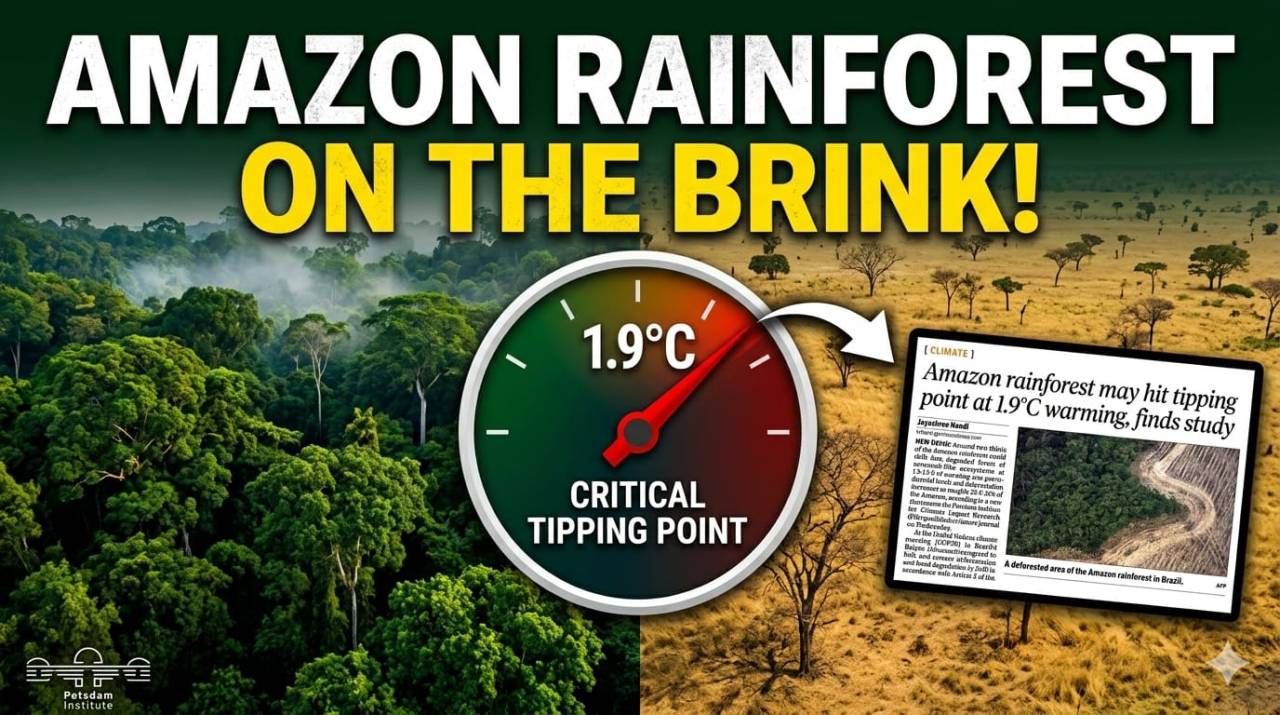
The world’s largest rainforest may be closer to collapse than scientists once believed—new research warns that even limited global warming, combined with rising deforestation, could push the Amazon beyond a point of no return.
The Amazon rainforest, often referred to as the "lungs of the planet," is facing a more immediate threat than previously realized. A groundbreaking study published in the journal Nature reveals that the world's largest tropical rainforest could reach a catastrophic tipping point if global temperatures rise by 1.5°C to 1.9°C above pre-industrial levels.
According to the research conducted by the Potsdam Institute for Climate Impact Research (PIK), this level of warming—combined with deforestation levels reaching 22% to 28%—could cause up to two-thirds of the Amazon to shift into degraded forests or savannah-like ecosystems.
The Deadly Synergy of Warming and Deforestation
The report emphasizes that deforestation significantly undermines the forest's natural resilience. While large-scale drying might only occur at warming levels of 3.7°C to 4°C in a pristine forest, the current rate of habitat loss has lowered that threshold significantly.
"Deforestation makes the Amazon far less resilient than we previously anticipated," stated Nico Wunderling, PIK scientist and lead author of the study. He noted that clearing trees dries out the atmosphere and weakens the forest's ability to generate its own rainfall. Currently, approximately 17% to 18% of the Amazon forest has already been lost, bringing the ecosystem dangerously close to the identified critical range.
How the "Rain Machine" Breaks Down
The Amazon is a self-sustaining system. A key reason for its survival is its ability to generate part of its own rainfall; up to half of the precipitation in the region comes from water recycled by the trees themselves.
- Moisture Recycling: Trees release water vapor into the atmosphere through transpiration.
- Rainfall Generation: This vapor later falls as rain across the Amazon basin.
- The Feedback Loop: When rainforest is lost, this recycling mechanism weakens, leading to increased drought stress.
The research team used UTrack, a three-dimensional Lagrangian atmospheric moisture tracking model, to map how moisture moves from evaporation to precipitation. This allowed them to quantify how localized deforestation can have "cascading" effects.
Arie Staal, Assistant Professor at Utrecht University and co-author of the study, explained that interrupting moisture transport in one area can cause regions hundreds or even thousands of kilometers away to lose resilience. This interconnectedness means that even moderate additional warming can trigger rapid, irreversible impacts across the entire system.
Global Commitment and the Road to COP30
The findings serve as a stark warning to the international community as they prepare for the United Nations climate meeting (COP30) in Belém, Brazil. Under Article 5 of the Paris Agreement, 196 countries have already agreed to halt and reverse deforestation and forest degradation by 2030.
As a deforested area in Brazil, the physical scars of land clearing are already widespread. The study highlights that preventing the Amazon from reaching this global tipping point is not just a regional concern but a vital necessity for maintaining global climate stability.
Key Statistics from the Study
Factor
Critical Threshold
Warming Level
1.5°C to 1.9°C
Deforestation Rate
22% to 28%
Current Forest Loss
17% to 18%
Forest at Risk
Up to 66% (two-thirds)
"When rainforest is lost, this moisture recycling weakens, drought stress increases and other forest regions become more vulnerable to degradation."
The message from the scientific community is loud and clear that the window to save the Amazon is closing faster than we thought. Without aggressive action to meet the 2030 targets and limit global warming, one of the Earth's most vital carbon sinks could soon become a source of emissions, accelerating the very climate crisis it once helped to mitigate.
The Amazon rainforest, often referred to as the "lungs of the planet," is facing a more immediate threat than previously realized. A groundbreaking study published in the journal Nature reveals that the world's largest tropical rainforest could reach a catastrophic tipping point if global temperatures rise by 1.5°C to 1.9°C above pre-industrial levels.
According to the research conducted by the Potsdam Institute for Climate Impact Research (PIK), this level of warming—combined with deforestation levels reaching 22% to 28%—could cause up to two-thirds of the Amazon to shift into degraded forests or savannah-like ecosystems.
The Deadly Synergy of Warming and Deforestation
The report emphasizes that deforestation significantly undermines the forest's natural resilience. While large-scale drying might only occur at warming levels of 3.7°C to 4°C in a pristine forest, the current rate of habitat loss has lowered that threshold significantly.
"Deforestation makes the Amazon far less resilient than we previously anticipated," stated Nico Wunderling, PIK scientist and lead author of the study. He noted that clearing trees dries out the atmosphere and weakens the forest's ability to generate its own rainfall. Currently, approximately 17% to 18% of the Amazon forest has already been lost, bringing the ecosystem dangerously close to the identified critical range.
How the "Rain Machine" Breaks Down
The Amazon is a self-sustaining system. A key reason for its survival is its ability to generate part of its own rainfall; up to half of the precipitation in the region comes from water recycled by the trees themselves.
- Moisture Recycling: Trees release water vapor into the atmosphere through transpiration.
- Rainfall Generation: This vapor later falls as rain across the Amazon basin.
- The Feedback Loop: When rainforest is lost, this recycling mechanism weakens, leading to increased drought stress.
The research team used UTrack, a three-dimensional Lagrangian atmospheric moisture tracking model, to map how moisture moves from evaporation to precipitation. This allowed them to quantify how localized deforestation can have "cascading" effects.
Arie Staal, Assistant Professor at Utrecht University and co-author of the study, explained that interrupting moisture transport in one area can cause regions hundreds or even thousands of kilometers away to lose resilience. This interconnectedness means that even moderate additional warming can trigger rapid, irreversible impacts across the entire system.
Global Commitment and the Road to COP30
The findings serve as a stark warning to the international community as they prepare for the United Nations climate meeting (COP30) in Belém, Brazil. Under Article 5 of the Paris Agreement, 196 countries have already agreed to halt and reverse deforestation and forest degradation by 2030.
As a deforested area in Brazil, the physical scars of land clearing are already widespread. The study highlights that preventing the Amazon from reaching this global tipping point is not just a regional concern but a vital necessity for maintaining global climate stability.
Key Statistics from the Study
|
Factor |
Critical Threshold |
|
Warming Level |
1.5°C to 1.9°C |
|
Deforestation Rate |
22% to 28% |
|
Current Forest Loss |
17% to 18% |
|
Forest at Risk |
Up to 66% (two-thirds) |
"When rainforest is lost, this moisture recycling weakens, drought stress increases and other forest regions become more vulnerable to degradation."
The message from the scientific community is loud and clear that the window to save the Amazon is closing faster than we thought. Without aggressive action to meet the 2030 targets and limit global warming, one of the Earth's most vital carbon sinks could soon become a source of emissions, accelerating the very climate crisis it once helped to mitigate.























Leave a Comment