
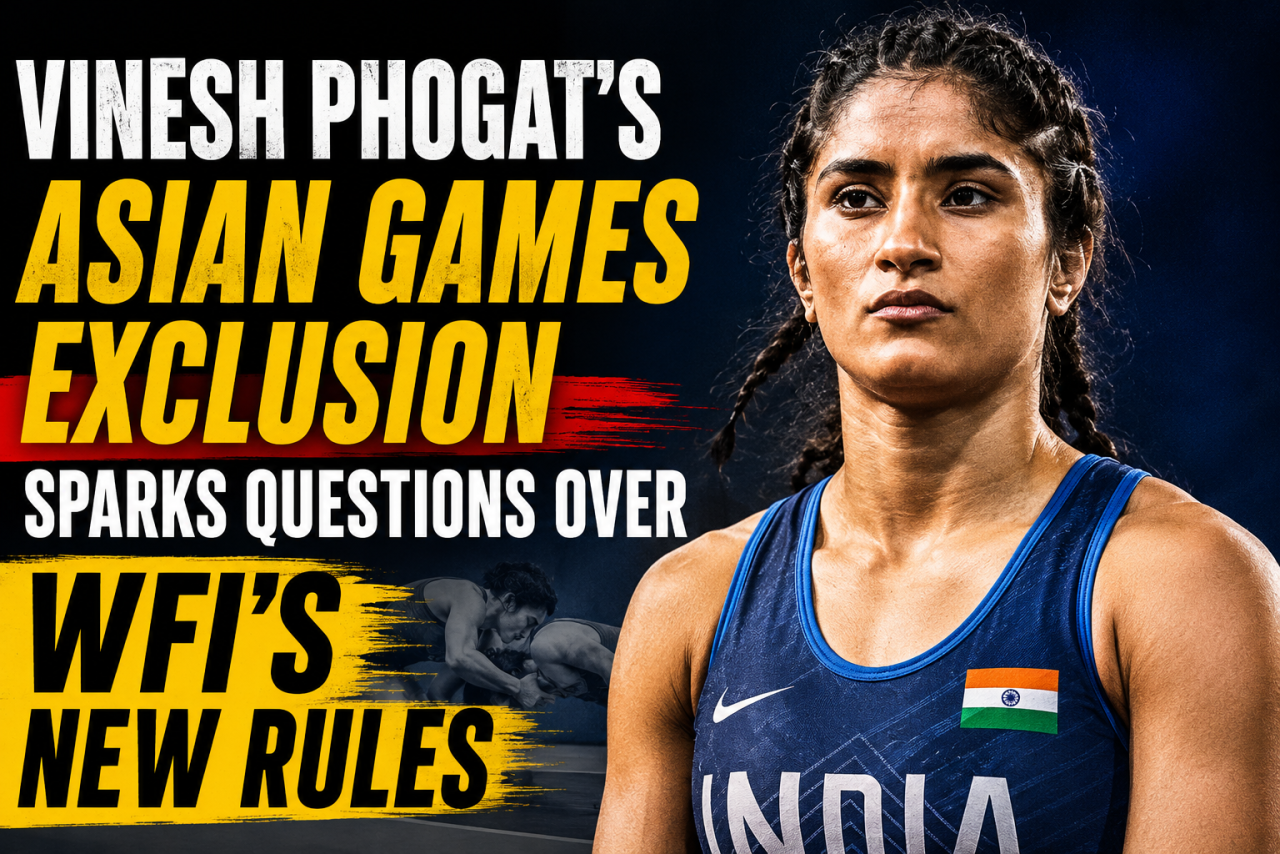
Can a decorated champion be ruled out by paperwork alone? Vinesh Phogat’s exclusion from the Asian Games trials has reignited a national debate over fairness, policy, and the future of Indian wrestling.
The landscape of Indian wrestling has shifted once again, leaving one of the country’s most celebrated athletes on uncertain ground. The exclusion of Vinesh Phogat from the selection trials for the 2026 Asian Games has triggered intense debate across India’s sporting community, raising uncomfortable questions about fairness, governance, and the future of elite athletes returning to competition.
For many sports fans, this is not merely a procedural dispute. It is a story about how rigid administrative systems can collide with the legacy of an athlete who has represented India on the world stage for over a decade.
The Policy Shift at the Centre of the Controversy
At the heart of the issue lies a revised selection framework introduced by the Wrestling Federation of India. Under the new rules, only medal winners from three designated domestic tournaments are eligible for the Asian Games selection trials scheduled for May 30 and 31.
The qualifying events include:
- The 2025 Senior National Wrestling Championships in Ahmedabad.
- The 2026 Senior Federation Cup in Ghaziabad.
- The 2026 Under-20 National Championships in Bhilai.
Because Vinesh Phogat did not compete in these tournaments during her temporary retirement phase and personal transition into motherhood, she no longer satisfies the eligibility requirements. The WFI has also clarified that previous international achievements will not influence eligibility decisions.
That effectively means her World Championship medals, Commonwealth Games success, and three Olympic appearances carry no formal weight in the current selection process.
A Comeback Shadowed by Administrative Barriers
The controversy has intensified because Phogat had already planned a competitive comeback through the National Open Ranking Tournament in Gonda, scheduled between May 10 and 12. However, the federation confirmed that performances in this event would not impact Asian Games qualification.
The situation is further complicated by anti-doping regulations overseen by the World Anti-Doping Agency and United World Wrestling.
Under international rules, retired athletes seeking to return to competition must provide a six-month notice period before re-entering the Registered Testing Pool. This requirement exists to ensure adequate anti-doping monitoring before athletes resume elite participation.
While reports indicate that Phogat may have complied with these procedures, the WFI is reportedly awaiting formal confirmation from United World Wrestling. Additionally, a recorded “whereabouts failure” in December 2025 — which is not equivalent to a doping offence — has added another layer of scrutiny around her return.
Why the Debate Extends Beyond Wrestling
The reaction to this decision goes far beyond sporting eligibility. For many Indians, Vinesh Phogat represents resilience, defiance, and perseverance through adversity.
Her journey has included:
- Historic international medals.
- Public protests against wrestling administration.
- The emotional aftermath of her Paris Olympics disappointment.
- A return to competition after motherhood.
As a result, her exclusion has become symbolic of a larger debate about how sporting institutions treat elite athletes, especially those who challenge authority or step away temporarily due to personal circumstances.
Supporters of the federation argue that clear rules are essential to ensure fairness for younger wrestlers competing consistently within the domestic structure. Critics, however, question whether strict procedural criteria should completely outweigh proven international experience and competitive pedigree.
The timing of the policy has also raised suspicion among sections of the wrestling community, with some arguing that sudden eligibility conditions disproportionately disadvantage returning veterans.
The Sporting Consequence for India
Beyond the administrative dispute lies a practical concern for Indian wrestling itself. Excluding an experienced athlete like Vinesh Phogat potentially weakens India’s medal prospects at a major continental event.
Her absence raises an uncomfortable question: should national representation prioritize current procedural compliance alone, or should it also account for demonstrated excellence at the international level?
This debate is likely to continue well beyond the Asian Games trials, particularly as Indian sports governance increasingly faces demands for transparency, consistency, and athlete-centric policies.
Final Take
The 2026 Asian Games in Japan will test the depth of Indian wrestling. Yet for many supporters, the tournament may feel incomplete without one of India’s most recognizable wrestlers on the mat.
Whether this chapter becomes a temporary setback or the closing act of Vinesh Phogat’s career remains uncertain. What is clear, however, is that her exclusion has reignited a larger conversation about how Indian sport balances rules, fairness, and the legacy of its champions.
The landscape of Indian wrestling has shifted once again, leaving one of the country’s most celebrated athletes on uncertain ground. The exclusion of Vinesh Phogat from the selection trials for the 2026 Asian Games has triggered intense debate across India’s sporting community, raising uncomfortable questions about fairness, governance, and the future of elite athletes returning to competition.
For many sports fans, this is not merely a procedural dispute. It is a story about how rigid administrative systems can collide with the legacy of an athlete who has represented India on the world stage for over a decade.
The Policy Shift at the Centre of the Controversy
At the heart of the issue lies a revised selection framework introduced by the Wrestling Federation of India. Under the new rules, only medal winners from three designated domestic tournaments are eligible for the Asian Games selection trials scheduled for May 30 and 31.
The qualifying events include:
- The 2025 Senior National Wrestling Championships in Ahmedabad.
- The 2026 Senior Federation Cup in Ghaziabad.
- The 2026 Under-20 National Championships in Bhilai.
Because Vinesh Phogat did not compete in these tournaments during her temporary retirement phase and personal transition into motherhood, she no longer satisfies the eligibility requirements. The WFI has also clarified that previous international achievements will not influence eligibility decisions.
That effectively means her World Championship medals, Commonwealth Games success, and three Olympic appearances carry no formal weight in the current selection process.
A Comeback Shadowed by Administrative Barriers
The controversy has intensified because Phogat had already planned a competitive comeback through the National Open Ranking Tournament in Gonda, scheduled between May 10 and 12. However, the federation confirmed that performances in this event would not impact Asian Games qualification.
The situation is further complicated by anti-doping regulations overseen by the World Anti-Doping Agency and United World Wrestling.
Under international rules, retired athletes seeking to return to competition must provide a six-month notice period before re-entering the Registered Testing Pool. This requirement exists to ensure adequate anti-doping monitoring before athletes resume elite participation.
While reports indicate that Phogat may have complied with these procedures, the WFI is reportedly awaiting formal confirmation from United World Wrestling. Additionally, a recorded “whereabouts failure” in December 2025 — which is not equivalent to a doping offence — has added another layer of scrutiny around her return.
Why the Debate Extends Beyond Wrestling
The reaction to this decision goes far beyond sporting eligibility. For many Indians, Vinesh Phogat represents resilience, defiance, and perseverance through adversity.
Her journey has included:
- Historic international medals.
- Public protests against wrestling administration.
- The emotional aftermath of her Paris Olympics disappointment.
- A return to competition after motherhood.
As a result, her exclusion has become symbolic of a larger debate about how sporting institutions treat elite athletes, especially those who challenge authority or step away temporarily due to personal circumstances.
Supporters of the federation argue that clear rules are essential to ensure fairness for younger wrestlers competing consistently within the domestic structure. Critics, however, question whether strict procedural criteria should completely outweigh proven international experience and competitive pedigree.
The timing of the policy has also raised suspicion among sections of the wrestling community, with some arguing that sudden eligibility conditions disproportionately disadvantage returning veterans.
The Sporting Consequence for India
Beyond the administrative dispute lies a practical concern for Indian wrestling itself. Excluding an experienced athlete like Vinesh Phogat potentially weakens India’s medal prospects at a major continental event.
Her absence raises an uncomfortable question: should national representation prioritize current procedural compliance alone, or should it also account for demonstrated excellence at the international level?
This debate is likely to continue well beyond the Asian Games trials, particularly as Indian sports governance increasingly faces demands for transparency, consistency, and athlete-centric policies.
Final Take
The 2026 Asian Games in Japan will test the depth of Indian wrestling. Yet for many supporters, the tournament may feel incomplete without one of India’s most recognizable wrestlers on the mat.
Whether this chapter becomes a temporary setback or the closing act of Vinesh Phogat’s career remains uncertain. What is clear, however, is that her exclusion has reignited a larger conversation about how Indian sport balances rules, fairness, and the legacy of its champions.

















Leave a Comment