
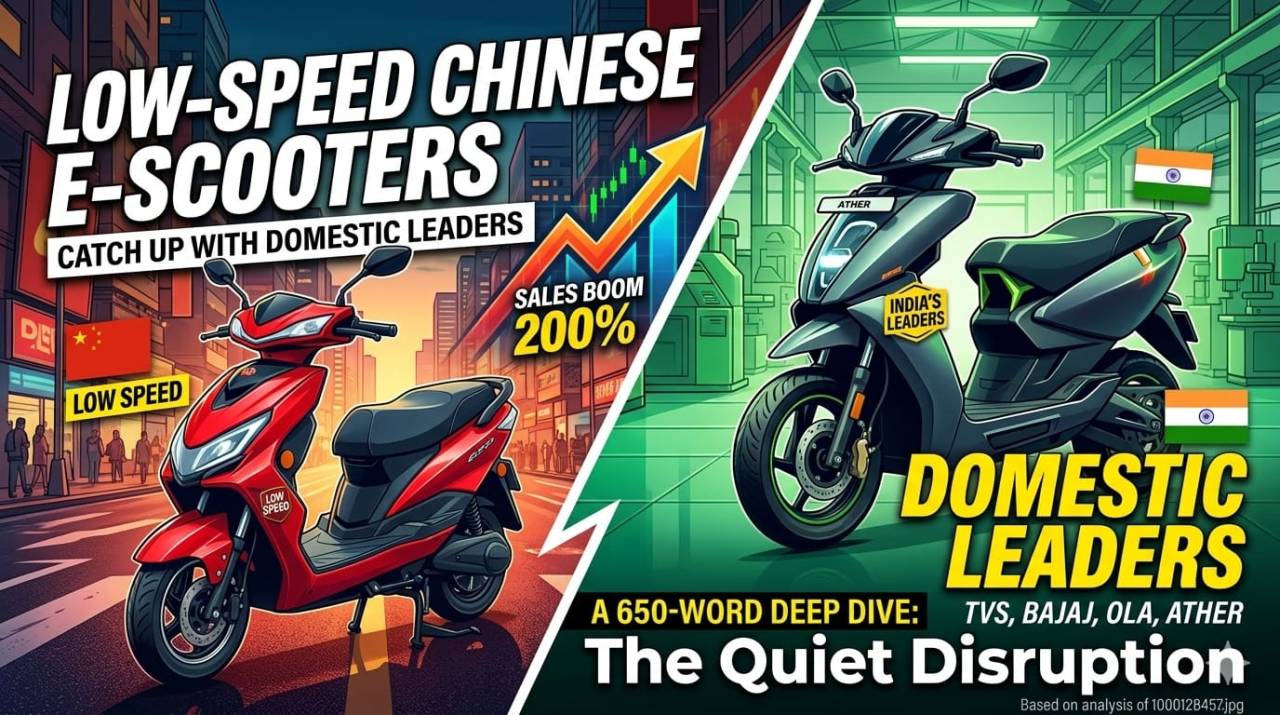
A fast-growing wave of low-speed electric scooters, powered by cheap Chinese imports and regulatory gaps, is quietly matching India’s biggest EV brands and reshaping the two-wheeler market.
The Indian electric vehicle (EV) sector is undergoing a structural shift that is unfolding largely outside the formal tracking systems. A rapidly expanding segment of low-speed electric scooters—heavily dependent on inexpensive Chinese imports—is quietly reshaping market dynamics and challenging established manufacturers across the country.
As highlighted in data referenced by two-wheeler consultancy InsightEV, this parallel market has grown at a pace that has caught both policymakers and legacy EV makers off guard.
A Parallel Market Operating Below the Radar
The defining feature of these low-speed electric scooters is their capped top speed of 25 kmph. Because of this limitation, they fall outside mandatory registration requirements on the government’s vehicle database system, the Vahan portal.
This exemption has created a structural blind spot. While high-speed electric scooters are formally tracked, the low-speed category operates with limited visibility, despite its rapidly growing scale.
Industry estimates suggest that this segment is no longer marginal. Instead, it is becoming a core part of India’s two-wheeler EV ecosystem.
Sales Parity with Major EV Players
According to data cited from InsightEV, the growth trajectory of low-speed scooters has been striking:
- Sales surged by more than 200% in 2025
- Total volumes reached approximately 1.3 million units
- High-speed registered electric scooters also recorded around 1.3 million units, but with only 12% growth
This places the unregistered low-speed segment at near parity with India’s organized EV market, which includes major manufacturers such as TVS Motor Co., Bajaj Auto, Ola Electric Mobility, and Ather Energy.
The implication is significant: an informal and largely unregulated ecosystem is now matching the output of India’s most established EV brands.
The Knock-Down Import Pipeline
Industry executives attribute much of this expansion to a low-cost import model built around completely knocked-down (CKD) kits sourced from China. These kits are imported, assembled locally, and distributed through fragmented dealer networks.
This structure has drastically lowered entry barriers.
As noted by Kunal Arya, Managing Director at Zelio E-Mobility:
“There are no standards, and import barriers are also not there, so anyone is entering the market.”
The result is a highly decentralised manufacturing and assembly ecosystem where small players can enter the EV space with minimal capital investment. Arya estimates that the market is expanding rapidly, with sales potentially exceeding 200,000 units per month, far above earlier projections.
Regulatory Gaps and Market Expansion
The absence of mandatory registration for low-speed scooters has enabled rapid scale without corresponding oversight. Since these vehicles do not appear consistently in national databases, their true penetration is difficult to measure in real time.
This has also created uneven competition between compliant manufacturers and informal assemblers who are not subject to the same regulatory burden, certification requirements, or reporting obligations.
Quality Risks and Industry Concerns
While the growth of low-speed scooters has expanded EV accessibility, it has also raised serious concerns within the organised sector.
Industry stakeholders warn of three major risks:
1. Safety and reliability concerns
Battery quality, component durability, and assembly standards vary widely across unregulated imports, increasing the risk of failures.
2. Consumer trust erosion
Negative user experiences with low-cost vehicles could impact confidence in electric mobility as a whole, particularly at a time when adoption is accelerating.
3. Distortion of fair competition
Organised players investing in R&D, localisation, and compliance face cost disadvantages compared to unregulated assemblers.
A Market Moving Toward Correction
The current phase is often described by industry observers as a transitional “Wild West” period. While affordability has driven rapid adoption, experts suggest that regulatory clarity will ultimately determine the segment’s long-term structure.
Some believe the market will gradually consolidate as standards tighten and enforcement increases. Others argue that the scale of demand in the low-cost segment ensures its continued presence, albeit in a more regulated form.
Final Take
India’s EV transition is now split across two parallel ecosystems. One is driven by established manufacturers investing in innovation, localisation, and compliance. The other is a fast-moving, fragmented network built on imported kits and informal assembly lines.
As policy frameworks evolve, the tension between affordability and regulation is expected to intensify. For now, the low-speed segment continues to expand rapidly, quietly reshaping the foundations of India’s electric mobility landscape.
The Indian electric vehicle (EV) sector is undergoing a structural shift that is unfolding largely outside the formal tracking systems. A rapidly expanding segment of low-speed electric scooters—heavily dependent on inexpensive Chinese imports—is quietly reshaping market dynamics and challenging established manufacturers across the country.
As highlighted in data referenced by two-wheeler consultancy InsightEV, this parallel market has grown at a pace that has caught both policymakers and legacy EV makers off guard.
A Parallel Market Operating Below the Radar
The defining feature of these low-speed electric scooters is their capped top speed of 25 kmph. Because of this limitation, they fall outside mandatory registration requirements on the government’s vehicle database system, the Vahan portal.
This exemption has created a structural blind spot. While high-speed electric scooters are formally tracked, the low-speed category operates with limited visibility, despite its rapidly growing scale.
Industry estimates suggest that this segment is no longer marginal. Instead, it is becoming a core part of India’s two-wheeler EV ecosystem.
Sales Parity with Major EV Players
According to data cited from InsightEV, the growth trajectory of low-speed scooters has been striking:
- Sales surged by more than 200% in 2025
- Total volumes reached approximately 1.3 million units
- High-speed registered electric scooters also recorded around 1.3 million units, but with only 12% growth
This places the unregistered low-speed segment at near parity with India’s organized EV market, which includes major manufacturers such as TVS Motor Co., Bajaj Auto, Ola Electric Mobility, and Ather Energy.
The implication is significant: an informal and largely unregulated ecosystem is now matching the output of India’s most established EV brands.
The Knock-Down Import Pipeline
Industry executives attribute much of this expansion to a low-cost import model built around completely knocked-down (CKD) kits sourced from China. These kits are imported, assembled locally, and distributed through fragmented dealer networks.
This structure has drastically lowered entry barriers.
As noted by Kunal Arya, Managing Director at Zelio E-Mobility:
“There are no standards, and import barriers are also not there, so anyone is entering the market.”
The result is a highly decentralised manufacturing and assembly ecosystem where small players can enter the EV space with minimal capital investment. Arya estimates that the market is expanding rapidly, with sales potentially exceeding 200,000 units per month, far above earlier projections.
Regulatory Gaps and Market Expansion
The absence of mandatory registration for low-speed scooters has enabled rapid scale without corresponding oversight. Since these vehicles do not appear consistently in national databases, their true penetration is difficult to measure in real time.
This has also created uneven competition between compliant manufacturers and informal assemblers who are not subject to the same regulatory burden, certification requirements, or reporting obligations.
Quality Risks and Industry Concerns
While the growth of low-speed scooters has expanded EV accessibility, it has also raised serious concerns within the organised sector.
Industry stakeholders warn of three major risks:
1. Safety and reliability concerns
Battery quality, component durability, and assembly standards vary widely across unregulated imports, increasing the risk of failures.
2. Consumer trust erosion
Negative user experiences with low-cost vehicles could impact confidence in electric mobility as a whole, particularly at a time when adoption is accelerating.
3. Distortion of fair competition
Organised players investing in R&D, localisation, and compliance face cost disadvantages compared to unregulated assemblers.
A Market Moving Toward Correction
The current phase is often described by industry observers as a transitional “Wild West” period. While affordability has driven rapid adoption, experts suggest that regulatory clarity will ultimately determine the segment’s long-term structure.
Some believe the market will gradually consolidate as standards tighten and enforcement increases. Others argue that the scale of demand in the low-cost segment ensures its continued presence, albeit in a more regulated form.
Final Take
India’s EV transition is now split across two parallel ecosystems. One is driven by established manufacturers investing in innovation, localisation, and compliance. The other is a fast-moving, fragmented network built on imported kits and informal assembly lines.
As policy frameworks evolve, the tension between affordability and regulation is expected to intensify. For now, the low-speed segment continues to expand rapidly, quietly reshaping the foundations of India’s electric mobility landscape.
























Leave a Comment