
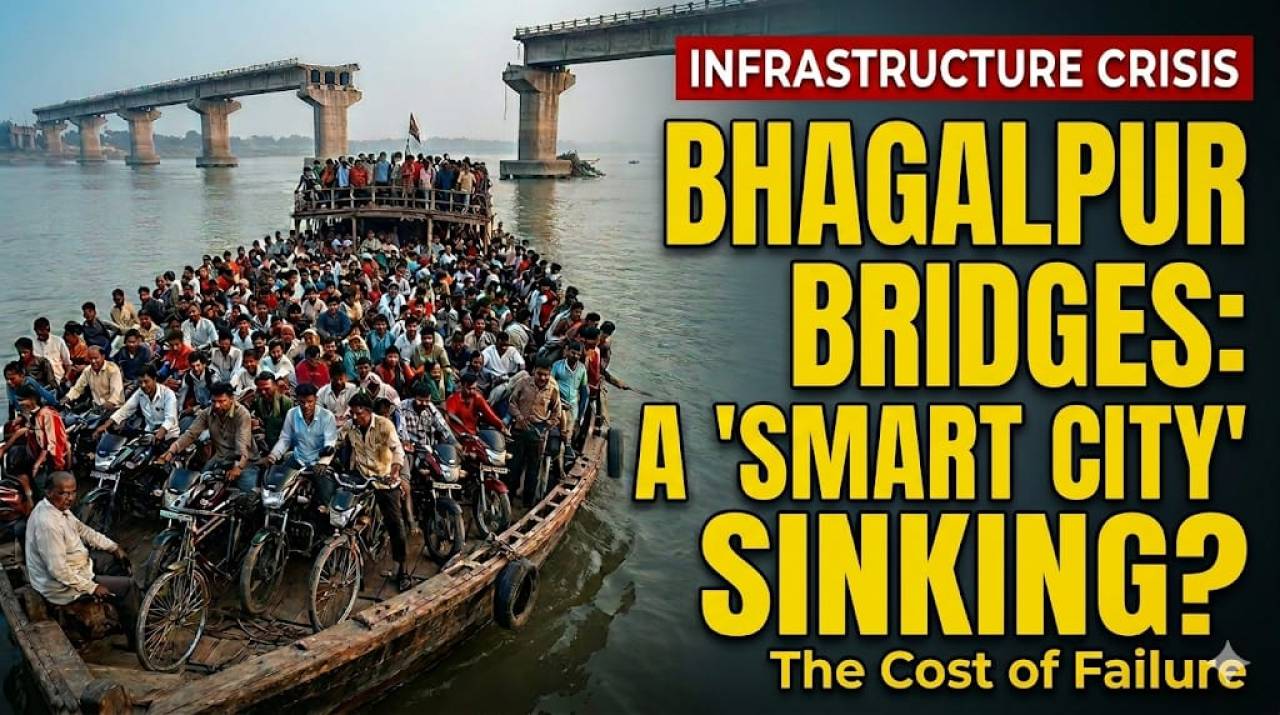
Bhagalpur was promised the future through India’s Smart Cities Mission, yet thousands now risk their lives daily on overcrowded ferries because critical bridges keep collapsing.
Bhagalpur, a city selected under India’s ambitious Smart Cities Mission, is facing a growing infrastructure crisis that has exposed the fragile state of its public safety systems. The collapse and deterioration of key bridge networks have forced thousands of residents to depend on overcrowded private ferries for daily transportation, creating a stark contrast between the promise of technological urban development and the harsh realities on the ground.
At a time when cities across India are investing in digital governance, surveillance systems, and smart mobility solutions, Bhagalpur’s residents are struggling for something far more basic: safe physical connectivity.
A City Cut Off by Infrastructure Failure
The current transportation crisis in Bhagalpur stems directly from repeated structural failures in critical bridge infrastructure. For a city positioned as an important regional and commercial center, the disruption of bridge access has created severe obstacles for trade, education, healthcare, and daily commuting.
With major road links either partially closed or rendered unsafe, residents have increasingly turned to private ferries to cross the river. Images emerging from the region show dangerously overcrowded boats carrying not only passengers but also motorcycles, bicycles, and goods in conditions that raise serious safety concerns.
This dependence on informal river transport is not merely an inconvenience. It represents a significant public risk. Many ferries reportedly operate without adequate safety equipment, regulated passenger limits, or emergency preparedness measures. Each crossing has effectively become a calculated gamble for ordinary citizens.
For a city carrying the “Smart City” label, the return to unsafe and primitive transit methods reflects a deep failure in planning, maintenance, and governance.
A Pattern of Structural Collapse
Bhagalpur’s infrastructure troubles are not isolated incidents. Instead, they form part of a broader and deeply troubling pattern of repeated engineering and administrative failures across Bihar’s bridge network.
The Aguwani-Sultanganj Bridge Crisis
Among the most controversial examples is the Aguwani-Sultanganj bridge project, which has become symbolic of alleged negligence in public infrastructure execution. Despite costing more than ₹1,700 crore, sections of the bridge reportedly collapsed multiple times between 2022 and 2024.
The repeated failures raised serious concerns regarding structural design, construction quality, material standards, and project supervision. When a major public infrastructure project collapses repeatedly during construction itself, questions inevitably arise about accountability and quality control mechanisms.
Vikramshila Setu Under Pressure
The Vikramshila Setu, one of the most important transport links connecting South Bihar, has also faced mounting structural stress. Technical observations over recent years pointed toward fatigue in concrete sections, deteriorating joints, and long-term maintenance neglect.
Partial closures and traffic restrictions on the bridge have disrupted transportation across the region, increasing congestion and forcing commuters and commercial vehicles onto longer alternative routes.
Together, these incidents suggest systemic weaknesses within infrastructure oversight and bridge management systems.
Economic Consequences Spreading Across the Region
The impact of bridge failures extends far beyond transportation delays. Bhagalpur functions as a crucial transit corridor linking Bihar with neighboring regions including Jharkhand and West Bengal. When key routes become unreliable, the economic consequences spread rapidly.
Heavy vehicles transporting goods are being diverted onto longer roads, increasing travel time, fuel consumption, and logistical costs. These additional costs eventually affect the prices of essential commodities, placing greater financial strain on ordinary households.
Local businesses, traders, and transport operators are also suffering from reduced efficiency and operational uncertainty.
The disruption has become particularly difficult for students and patients. Students commuting to educational institutions across the river face significant delays, while patients seeking specialized medical care risk losing critical time during emergencies.
The Smart Cities Mission was envisioned as a framework to improve urban efficiency and quality of life. Yet in Bhagalpur, the inability to ensure reliable mobility has instead weakened the city’s most basic public functions.
The Limits of “Smart” Urbanism
Bhagalpur has received substantial funding under the Smart Cities Mission, with major investments directed toward projects such as Integrated Command and Control Centres (ICCC), smart street lighting systems, digital monitoring infrastructure, and technology-driven governance initiatives.
While such projects can improve urban administration, critics increasingly argue that digital modernization cannot replace foundational structural reliability.
A city cannot meaningfully call itself “smart” if its bridges collapse, its roads remain unsafe, and its citizens must rely on overcrowded ferries for survival-level mobility.
Urban planners and policy analysts have repeatedly emphasized that technological upgrades should complement — not replace — investments in core public infrastructure. In Bhagalpur’s case, the imbalance has become difficult to ignore.
Visible, technology-oriented projects often attract greater political attention because they offer immediate public visibility. Structural audits, bridge reinforcement, and long-term engineering maintenance, by contrast, are less visible but far more essential.
The result is a dangerous misalignment of priorities where digital infrastructure expands while physical infrastructure weakens.
The Accountability Deficit
One of the biggest concerns surrounding repeated infrastructure failures in Bihar is the perceived lack of meaningful accountability.
Temporary suspensions of lower-level engineers or administrative inquiries have done little to restore public confidence. When multi-crore infrastructure projects repeatedly fail, scrutiny inevitably extends beyond junior officials toward contractors, consultants, supervisory agencies, and higher administrative authorities.
Experts argue that firms associated with repeated structural failures should face stricter penalties, including blacklisting from future public contracts where necessary. Public infrastructure funded by taxpayers cannot become a cycle of repeated collapse and reconstruction without consequences.
At the same time, independent structural audits of major bridges across the region have become increasingly necessary. Such assessments should ideally be conducted by credible third-party engineering institutions, with findings made publicly accessible to ensure transparency and rebuild public trust.
Returning to the Basics
The crisis in Bhagalpur highlights a broader lesson for urban development across India. Technology alone cannot define a modern city. Safe bridges, reliable roads, functional drainage systems, and durable public infrastructure remain the foundation upon which every smart initiative depends.
Until Bhagalpur’s residents can cross their rivers safely without risking their lives on overcrowded ferries, the promise of becoming a “Smart City” will remain incomplete.
The path forward requires more than digital dashboards and surveillance systems. It demands solid engineering, transparent oversight, long-term maintenance planning, and a governance culture that prioritizes public safety over optics.
For the people of Bhagalpur, the real measure of progress will not be found in smart screens or command centers, but in whether the bridges they depend upon can finally stand.
Bhagalpur, a city selected under India’s ambitious Smart Cities Mission, is facing a growing infrastructure crisis that has exposed the fragile state of its public safety systems. The collapse and deterioration of key bridge networks have forced thousands of residents to depend on overcrowded private ferries for daily transportation, creating a stark contrast between the promise of technological urban development and the harsh realities on the ground.
At a time when cities across India are investing in digital governance, surveillance systems, and smart mobility solutions, Bhagalpur’s residents are struggling for something far more basic: safe physical connectivity.
A City Cut Off by Infrastructure Failure
The current transportation crisis in Bhagalpur stems directly from repeated structural failures in critical bridge infrastructure. For a city positioned as an important regional and commercial center, the disruption of bridge access has created severe obstacles for trade, education, healthcare, and daily commuting.
With major road links either partially closed or rendered unsafe, residents have increasingly turned to private ferries to cross the river. Images emerging from the region show dangerously overcrowded boats carrying not only passengers but also motorcycles, bicycles, and goods in conditions that raise serious safety concerns.
This dependence on informal river transport is not merely an inconvenience. It represents a significant public risk. Many ferries reportedly operate without adequate safety equipment, regulated passenger limits, or emergency preparedness measures. Each crossing has effectively become a calculated gamble for ordinary citizens.
For a city carrying the “Smart City” label, the return to unsafe and primitive transit methods reflects a deep failure in planning, maintenance, and governance.
A Pattern of Structural Collapse
Bhagalpur’s infrastructure troubles are not isolated incidents. Instead, they form part of a broader and deeply troubling pattern of repeated engineering and administrative failures across Bihar’s bridge network.
The Aguwani-Sultanganj Bridge Crisis
Among the most controversial examples is the Aguwani-Sultanganj bridge project, which has become symbolic of alleged negligence in public infrastructure execution. Despite costing more than ₹1,700 crore, sections of the bridge reportedly collapsed multiple times between 2022 and 2024.
The repeated failures raised serious concerns regarding structural design, construction quality, material standards, and project supervision. When a major public infrastructure project collapses repeatedly during construction itself, questions inevitably arise about accountability and quality control mechanisms.
Vikramshila Setu Under Pressure
The Vikramshila Setu, one of the most important transport links connecting South Bihar, has also faced mounting structural stress. Technical observations over recent years pointed toward fatigue in concrete sections, deteriorating joints, and long-term maintenance neglect.
Partial closures and traffic restrictions on the bridge have disrupted transportation across the region, increasing congestion and forcing commuters and commercial vehicles onto longer alternative routes.
Together, these incidents suggest systemic weaknesses within infrastructure oversight and bridge management systems.
Economic Consequences Spreading Across the Region
The impact of bridge failures extends far beyond transportation delays. Bhagalpur functions as a crucial transit corridor linking Bihar with neighboring regions including Jharkhand and West Bengal. When key routes become unreliable, the economic consequences spread rapidly.
Heavy vehicles transporting goods are being diverted onto longer roads, increasing travel time, fuel consumption, and logistical costs. These additional costs eventually affect the prices of essential commodities, placing greater financial strain on ordinary households.
Local businesses, traders, and transport operators are also suffering from reduced efficiency and operational uncertainty.
The disruption has become particularly difficult for students and patients. Students commuting to educational institutions across the river face significant delays, while patients seeking specialized medical care risk losing critical time during emergencies.
The Smart Cities Mission was envisioned as a framework to improve urban efficiency and quality of life. Yet in Bhagalpur, the inability to ensure reliable mobility has instead weakened the city’s most basic public functions.
The Limits of “Smart” Urbanism
Bhagalpur has received substantial funding under the Smart Cities Mission, with major investments directed toward projects such as Integrated Command and Control Centres (ICCC), smart street lighting systems, digital monitoring infrastructure, and technology-driven governance initiatives.
While such projects can improve urban administration, critics increasingly argue that digital modernization cannot replace foundational structural reliability.
A city cannot meaningfully call itself “smart” if its bridges collapse, its roads remain unsafe, and its citizens must rely on overcrowded ferries for survival-level mobility.
Urban planners and policy analysts have repeatedly emphasized that technological upgrades should complement — not replace — investments in core public infrastructure. In Bhagalpur’s case, the imbalance has become difficult to ignore.
Visible, technology-oriented projects often attract greater political attention because they offer immediate public visibility. Structural audits, bridge reinforcement, and long-term engineering maintenance, by contrast, are less visible but far more essential.
The result is a dangerous misalignment of priorities where digital infrastructure expands while physical infrastructure weakens.
The Accountability Deficit
One of the biggest concerns surrounding repeated infrastructure failures in Bihar is the perceived lack of meaningful accountability.
Temporary suspensions of lower-level engineers or administrative inquiries have done little to restore public confidence. When multi-crore infrastructure projects repeatedly fail, scrutiny inevitably extends beyond junior officials toward contractors, consultants, supervisory agencies, and higher administrative authorities.
Experts argue that firms associated with repeated structural failures should face stricter penalties, including blacklisting from future public contracts where necessary. Public infrastructure funded by taxpayers cannot become a cycle of repeated collapse and reconstruction without consequences.
At the same time, independent structural audits of major bridges across the region have become increasingly necessary. Such assessments should ideally be conducted by credible third-party engineering institutions, with findings made publicly accessible to ensure transparency and rebuild public trust.
Returning to the Basics
The crisis in Bhagalpur highlights a broader lesson for urban development across India. Technology alone cannot define a modern city. Safe bridges, reliable roads, functional drainage systems, and durable public infrastructure remain the foundation upon which every smart initiative depends.
Until Bhagalpur’s residents can cross their rivers safely without risking their lives on overcrowded ferries, the promise of becoming a “Smart City” will remain incomplete.
The path forward requires more than digital dashboards and surveillance systems. It demands solid engineering, transparent oversight, long-term maintenance planning, and a governance culture that prioritizes public safety over optics.
For the people of Bhagalpur, the real measure of progress will not be found in smart screens or command centers, but in whether the bridges they depend upon can finally stand.




























Leave a Comment