
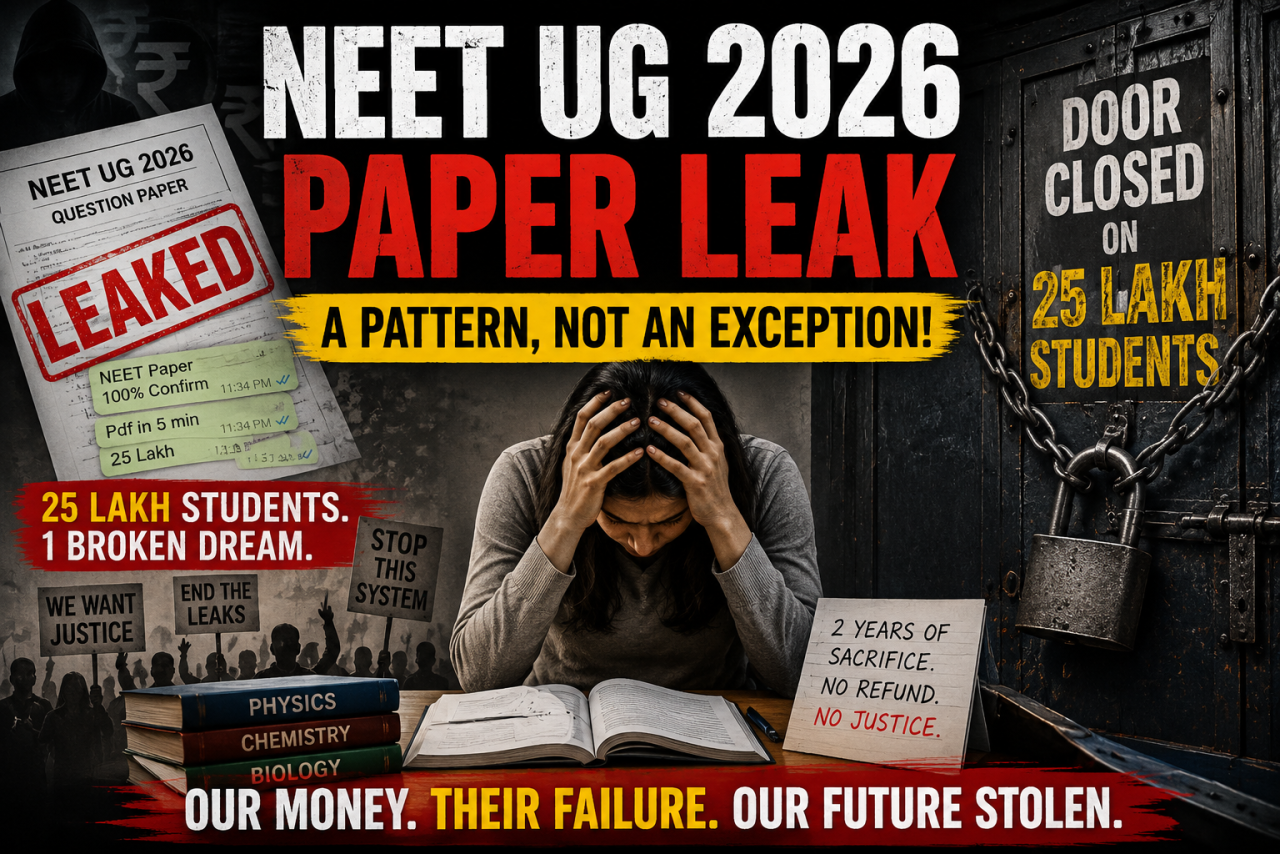
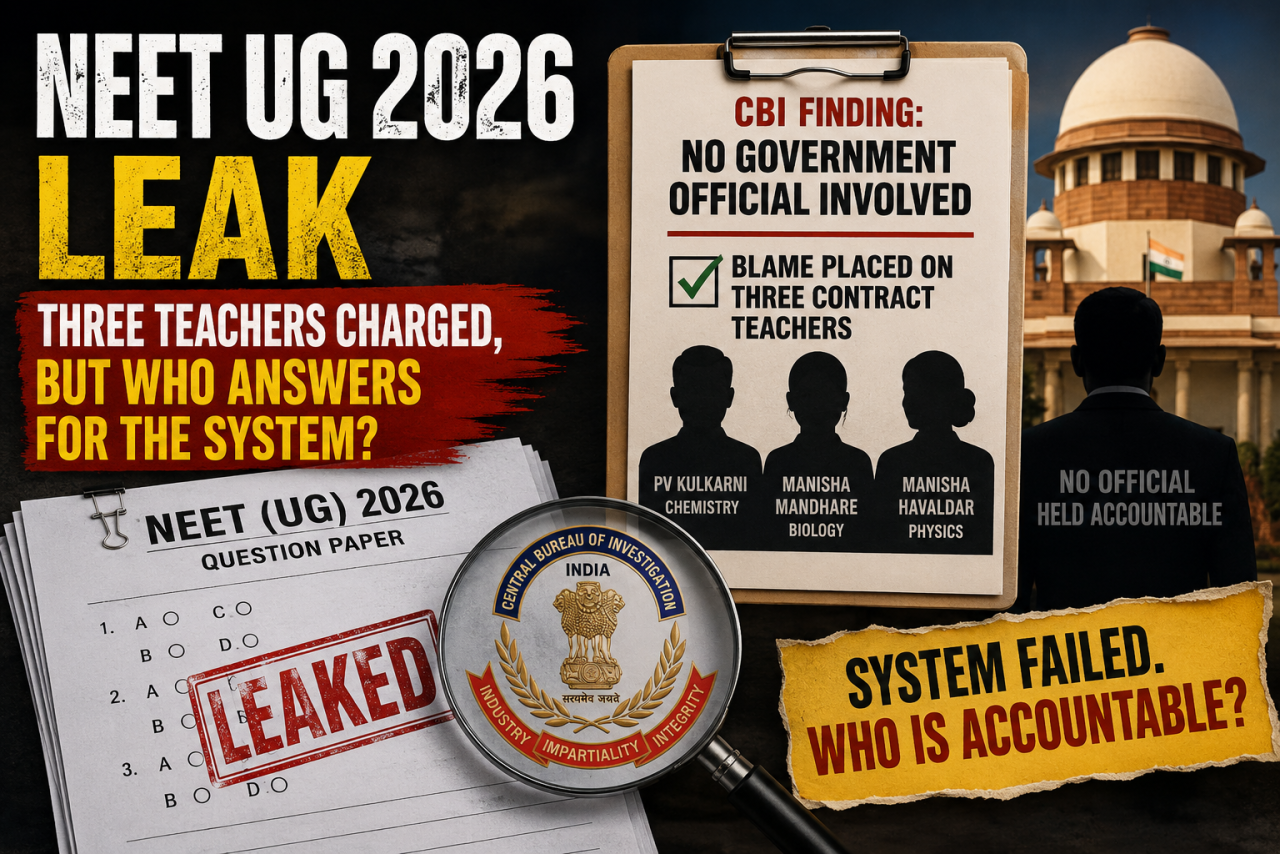
For nearly 25 lakh students, NEET UG 2026 was meant to be a life-changing opportunity. Instead, paper leak allegations sparked outrage across India, raising serious questions about corruption, exam security, and the future of millions of aspirants.
For millions of Indian students, NEET is not just an examination. It is a dream, a battle, and often the biggest turning point of their lives. Every year, students wake up before sunrise, spend endless hours in coaching institutes, sacrifice festivals, friendships, sleep, and sometimes even their mental health for one chance to enter a medical college.
But in 2026, that dream was once again shaken by allegations of a NEET-UG paper leak.
Around 22 to 25 lakh students appeared for the examination. Behind every candidate stood anxious parents, loans taken for coaching fees, years of preparation, and the hope of a better future. Yet all of it suddenly came under a cloud of doubt because a few people allegedly decided to turn education into a black market.
Reports suggest that the investigation into the alleged leak has now reached multiple states, with agencies like the CBI stepping in. According to media reports, leaked questions were allegedly sold for lakhs of rupees through organised networks operating across different cities. Some reports also claim that question papers or so-called “guess papers” were circulated before the examination itself.
If these allegations are proven true, then this is not just an exam scam.
It is a betrayal of an entire generation.
A Country Where Hard Work No Longer Feels Enough
The biggest damage caused by paper leaks is not only academic. It destroys faith.
Imagine a student from a small village in Bihar, Uttar Pradesh, Rajasthan, Assam, or Jharkhand. That student may have studied under poor electricity conditions, travelled long distances for coaching, or depended entirely on second-hand books.
Now imagine that same student learning that somebody else may have purchased the paper using money and connections.
What message does this send?
That honesty is foolish?
That merit can be bought?
That hard work matters less than corruption?
This is the most dangerous consequence of repeated paper leaks in India.
A nation survives on trust. Students study because they believe the system will reward effort fairly. Once that trust breaks, frustration turns into anger, hopelessness, and social resentment.
The Cost Is Paid by Every Citizen
Many people think a paper leak only affects students. That is not true.
Conducting a national examination like NEET costs hundreds of crores of rupees. Security arrangements, exam centres, transportation, invigilation, printing, administration, technology, and logistics are all funded by taxpayers.
That means every citizen of India pays for these examinations.
When a paper leak happens, public money is wasted.
Money that could have improved government schools.
Money that could have upgraded rural hospitals.
Money that could have funded scholarships for poor students.
Instead, the country is forced to spend again on investigations, re-examinations, legal battles, and damage control.
The emotional cost is even higher.
Students suffer anxiety attacks.
Parents lose sleep.
Families already struggling financially are pushed further into stress.
Some students spend two or three years preparing for NEET. Many families take loans to pay coaching fees. Some parents silently cut down household expenses so their children can buy study material.
There is no refund for those sacrifices.
Not an Isolated Incident Anymore
The most frightening part is that paper leaks are no longer shocking in India. They are becoming predictable.
Over the last several years, India has witnessed repeated allegations of leaks and irregularities in recruitment exams, entrance tests, and government examinations. From state-level recruitment tests to national-level entrance exams, scandals have repeatedly surfaced.
This has created a dangerous public perception that major exams in India are vulnerable.
That perception alone damages the credibility of institutions.
If students begin believing that examinations are controlled by “mafias” instead of merit, the entire education system loses moral authority.
And once faith in institutions collapses, rebuilding it becomes extremely difficult.
Coaching Culture and the Business of Pressure
India’s competitive exam ecosystem has become a giant industry.
Coaching hubs in cities like Kota, Sikar, Patna, Delhi, Hyderabad, and many others attract students from across the country. Families spend lakhs of rupees hoping their child will secure a medical seat.
The pressure is enormous.
For middle-class and poor families, NEET often becomes a do-or-die examination.
This intense pressure creates opportunities for criminals.
Whenever desperation increases, corruption finds space.
That is why paper leak networks survive.
They exploit fear.
They exploit ambition.
And they exploit the weakness of a system that repeatedly fails to secure examinations.
Mental Health Crisis Nobody Talks About
Every year after major exams, India hears heartbreaking stories of students facing depression, burnout, and emotional collapse.
The paper leak issue makes this even worse.
Students who prepared honestly begin doubting themselves.
Many feel cheated.
Some lose motivation completely.
Others feel trapped in an endless cycle of uncertainty.
A re-examination may look like a simple administrative decision on paper, but for students it means restarting stress all over again.
More sleepless nights.
More anxiety.
More financial burden.
And more emotional exhaustion.
In a country where student suicides are already a serious issue, authorities cannot ignore the mental impact of repeated exam controversies.
The Real Question: Who Is Accountable?
Whenever a paper leak happens, investigations begin, arrests are made, and politicians make statements.
But ordinary citizens keep asking the same question:
Why does this continue to happen?
India is a country with advanced digital infrastructure, Aadhaar systems, banking technology, and space missions. If the nation can achieve such technological progress, why does it still struggle to conduct secure examinations?
Why are highly sensitive papers still vulnerable?
Why do organised leak networks repeatedly emerge?
And why does accountability often disappear after public outrage fades away?
The anger surrounding NEET-UG 2026 is not only about one examination.
It is about accumulated frustration.
Students feel that they are repeatedly paying the price for institutional failures.
India Cannot Afford to Lose Its Youth
India often speaks proudly about its demographic dividend. Politicians describe the country’s youth population as its greatest strength.
But a nation cannot call its youth an asset while forcing them to fight corruption for basic fairness.
Young people do not only need opportunities.
They need trust in the system.
If talented students begin believing that honesty has no value, the country risks creating an entire generation filled with cynicism.
That would be far more dangerous than any paper leak.
Because once young citizens lose faith in institutions, they also lose faith in the future.
What Needs to Change
India urgently needs deeper examination reforms.
Secure digital systems, stronger monitoring, faster investigations, strict punishment for leak networks, transparent communication, and institutional accountability are no longer optional.
The country also needs to reduce the unhealthy pressure surrounding a single examination.
No student’s entire future should depend on one test vulnerable to manipulation.
Most importantly, authorities must remember one thing:
Behind every NEET roll number is a real human story.
A father working overtime.
A mother sacrificing her savings.
A student studying late into the night.
A dream built slowly over years.
When examination systems fail, those dreams collapse.
And when millions of dreams collapse together, the damage goes far beyond education.
It becomes a national crisis.
The NEET-UG 2026 controversy should not be treated as just another headline that disappears after a few weeks of television debates.
It should serve as a warning.
Because if India cannot protect fairness in education, then the country risks teaching its youth the worst possible lesson:
That corruption is stronger than hard work.
And no nation can progress for long after teaching that lesson to millions of students.
For millions of Indian students, NEET is not just an examination. It is a dream, a battle, and often the biggest turning point of their lives. Every year, students wake up before sunrise, spend endless hours in coaching institutes, sacrifice festivals, friendships, sleep, and sometimes even their mental health for one chance to enter a medical college.
But in 2026, that dream was once again shaken by allegations of a NEET-UG paper leak.
Around 22 to 25 lakh students appeared for the examination. Behind every candidate stood anxious parents, loans taken for coaching fees, years of preparation, and the hope of a better future. Yet all of it suddenly came under a cloud of doubt because a few people allegedly decided to turn education into a black market.
Reports suggest that the investigation into the alleged leak has now reached multiple states, with agencies like the CBI stepping in. According to media reports, leaked questions were allegedly sold for lakhs of rupees through organised networks operating across different cities. Some reports also claim that question papers or so-called “guess papers” were circulated before the examination itself.
If these allegations are proven true, then this is not just an exam scam.
It is a betrayal of an entire generation.
A Country Where Hard Work No Longer Feels Enough
The biggest damage caused by paper leaks is not only academic. It destroys faith.
Imagine a student from a small village in Bihar, Uttar Pradesh, Rajasthan, Assam, or Jharkhand. That student may have studied under poor electricity conditions, travelled long distances for coaching, or depended entirely on second-hand books.
Now imagine that same student learning that somebody else may have purchased the paper using money and connections.
What message does this send?
That honesty is foolish?
That merit can be bought?
That hard work matters less than corruption?
This is the most dangerous consequence of repeated paper leaks in India.
A nation survives on trust. Students study because they believe the system will reward effort fairly. Once that trust breaks, frustration turns into anger, hopelessness, and social resentment.
The Cost Is Paid by Every Citizen
Many people think a paper leak only affects students. That is not true.
Conducting a national examination like NEET costs hundreds of crores of rupees. Security arrangements, exam centres, transportation, invigilation, printing, administration, technology, and logistics are all funded by taxpayers.
That means every citizen of India pays for these examinations.
When a paper leak happens, public money is wasted.
Money that could have improved government schools.
Money that could have upgraded rural hospitals.
Money that could have funded scholarships for poor students.
Instead, the country is forced to spend again on investigations, re-examinations, legal battles, and damage control.
The emotional cost is even higher.
Students suffer anxiety attacks.
Parents lose sleep.
Families already struggling financially are pushed further into stress.
Some students spend two or three years preparing for NEET. Many families take loans to pay coaching fees. Some parents silently cut down household expenses so their children can buy study material.
There is no refund for those sacrifices.
Not an Isolated Incident Anymore
The most frightening part is that paper leaks are no longer shocking in India. They are becoming predictable.
Over the last several years, India has witnessed repeated allegations of leaks and irregularities in recruitment exams, entrance tests, and government examinations. From state-level recruitment tests to national-level entrance exams, scandals have repeatedly surfaced.
This has created a dangerous public perception that major exams in India are vulnerable.
That perception alone damages the credibility of institutions.
If students begin believing that examinations are controlled by “mafias” instead of merit, the entire education system loses moral authority.
And once faith in institutions collapses, rebuilding it becomes extremely difficult.
Coaching Culture and the Business of Pressure
India’s competitive exam ecosystem has become a giant industry.
Coaching hubs in cities like Kota, Sikar, Patna, Delhi, Hyderabad, and many others attract students from across the country. Families spend lakhs of rupees hoping their child will secure a medical seat.
The pressure is enormous.
For middle-class and poor families, NEET often becomes a do-or-die examination.
This intense pressure creates opportunities for criminals.
Whenever desperation increases, corruption finds space.
That is why paper leak networks survive.
They exploit fear.
They exploit ambition.
And they exploit the weakness of a system that repeatedly fails to secure examinations.
Mental Health Crisis Nobody Talks About
Every year after major exams, India hears heartbreaking stories of students facing depression, burnout, and emotional collapse.
The paper leak issue makes this even worse.
Students who prepared honestly begin doubting themselves.
Many feel cheated.
Some lose motivation completely.
Others feel trapped in an endless cycle of uncertainty.
A re-examination may look like a simple administrative decision on paper, but for students it means restarting stress all over again.
More sleepless nights.
More anxiety.
More financial burden.
And more emotional exhaustion.
In a country where student suicides are already a serious issue, authorities cannot ignore the mental impact of repeated exam controversies.
The Real Question: Who Is Accountable?
Whenever a paper leak happens, investigations begin, arrests are made, and politicians make statements.
But ordinary citizens keep asking the same question:
Why does this continue to happen?
India is a country with advanced digital infrastructure, Aadhaar systems, banking technology, and space missions. If the nation can achieve such technological progress, why does it still struggle to conduct secure examinations?
Why are highly sensitive papers still vulnerable?
Why do organised leak networks repeatedly emerge?
And why does accountability often disappear after public outrage fades away?
The anger surrounding NEET-UG 2026 is not only about one examination.
It is about accumulated frustration.
Students feel that they are repeatedly paying the price for institutional failures.
India Cannot Afford to Lose Its Youth
India often speaks proudly about its demographic dividend. Politicians describe the country’s youth population as its greatest strength.
But a nation cannot call its youth an asset while forcing them to fight corruption for basic fairness.
Young people do not only need opportunities.
They need trust in the system.
If talented students begin believing that honesty has no value, the country risks creating an entire generation filled with cynicism.
That would be far more dangerous than any paper leak.
Because once young citizens lose faith in institutions, they also lose faith in the future.
What Needs to Change
India urgently needs deeper examination reforms.
Secure digital systems, stronger monitoring, faster investigations, strict punishment for leak networks, transparent communication, and institutional accountability are no longer optional.
The country also needs to reduce the unhealthy pressure surrounding a single examination.
No student’s entire future should depend on one test vulnerable to manipulation.
Most importantly, authorities must remember one thing:
Behind every NEET roll number is a real human story.
A father working overtime.
A mother sacrificing her savings.
A student studying late into the night.
A dream built slowly over years.
When examination systems fail, those dreams collapse.
And when millions of dreams collapse together, the damage goes far beyond education.
It becomes a national crisis.
The NEET-UG 2026 controversy should not be treated as just another headline that disappears after a few weeks of television debates.
It should serve as a warning.
Because if India cannot protect fairness in education, then the country risks teaching its youth the worst possible lesson:
That corruption is stronger than hard work.
And no nation can progress for long after teaching that lesson to millions of students.




















Leave a Comment