
As inflation and global supply shocks push manufacturing costs higher, India’s biggest FMCG companies are quietly raising prices, shrinking pack sizes, and reshaping the economics of everyday consumption.
For millions of Indian consumers, inflation is no longer just reflected in fuel prices or monthly electricity bills. It is now quietly entering kitchens, grocery shelves, and shopping baskets through smaller biscuit packets, costlier milk, and pricier daily essentials.
India’s fast-moving consumer goods (FMCG) sector has begun responding aggressively to rising input costs, with several major companies either increasing prices or reducing product quantities to protect margins amid mounting global and domestic pressures.
The shift marks a significant moment for India’s consumer economy, especially at a time when demand recovery remains fragile and household budgets are already under strain.
According to industry reports and recent corporate earnings statements, large FMCG players such as Britannia Industries, Dabur India, and Hindustan Unilever have acknowledged increasing inflationary pressures linked to fuel, packaging, edible oils, dairy products, and agricultural commodities.
The trigger behind these rising costs is both global and domestic.
The ongoing geopolitical tensions in West Asia have pushed up crude-linked input costs and freight expenses, while international edible oil prices have climbed sharply in recent months. Simultaneously, erratic weather conditions and concerns surrounding crop output have added further pressure on food inflation within India.
This combination is now forcing companies to pass on part of the burden to consumers.
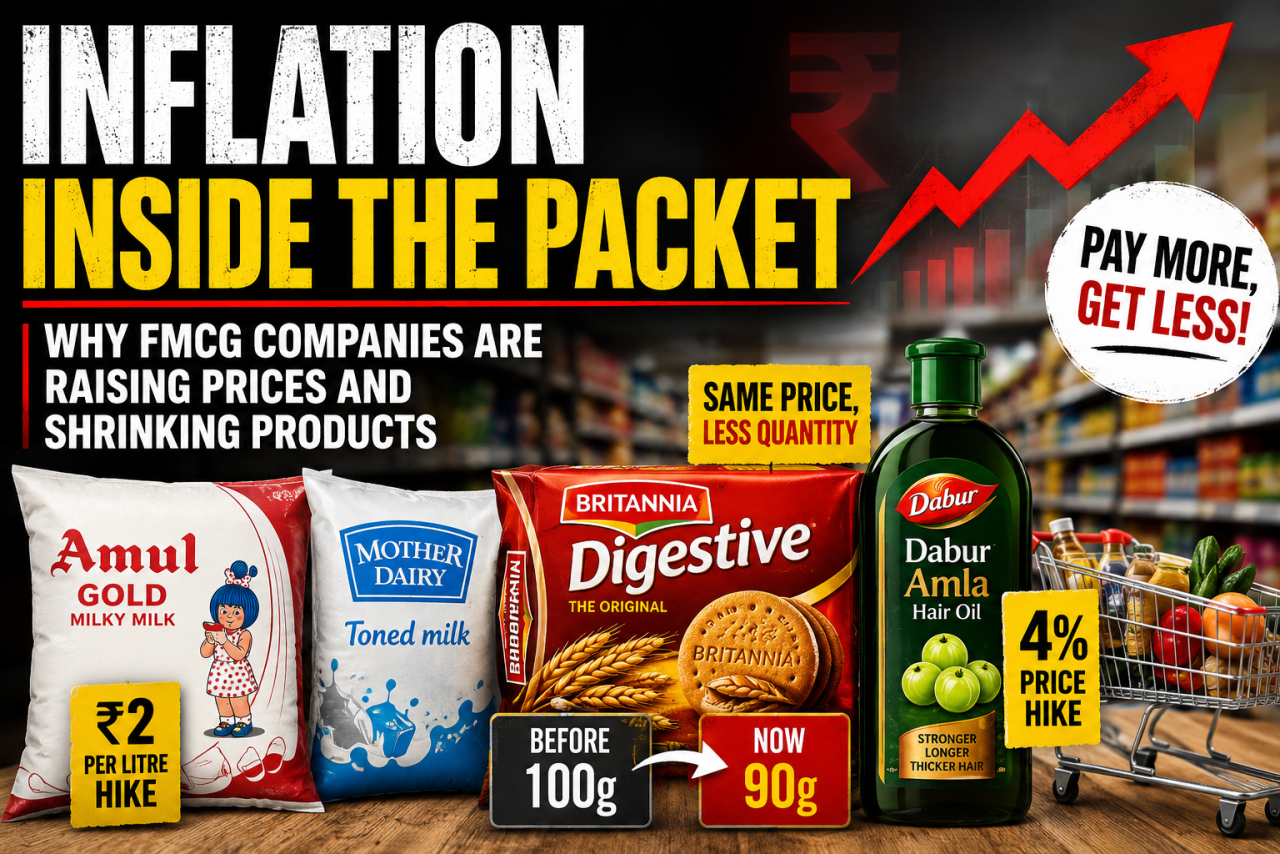
One of the clearest examples is the dairy sector. Leading milk cooperatives and regional dairy brands — including Amul, Mother Dairy, Indore-based Sanchi Milk, and Kerala’s Milma — have raised milk prices by ₹2 per litre. Industry experts believe further hikes cannot be ruled out if feed, transportation, and energy costs continue to rise.
The packaged food industry is facing a similar squeeze.
Executives at Britannia Industries have indicated that elevated temperatures and a possible El Niño impact may keep milk prices firm, while wheat prices have also remained under pressure following unseasonal weather disruptions earlier this year. The company has hinted at using a combination of selective price hikes and “grammage cuts” in lower-priced packs to manage costs.
That term — grammage cuts — may sound technical, but consumers encounter it almost every day.
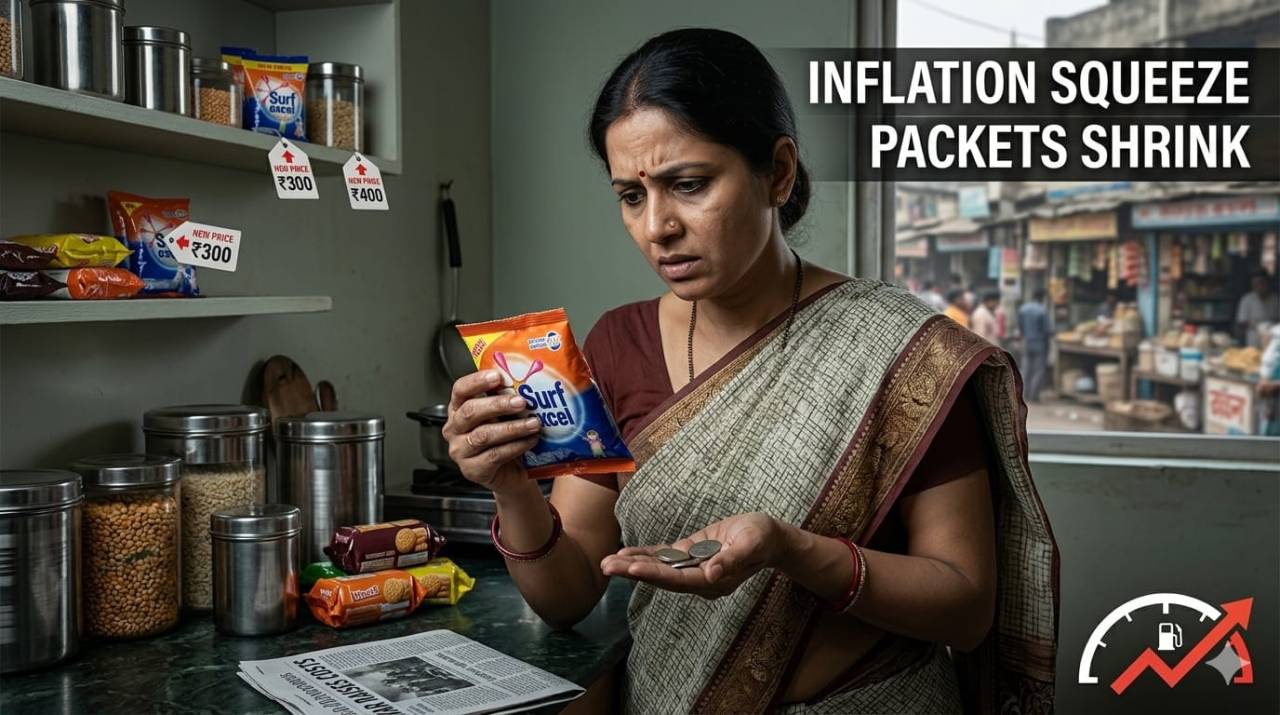
More commonly known as shrinkflation, the strategy allows companies to maintain the same retail price while quietly reducing the quantity inside the package. A ₹10 snack packet may still cost ₹10, but contain fewer grams than before. For companies, it protects price-sensitive demand. For consumers, it effectively means paying more for less.
The strategy has become increasingly common in India’s FMCG landscape because low-cost products dominate mass-market consumption. Even a small visible increase in price can alter buying behavior in rural and middle-class urban markets. Companies therefore prefer to reduce quantity rather than risk losing customers through direct price hikes.
The pressure is not limited to food products alone.
Dabur India has already announced a 4% price increase across parts of its portfolio to offset inflationary costs. The company has also warned that another round of hikes may follow if international conflicts continue to disrupt commodity markets.
Similarly, executives at Hindustan Unilever have acknowledged that inflation is spreading sequentially across categories — beginning with home care, then personal care, and eventually food products.
Economic indicators support these concerns.
India’s Wholesale Price Index (WPI) has risen significantly year-on-year, driven by mineral oils, crude oil, natural gas, and metals. Retail food inflation has also accelerated, particularly due to rising vegetable and edible oil prices. India, which imports nearly 60% of its edible oil requirements, remains highly vulnerable to global commodity fluctuations.
The government has attempted to ease domestic pressure through measures such as extending restrictions on sugar exports to stabilize local prices. However, global supply-side disruptions remain difficult to predict or control.
For consumers, the implications are becoming increasingly visible in everyday life.
Monthly grocery bills are rising gradually, product sizes are shrinking subtly, and the purchasing power of small denominations is eroding faster than before. What once felt like minor price adjustments are now accumulating into a broader cost-of-living challenge for middle-class and lower-income households.
As FMCG companies navigate the difficult balance between weak demand and soaring production costs, India’s consumers may have to prepare for a prolonged phase of silent inflation — one where the real price increase is not always printed on the packet, but hidden inside it.
For millions of Indian consumers, inflation is no longer just reflected in fuel prices or monthly electricity bills. It is now quietly entering kitchens, grocery shelves, and shopping baskets through smaller biscuit packets, costlier milk, and pricier daily essentials.
India’s fast-moving consumer goods (FMCG) sector has begun responding aggressively to rising input costs, with several major companies either increasing prices or reducing product quantities to protect margins amid mounting global and domestic pressures.
The shift marks a significant moment for India’s consumer economy, especially at a time when demand recovery remains fragile and household budgets are already under strain.
According to industry reports and recent corporate earnings statements, large FMCG players such as Britannia Industries, Dabur India, and Hindustan Unilever have acknowledged increasing inflationary pressures linked to fuel, packaging, edible oils, dairy products, and agricultural commodities.
The trigger behind these rising costs is both global and domestic.
The ongoing geopolitical tensions in West Asia have pushed up crude-linked input costs and freight expenses, while international edible oil prices have climbed sharply in recent months. Simultaneously, erratic weather conditions and concerns surrounding crop output have added further pressure on food inflation within India.
This combination is now forcing companies to pass on part of the burden to consumers.
One of the clearest examples is the dairy sector. Leading milk cooperatives and regional dairy brands — including Amul, Mother Dairy, Indore-based Sanchi Milk, and Kerala’s Milma — have raised milk prices by ₹2 per litre. Industry experts believe further hikes cannot be ruled out if feed, transportation, and energy costs continue to rise.
The packaged food industry is facing a similar squeeze.
Executives at Britannia Industries have indicated that elevated temperatures and a possible El Niño impact may keep milk prices firm, while wheat prices have also remained under pressure following unseasonal weather disruptions earlier this year. The company has hinted at using a combination of selective price hikes and “grammage cuts” in lower-priced packs to manage costs.
That term — grammage cuts — may sound technical, but consumers encounter it almost every day.
More commonly known as shrinkflation, the strategy allows companies to maintain the same retail price while quietly reducing the quantity inside the package. A ₹10 snack packet may still cost ₹10, but contain fewer grams than before. For companies, it protects price-sensitive demand. For consumers, it effectively means paying more for less.
The strategy has become increasingly common in India’s FMCG landscape because low-cost products dominate mass-market consumption. Even a small visible increase in price can alter buying behavior in rural and middle-class urban markets. Companies therefore prefer to reduce quantity rather than risk losing customers through direct price hikes.
The pressure is not limited to food products alone.
Dabur India has already announced a 4% price increase across parts of its portfolio to offset inflationary costs. The company has also warned that another round of hikes may follow if international conflicts continue to disrupt commodity markets.
Similarly, executives at Hindustan Unilever have acknowledged that inflation is spreading sequentially across categories — beginning with home care, then personal care, and eventually food products.
Economic indicators support these concerns.
India’s Wholesale Price Index (WPI) has risen significantly year-on-year, driven by mineral oils, crude oil, natural gas, and metals. Retail food inflation has also accelerated, particularly due to rising vegetable and edible oil prices. India, which imports nearly 60% of its edible oil requirements, remains highly vulnerable to global commodity fluctuations.
The government has attempted to ease domestic pressure through measures such as extending restrictions on sugar exports to stabilize local prices. However, global supply-side disruptions remain difficult to predict or control.
For consumers, the implications are becoming increasingly visible in everyday life.
Monthly grocery bills are rising gradually, product sizes are shrinking subtly, and the purchasing power of small denominations is eroding faster than before. What once felt like minor price adjustments are now accumulating into a broader cost-of-living challenge for middle-class and lower-income households.
As FMCG companies navigate the difficult balance between weak demand and soaring production costs, India’s consumers may have to prepare for a prolonged phase of silent inflation — one where the real price increase is not always printed on the packet, but hidden inside it.





















Leave a Comment