
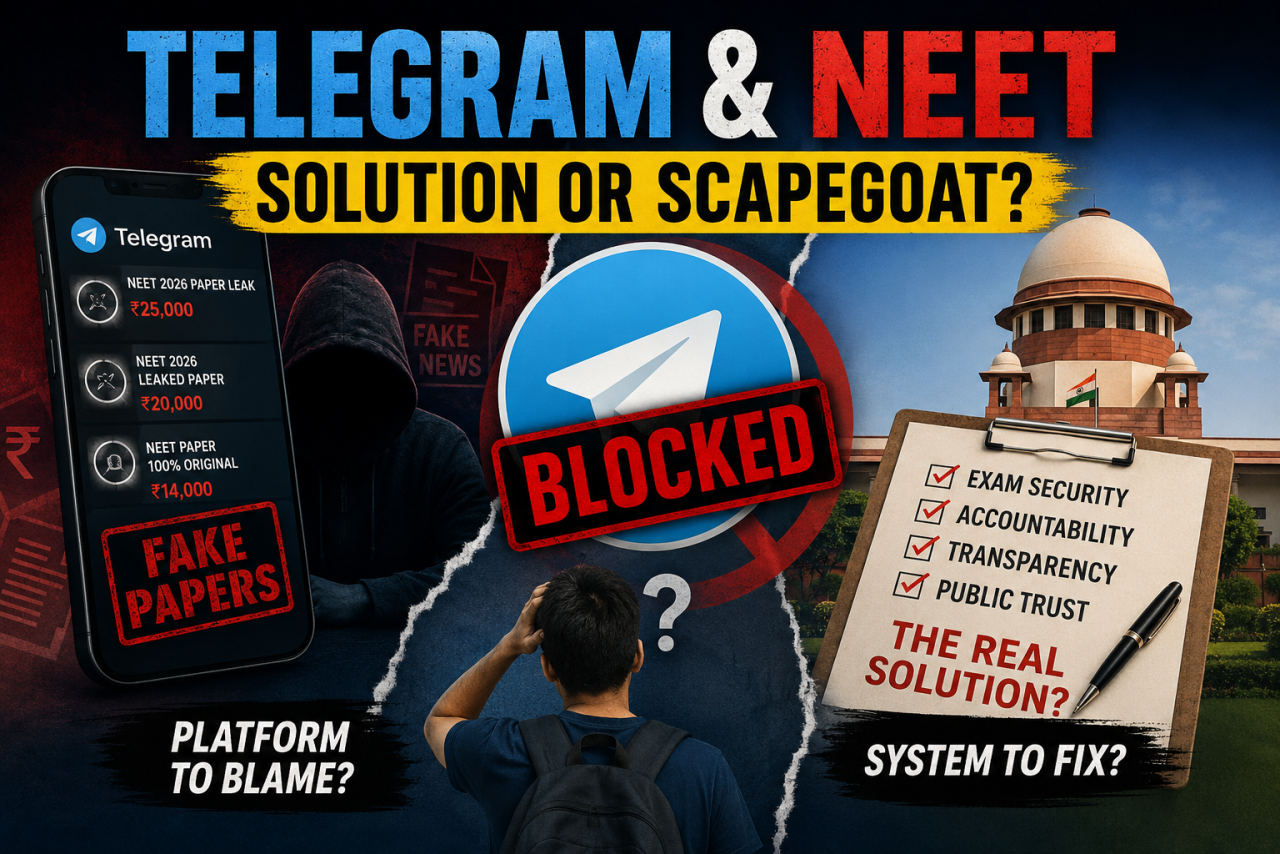
When exam scandals erupt, is banning a platform the easiest answer? The Telegram-NEET controversy raises a deeper question: are authorities solving the problem or simply finding someone to blame?
When a major national examination faces allegations of leaks, malpractice, and misinformation, governments are expected to act swiftly. In the case of NEET-UG 2026, the Centre chose an unprecedented step: temporarily blocking access to Telegram across India and disabling its message-editing feature until June 30. According to the report, the action was taken on the recommendation of the National Testing Agency (NTA), which argued that certain Telegram channels were being used to circulate fake question papers, doctored content, and misleading claims related to the examination.
The move immediately raised an important question: has Telegram become the culprit behind the NEET controversy, or is it merely a convenient target in a much larger problem?
Why Was Telegram Targeted?
The NTA's reasoning appears straightforward. Officials claimed that several Telegram channels openly advertised access to "leaked" NEET papers, charging anywhere between ₹14,000 and ₹25,000. The agency also argued that Telegram's message-editing feature allowed users to alter timestamps and modify posts after publication, creating the illusion that certain papers had been uploaded before the examination when they were actually posted later.
From the agency's perspective, this was not merely misinformation but a deliberate attempt to undermine public confidence in the examination system. The government therefore sought to restrict access to Telegram and temporarily disable features that could facilitate such activities.
At first glance, the decision seems reasonable. If criminals are exploiting a platform to spread fraud, stopping that channel could reduce harm. Yet the larger question remains: does shutting down access address the root cause of the problem?
The Real Problem Is Not Telegram
Telegram is a communication tool. Like email, WhatsApp, Facebook, X, or any other platform, it can be used for both legitimate and illegitimate purposes.
The existence of fake papers on Telegram does not automatically mean Telegram caused the problem. Fraudsters existed before Telegram and would continue to exist even if Telegram disappeared tomorrow.
Despite the removal of hundreds of channels, fraudsters continued to emerge. This observation is crucial because it demonstrates that the issue lies not with a single platform but with an ecosystem of examination scams.
If a leak genuinely occurs, the source is unlikely to be a messaging app. The source would be somewhere within the examination chain itself—printing facilities, transportation networks, storage systems, officials, coaching intermediaries, or organised criminal groups. A platform may distribute leaked material, but it does not create the leak.
Blaming the platform risks confusing distribution with origin.
The Danger of Treating Symptoms Instead of Causes
Public institutions often face pressure to show immediate action during crises. Blocking a platform is visible, dramatic, and easy to communicate. It sends a message that authorities are doing something.
However, visible action is not always effective action.
Consider a leaking water tank. Placing a bucket under the leak may reduce the mess temporarily, but it does not repair the crack. Similarly, restricting Telegram may slow the spread of fraudulent material, but it does not necessarily prevent future examination irregularities.
The deeper issues include:
- Security of examination papers.
- Accountability within the examination process.
- Monitoring organised cheating networks.
- Rapid verification mechanisms for fake claims.
- Public trust in institutions.
None of these challenges disappear simply because one platform is blocked.
Who Should Be Accountable?
Accountability should be distributed according to responsibility.
If criminals are selling fake papers, they should be prosecuted.
If social media platforms knowingly ignore illegal activity, they should cooperate with law enforcement and face regulatory scrutiny.
But examination authorities must also be accountable for ensuring that papers remain secure and that candidates have confidence in the system.
The danger arises when attention shifts entirely toward external actors while institutional shortcomings receive less scrutiny.
For many students and parents, the central concern is not whether Telegram hosted fake papers. Their concern is whether the examination process itself is trustworthy. Blocking a platform does little to answer that question.
The Cost of Platform-Wide Restrictions
Millions of ordinary users rely on Telegram for perfectly legitimate purposes.
Students use it for study groups.
Teachers use it for sharing educational material.
Journalists use it for communication.
Businesses use it for customer engagement.
Researchers and professionals use it for collaboration.
When access to an entire platform is restricted, these users also bear the consequences despite having no connection to examination fraud.
This raises an important policy question: should governments target specific offenders and channels, or should they impose broad restrictions affecting everyone?
In democratic societies, narrowly targeted enforcement is generally considered preferable because it minimises collateral damage.
A Better Approach
Instead of treating Telegram as the primary problem, authorities could focus on a broader strategy:
- Strengthening examination security.
- Tracking financial transactions linked to paper-selling scams.
- Using cybercrime units to identify organised fraud networks.
- Requiring platforms to respond rapidly to verified illegal content.
- Increasing transparency about investigations.
- Building public communication systems that quickly debunk false claims.
Such measures would address both the source and spread of misinformation without placing excessive emphasis on a single platform.
Final Take
The government's action against Telegram reflects a genuine concern about misinformation and examination fraud. Few would disagree that fake-paper rackets deserve strong action.
However, it would be simplistic to conclude that Telegram is the reason NEET controversies exist. At most, it is one channel through which fraudsters operate.
The larger challenge lies in safeguarding the integrity of India's examination system itself. If policymakers focus only on where information spreads rather than how problems originate, they risk treating symptoms while leaving underlying vulnerabilities untouched.
The NEET controversy therefore presents a broader lesson. Public trust is restored not by finding a convenient villain, but by ensuring transparent accountability across the entire examination process. Telegram may be part of the story, but it is unlikely to be the whole story.
When a major national examination faces allegations of leaks, malpractice, and misinformation, governments are expected to act swiftly. In the case of NEET-UG 2026, the Centre chose an unprecedented step: temporarily blocking access to Telegram across India and disabling its message-editing feature until June 30. According to the report, the action was taken on the recommendation of the National Testing Agency (NTA), which argued that certain Telegram channels were being used to circulate fake question papers, doctored content, and misleading claims related to the examination.
The move immediately raised an important question: has Telegram become the culprit behind the NEET controversy, or is it merely a convenient target in a much larger problem?
Why Was Telegram Targeted?
The NTA's reasoning appears straightforward. Officials claimed that several Telegram channels openly advertised access to "leaked" NEET papers, charging anywhere between ₹14,000 and ₹25,000. The agency also argued that Telegram's message-editing feature allowed users to alter timestamps and modify posts after publication, creating the illusion that certain papers had been uploaded before the examination when they were actually posted later.
From the agency's perspective, this was not merely misinformation but a deliberate attempt to undermine public confidence in the examination system. The government therefore sought to restrict access to Telegram and temporarily disable features that could facilitate such activities.
At first glance, the decision seems reasonable. If criminals are exploiting a platform to spread fraud, stopping that channel could reduce harm. Yet the larger question remains: does shutting down access address the root cause of the problem?
The Real Problem Is Not Telegram
Telegram is a communication tool. Like email, WhatsApp, Facebook, X, or any other platform, it can be used for both legitimate and illegitimate purposes.
The existence of fake papers on Telegram does not automatically mean Telegram caused the problem. Fraudsters existed before Telegram and would continue to exist even if Telegram disappeared tomorrow.
Despite the removal of hundreds of channels, fraudsters continued to emerge. This observation is crucial because it demonstrates that the issue lies not with a single platform but with an ecosystem of examination scams.
If a leak genuinely occurs, the source is unlikely to be a messaging app. The source would be somewhere within the examination chain itself—printing facilities, transportation networks, storage systems, officials, coaching intermediaries, or organised criminal groups. A platform may distribute leaked material, but it does not create the leak.
Blaming the platform risks confusing distribution with origin.
The Danger of Treating Symptoms Instead of Causes
Public institutions often face pressure to show immediate action during crises. Blocking a platform is visible, dramatic, and easy to communicate. It sends a message that authorities are doing something.
However, visible action is not always effective action.
Consider a leaking water tank. Placing a bucket under the leak may reduce the mess temporarily, but it does not repair the crack. Similarly, restricting Telegram may slow the spread of fraudulent material, but it does not necessarily prevent future examination irregularities.
The deeper issues include:
- Security of examination papers.
- Accountability within the examination process.
- Monitoring organised cheating networks.
- Rapid verification mechanisms for fake claims.
- Public trust in institutions.
None of these challenges disappear simply because one platform is blocked.
Who Should Be Accountable?
Accountability should be distributed according to responsibility.
If criminals are selling fake papers, they should be prosecuted.
If social media platforms knowingly ignore illegal activity, they should cooperate with law enforcement and face regulatory scrutiny.
But examination authorities must also be accountable for ensuring that papers remain secure and that candidates have confidence in the system.
The danger arises when attention shifts entirely toward external actors while institutional shortcomings receive less scrutiny.
For many students and parents, the central concern is not whether Telegram hosted fake papers. Their concern is whether the examination process itself is trustworthy. Blocking a platform does little to answer that question.
The Cost of Platform-Wide Restrictions
Millions of ordinary users rely on Telegram for perfectly legitimate purposes.
Students use it for study groups.
Teachers use it for sharing educational material.
Journalists use it for communication.
Businesses use it for customer engagement.
Researchers and professionals use it for collaboration.
When access to an entire platform is restricted, these users also bear the consequences despite having no connection to examination fraud.
This raises an important policy question: should governments target specific offenders and channels, or should they impose broad restrictions affecting everyone?
In democratic societies, narrowly targeted enforcement is generally considered preferable because it minimises collateral damage.
A Better Approach
Instead of treating Telegram as the primary problem, authorities could focus on a broader strategy:
- Strengthening examination security.
- Tracking financial transactions linked to paper-selling scams.
- Using cybercrime units to identify organised fraud networks.
- Requiring platforms to respond rapidly to verified illegal content.
- Increasing transparency about investigations.
- Building public communication systems that quickly debunk false claims.
Such measures would address both the source and spread of misinformation without placing excessive emphasis on a single platform.
Final Take
The government's action against Telegram reflects a genuine concern about misinformation and examination fraud. Few would disagree that fake-paper rackets deserve strong action.
However, it would be simplistic to conclude that Telegram is the reason NEET controversies exist. At most, it is one channel through which fraudsters operate.
The larger challenge lies in safeguarding the integrity of India's examination system itself. If policymakers focus only on where information spreads rather than how problems originate, they risk treating symptoms while leaving underlying vulnerabilities untouched.
The NEET controversy therefore presents a broader lesson. Public trust is restored not by finding a convenient villain, but by ensuring transparent accountability across the entire examination process. Telegram may be part of the story, but it is unlikely to be the whole story.






















Leave a Comment