
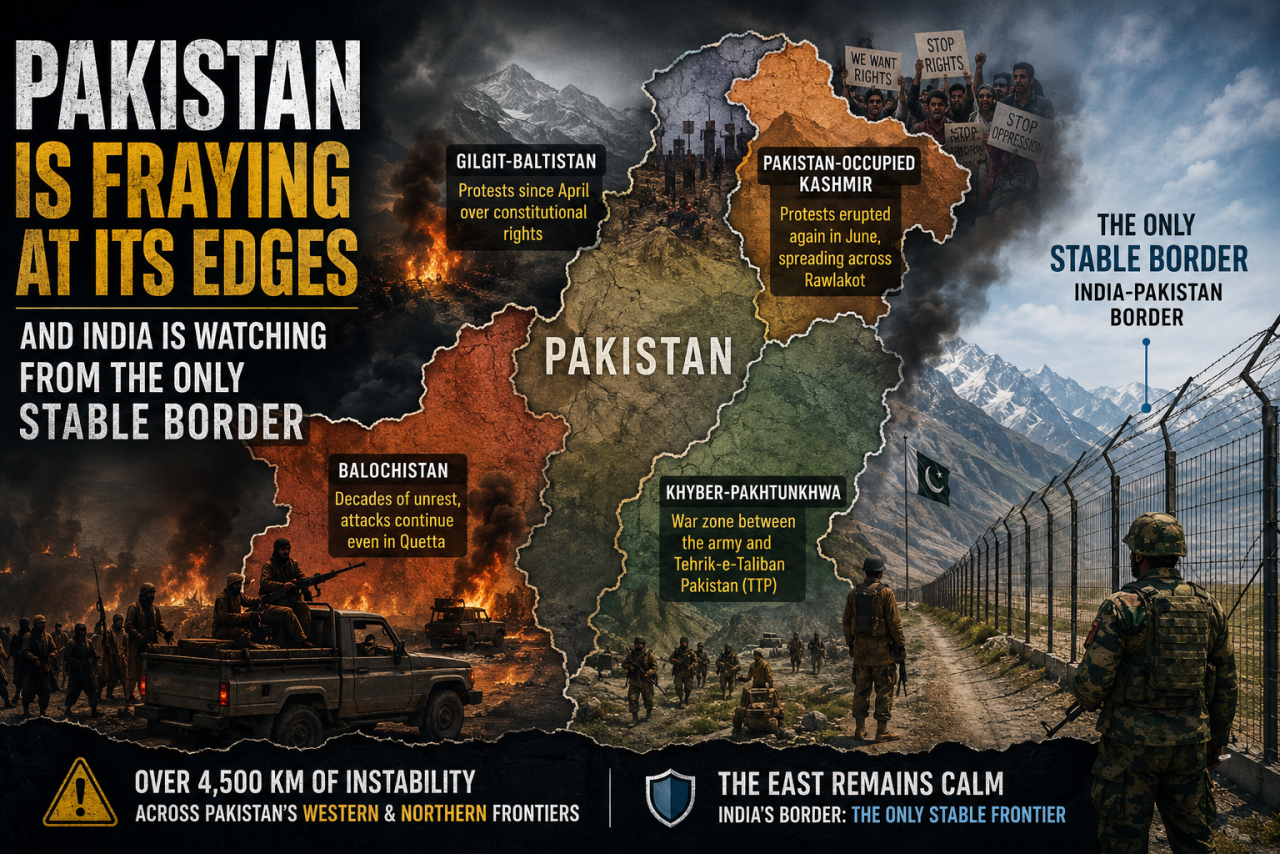
Pakistan is battling unrest across nearly every frontier. Ironically, its border with India has become its most stable one. What does this reveal about the country's future and South Asia's security landscape?
Pakistan's map may appear intact from a distance, but a closer look reveals a country under mounting internal strain. From Balochistan in the southwest to Gilgit-Baltistan in the north, and from Khyber-Pakhtunkhwa to Pakistan-occupied Kashmir (PoK), unrest has become a recurring feature of life on the country's periphery. Though each region has its own history and grievances, they share one common complaint that Islamabad has governed them as strategic territories rather than as equal stakeholders in the federation.
For India, this evolving situation deserves careful attention. While Pakistan's western and northern frontiers are witnessing growing instability, its eastern border with India remains the only major frontier that has stayed relatively stable. This contrast has important implications for how New Delhi should assess Pakistan's changing strategic landscape.
A History of Unfulfilled Promises
The protests that erupted in Pakistan-occupied Kashmir in June were not unprecedented. The Rawalakot region witnessed a similar uprising between 1950 and 1956, when local leaders attempted to establish an alternative administration before being suppressed by Pakistani forces.
More than seven decades later, the demands remain strikingly similar. Protesters continue to seek greater political representation, control over local resources, and the reopening of traditional trade routes with India. Islamabad has consistently resisted the last demand, fearing it could weaken Pakistan's official position on the Kashmir dispute, despite the significant economic benefits such connectivity could bring to local communities.
Gilgit-Baltistan reflects a similar pattern. Demonstrators have demanded a genuine constituent assembly, a larger share of electricity generated from the Diamer-Bhasha Dam, restrictions on mining leases granted to outside companies, and the reopening of the historic Kargil trade route. Pakistan's Parliament has passed resolutions promising rights comparable to those enjoyed by the country's provinces, but constitutional ambiguity surrounding the Kashmir dispute has prevented those promises from translating into meaningful reforms.
Balochistan and the Deepening Trust Deficit
Balochistan remains Pakistan's most volatile province. Despite an extensive military presence, militant attacks continue to expose weaknesses in the state's security apparatus. Even Quetta, considered one of the province's most secure cities, has witnessed repeated security incidents. In July, militants reportedly overran a police post in Zhob, killing several personnel.
Public anger has also been fuelled by allegations of enforced disappearances, extrajudicial killings, and limited political representation. Official responses have often focused on symbolic measures rather than structural reforms, leaving underlying grievances unresolved.
Meanwhile, smuggling networks involving Iranian fuel, narcotics, and other illicit trade continue to flourish across the porous border. Reports over the years have also highlighted allegations of corruption within sections of the security establishment, further eroding public confidence in state institutions.
Khyber-Pakhtunkhwa Remains a Security Challenge
Pakistan's northwestern province of Khyber-Pakhtunkhwa presents another complex challenge. The Pakistani military continues to battle the Tehrik-e-Taliban Pakistan (TTP), which remains active across the tribal belt. Pakistani authorities have also acknowledged concerns about cross-border smuggling and militant movement along the Afghanistan frontier.
The combination of insurgency, weak governance, and difficult terrain has made large parts of the region increasingly difficult to administer effectively.
Why This Matters for India
Perhaps the most significant development is not the unrest in any one region but the possibility that these separate movements are beginning to find common ground. Reports indicate that representatives from Khyber-Pakhtunkhwa attempted to participate in protests in Pakistan-occupied Kashmir, while Baloch activists have expressed solidarity with Pashtun groups despite their differing political objectives.
Together, Pakistan's frontiers with Afghanistan, Iran, and several internally contested regions account for more than 4,500 kilometres of territory facing varying degrees of instability. In contrast, the international border with India remains Pakistan's most stable frontier.
This reality offers an important perspective for Indian policymakers. For decades, discussions about Pakistan in India have understandably centred on terrorism, infiltration, and cross-border security threats. Those concerns remain valid. However, Pakistan's growing internal challenges suggest that its military establishment is increasingly occupied with managing domestic instability across multiple fronts.
A state struggling to maintain control over its own peripheries inevitably faces constraints on its strategic bandwidth. That does not eliminate security risks for India, nor does it justify complacency. Instead, it calls for a more nuanced understanding of Pakistan—one that combines traditional security assessments with close observation of the country's internal political and social fractures.
As Pakistan grapples with mounting unrest along nearly all of its frontiers, the stability of its border with India stands out as an exception. Whether that stability endures will depend not only on bilateral relations but also on how successfully Islamabad addresses the longstanding grievances that continue to reshape its own internal landscape.
Pakistan's map may appear intact from a distance, but a closer look reveals a country under mounting internal strain. From Balochistan in the southwest to Gilgit-Baltistan in the north, and from Khyber-Pakhtunkhwa to Pakistan-occupied Kashmir (PoK), unrest has become a recurring feature of life on the country's periphery. Though each region has its own history and grievances, they share one common complaint that Islamabad has governed them as strategic territories rather than as equal stakeholders in the federation.
For India, this evolving situation deserves careful attention. While Pakistan's western and northern frontiers are witnessing growing instability, its eastern border with India remains the only major frontier that has stayed relatively stable. This contrast has important implications for how New Delhi should assess Pakistan's changing strategic landscape.
A History of Unfulfilled Promises
The protests that erupted in Pakistan-occupied Kashmir in June were not unprecedented. The Rawalakot region witnessed a similar uprising between 1950 and 1956, when local leaders attempted to establish an alternative administration before being suppressed by Pakistani forces.
More than seven decades later, the demands remain strikingly similar. Protesters continue to seek greater political representation, control over local resources, and the reopening of traditional trade routes with India. Islamabad has consistently resisted the last demand, fearing it could weaken Pakistan's official position on the Kashmir dispute, despite the significant economic benefits such connectivity could bring to local communities.
Gilgit-Baltistan reflects a similar pattern. Demonstrators have demanded a genuine constituent assembly, a larger share of electricity generated from the Diamer-Bhasha Dam, restrictions on mining leases granted to outside companies, and the reopening of the historic Kargil trade route. Pakistan's Parliament has passed resolutions promising rights comparable to those enjoyed by the country's provinces, but constitutional ambiguity surrounding the Kashmir dispute has prevented those promises from translating into meaningful reforms.
Balochistan and the Deepening Trust Deficit
Balochistan remains Pakistan's most volatile province. Despite an extensive military presence, militant attacks continue to expose weaknesses in the state's security apparatus. Even Quetta, considered one of the province's most secure cities, has witnessed repeated security incidents. In July, militants reportedly overran a police post in Zhob, killing several personnel.
Public anger has also been fuelled by allegations of enforced disappearances, extrajudicial killings, and limited political representation. Official responses have often focused on symbolic measures rather than structural reforms, leaving underlying grievances unresolved.
Meanwhile, smuggling networks involving Iranian fuel, narcotics, and other illicit trade continue to flourish across the porous border. Reports over the years have also highlighted allegations of corruption within sections of the security establishment, further eroding public confidence in state institutions.
Khyber-Pakhtunkhwa Remains a Security Challenge
Pakistan's northwestern province of Khyber-Pakhtunkhwa presents another complex challenge. The Pakistani military continues to battle the Tehrik-e-Taliban Pakistan (TTP), which remains active across the tribal belt. Pakistani authorities have also acknowledged concerns about cross-border smuggling and militant movement along the Afghanistan frontier.
The combination of insurgency, weak governance, and difficult terrain has made large parts of the region increasingly difficult to administer effectively.
Why This Matters for India
Perhaps the most significant development is not the unrest in any one region but the possibility that these separate movements are beginning to find common ground. Reports indicate that representatives from Khyber-Pakhtunkhwa attempted to participate in protests in Pakistan-occupied Kashmir, while Baloch activists have expressed solidarity with Pashtun groups despite their differing political objectives.
Together, Pakistan's frontiers with Afghanistan, Iran, and several internally contested regions account for more than 4,500 kilometres of territory facing varying degrees of instability. In contrast, the international border with India remains Pakistan's most stable frontier.
This reality offers an important perspective for Indian policymakers. For decades, discussions about Pakistan in India have understandably centred on terrorism, infiltration, and cross-border security threats. Those concerns remain valid. However, Pakistan's growing internal challenges suggest that its military establishment is increasingly occupied with managing domestic instability across multiple fronts.
A state struggling to maintain control over its own peripheries inevitably faces constraints on its strategic bandwidth. That does not eliminate security risks for India, nor does it justify complacency. Instead, it calls for a more nuanced understanding of Pakistan—one that combines traditional security assessments with close observation of the country's internal political and social fractures.
As Pakistan grapples with mounting unrest along nearly all of its frontiers, the stability of its border with India stands out as an exception. Whether that stability endures will depend not only on bilateral relations but also on how successfully Islamabad addresses the longstanding grievances that continue to reshape its own internal landscape.


















Leave a Comment