
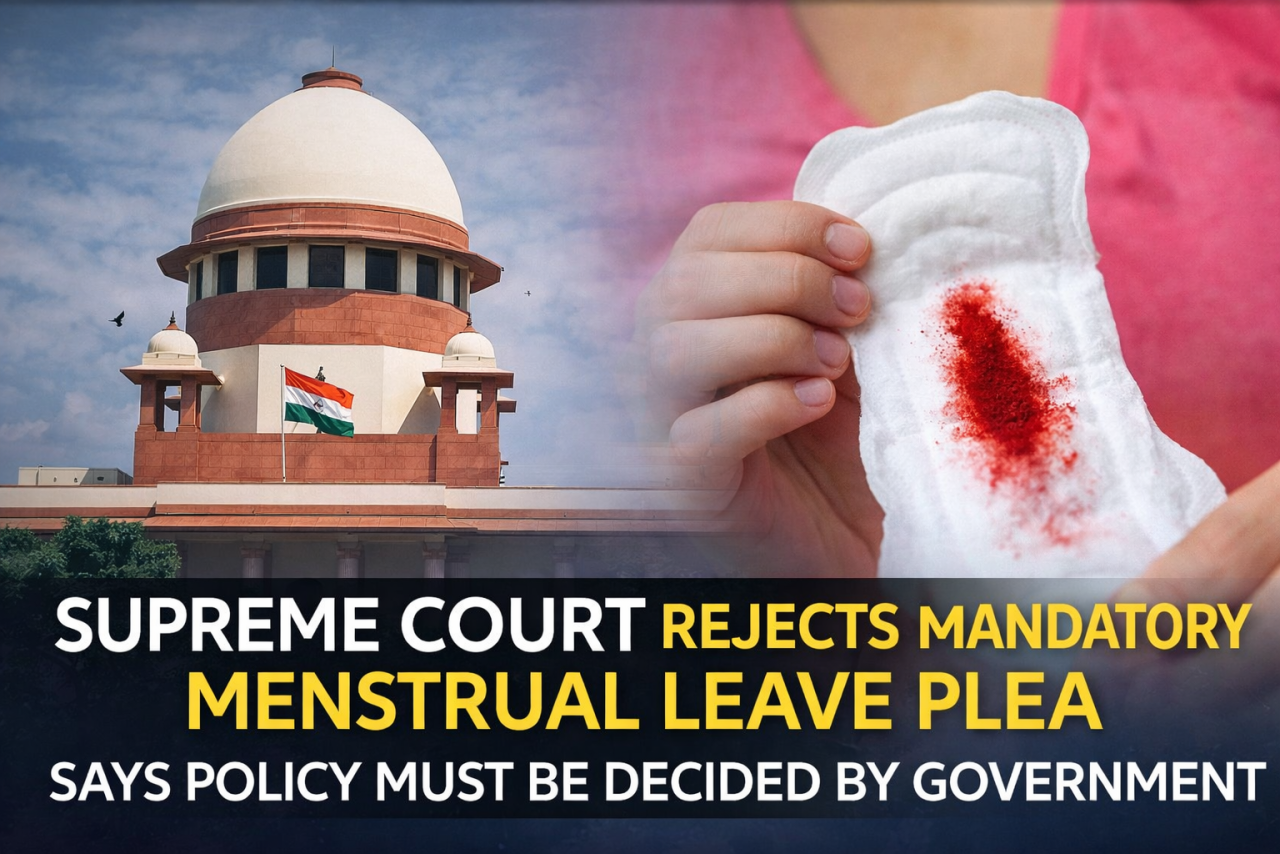
A plea seeking mandatory menstrual leave reached the Supreme Court, but the court believes such a law could have unintended consequences for women in the job market.
The Supreme Court has declined to entertain a plea seeking mandatory menstrual leave for women across workplaces, observing that imposing such a requirement through judicial intervention may not necessarily serve women’s long-term interests. Instead, the court indicated that the matter is better suited for policy deliberation by the government.
A bench headed by Chief Justice of India Surya Kant said that while the issue raises important concerns about women’s health and workplace dignity, mandating menstrual leave through a legal directive could produce unintended consequences in the job market.
The court pointed out that policies framed without considering broader workplace realities might influence hiring practices and create challenges for women seeking employment.
Court Highlights “Practical Realities”
During the hearing, the bench remarked that introducing a compulsory legal provision could shape employer perceptions in ways that might ultimately disadvantage women in recruitment decisions.
According to the court, the “mindset” that could develop around such a law might lead employers to view female employees through a different lens, particularly in competitive sectors where attendance and productivity expectations are tightly structured.
The judges emphasized that while the intention behind the proposal is rooted in welfare and gender sensitivity, the long-term implications require careful examination before a nationwide policy is imposed.
PIL Sought Uniform Policy
The observations came while the court was hearing a Public Interest Litigation (PIL) filed by advocate Shailendra Mani Tripathi, who argued that India lacks a uniform framework addressing menstrual leave.
The petitioner urged the court to direct the government to introduce a nationwide policy ensuring paid leave for women during menstruation, highlighting the physical discomfort and health concerns many women experience during that time.
Tripathi also pointed out that several institutions and organizations across the country have voluntarily introduced menstrual leave policies, suggesting that a broader national standard could bring consistency and fairness.
However, the Supreme Court declined to intervene directly, stating that policy formulation falls primarily within the domain of the executive and legislative branches.
Existing Policies in Some States
Although India does not currently have a national law guaranteeing menstrual leave, certain states and institutions have experimented with such policies.
For example, Bihar has long provided menstrual leave provisions for women in government service. Similarly, Kerala has extended menstrual leave to female students in state universities.
In addition, some private companies and educational institutions have voluntarily adopted menstrual leave policies in recent years as part of broader workplace wellness initiatives.
These examples, the court indicated, demonstrate that the issue is evolving through policy experimentation rather than judicial mandates.
Government Consultation Suggested
The Supreme Court noted that a comprehensive approach would require consultation with multiple stakeholders, including employers, labour bodies, healthcare experts, and women’s rights organizations.
Such discussions, the bench suggested, could help design a balanced policy that protects women’s health while also addressing concerns about workplace discrimination or unintended employment barriers.
The court therefore left the matter open for the Union government to examine and formulate policy options if it deems necessary.
Broader Debate Continues
The question of menstrual leave has sparked debate across India and globally. Supporters argue that recognizing menstruation through workplace policies promotes dignity, health awareness, and gender equity.
Critics, however, warn that mandatory provisions could reinforce stereotypes about women’s productivity or create hesitation among employers when hiring female workers.
The Supreme Court’s remarks reflect this delicate balance between workplace welfare and economic participation, suggesting that any solution must carefully weigh both dimensions.
Final Take
While the court’s refusal to entertain the plea means there will be no immediate nationwide mandate, the discussion around menstrual leave is unlikely to fade.
As more organizations experiment with gender-sensitive workplace policies and public awareness grows around menstrual health, the issue may increasingly find its way into legislative and policy discussions.
For now, the Supreme Court has signaled that the debate belongs in the realm of public policy rather than judicial decree — leaving lawmakers and policymakers to decide whether India should adopt a uniform menstrual leave framework in the future.




















Leave a Comment