
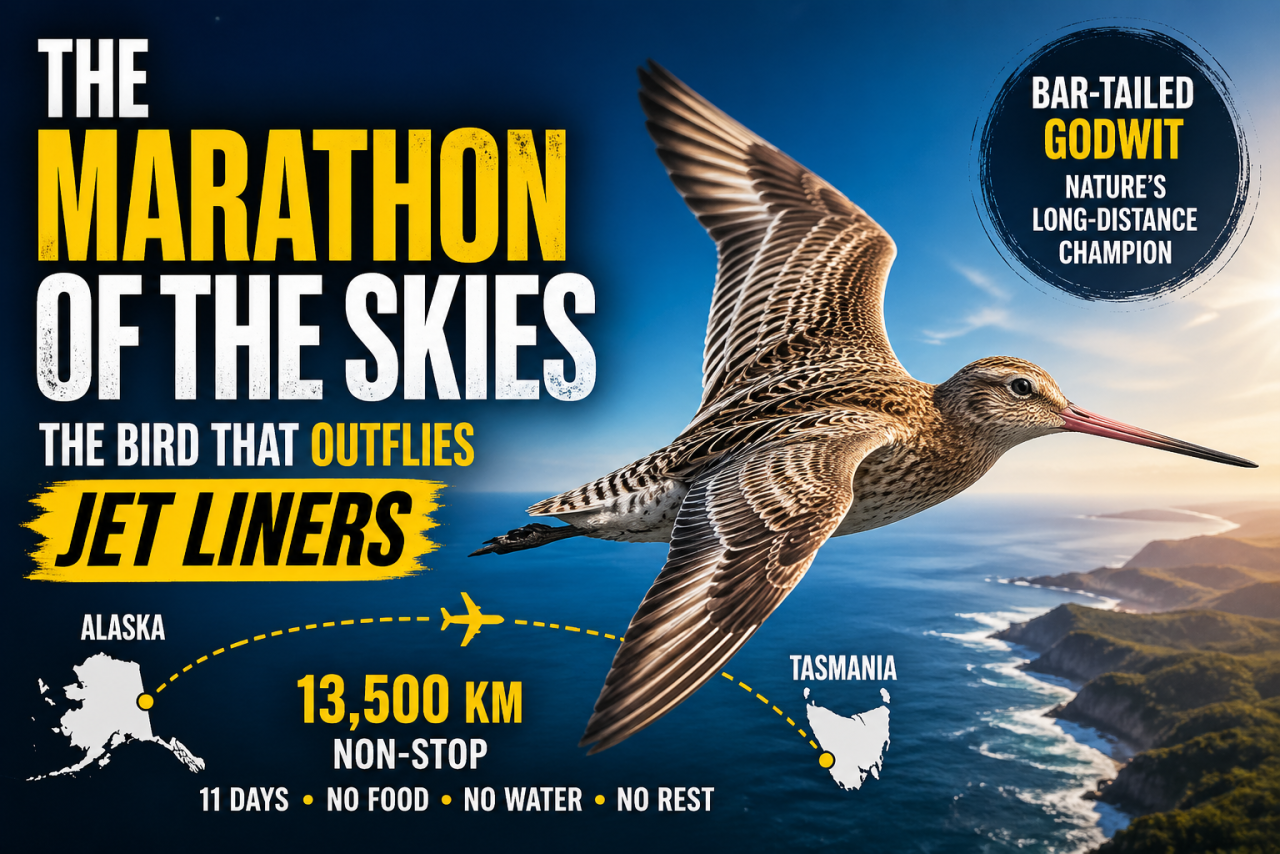
A five-month-old Bar-tailed Godwit has just flown 13,500 kilometres across the Pacific—without stopping even once.
A juvenile Bar-tailed Godwit has completed a non-stop migration of more than 13,500 km from Alaska to Tasmania, one of the longest recorded continuous flights by any bird. The journey, tracked by researchers, took about 11 days and was undertaken without feeding, drinking or landing.
The species is known for long-distance seasonal migration along the East Asian-Australasian Flyway, a corridor used by millions of shorebirds moving between Arctic breeding grounds and southern non-breeding sites. The latest tracked flight has drawn attention due to the bird’s age—around five months—and the absence of prior migration experience.
Physiological adaptation
Ahead of departure, Bar-tailed Godwits undergo rapid physiological changes. They accumulate fat reserves by feeding intensively, often doubling body weight. At the same time, non-essential organs such as parts of the digestive system temporarily reduce in size, lowering body mass and reallocating energy for sustained flight.
During migration, the birds rely entirely on stored fat as fuel. Studies indicate that metabolic efficiency and aerodynamic body structure enable continuous flight over open ocean, where landing is not possible.
Flight behaviour and endurance
Researchers have observed that long-distance migratory birds can maintain flight using energy-conserving strategies, including gliding and favorable wind patterns. Evidence also suggests the use of unihemispheric sleep—where one hemisphere of the brain rests while the other remains active—allowing birds to sustain navigation and flight over extended periods.
While the Bar-tailed Godwit holds records for non-stop distance, other species demonstrate comparable endurance in different ways. The Arctic Tern undertakes an annual pole-to-pole migration of up to 70,000 km. The Ruby-throated Hummingbird crosses the Gulf of Mexico in a single flight despite its small size. The Alpine Swift is capable of remaining airborne for months.
Navigation mechanisms
Scientists continue to study how migratory birds navigate across vast distances. Evidence points to a multi-layered system combining solar and stellar positioning with geomagnetic sensing. The ability to detect Earth’s magnetic field—known as magnetoreception—acts as an internal compass. Additional cues may include polarized light patterns and low-frequency environmental signals.
The accuracy of navigation in juvenile birds, which migrate without guidance, remains a key area of research. Tracking data suggests that first-time migrants can follow species-specific routes with high precision.
Conservation concerns
Long-distance migration depends on the availability of stopover habitats such as wetlands, estuaries and mudflats. These sites provide critical feeding grounds where birds replenish energy reserves. Habitat loss due to coastal development, pollution and climate change has reduced the number of viable stopover points along major flyways.
Conservation groups have identified several stretches of the East Asian-Australasian Flyway as under threat. Declines in shorebird populations have been linked to the degradation of intertidal zones, particularly in parts of East Asia.
Indicator of ecosystem health
Migratory shorebirds are considered indicators of ecosystem health due to their reliance on geographically dispersed habitats. Disruptions at any point along their route can affect survival and breeding success.
The recorded 13,500-km non-stop flight highlights both the biological capacity of migratory birds and the ecological dependencies that sustain them. Researchers say continued monitoring is essential to understand migration patterns and to inform conservation strategies across international boundaries.
A juvenile Bar-tailed Godwit has completed a non-stop migration of more than 13,500 km from Alaska to Tasmania, one of the longest recorded continuous flights by any bird. The journey, tracked by researchers, took about 11 days and was undertaken without feeding, drinking or landing.
The species is known for long-distance seasonal migration along the East Asian-Australasian Flyway, a corridor used by millions of shorebirds moving between Arctic breeding grounds and southern non-breeding sites. The latest tracked flight has drawn attention due to the bird’s age—around five months—and the absence of prior migration experience.
Physiological adaptation
Ahead of departure, Bar-tailed Godwits undergo rapid physiological changes. They accumulate fat reserves by feeding intensively, often doubling body weight. At the same time, non-essential organs such as parts of the digestive system temporarily reduce in size, lowering body mass and reallocating energy for sustained flight.
During migration, the birds rely entirely on stored fat as fuel. Studies indicate that metabolic efficiency and aerodynamic body structure enable continuous flight over open ocean, where landing is not possible.
Flight behaviour and endurance
Researchers have observed that long-distance migratory birds can maintain flight using energy-conserving strategies, including gliding and favorable wind patterns. Evidence also suggests the use of unihemispheric sleep—where one hemisphere of the brain rests while the other remains active—allowing birds to sustain navigation and flight over extended periods.
While the Bar-tailed Godwit holds records for non-stop distance, other species demonstrate comparable endurance in different ways. The Arctic Tern undertakes an annual pole-to-pole migration of up to 70,000 km. The Ruby-throated Hummingbird crosses the Gulf of Mexico in a single flight despite its small size. The Alpine Swift is capable of remaining airborne for months.
Navigation mechanisms
Scientists continue to study how migratory birds navigate across vast distances. Evidence points to a multi-layered system combining solar and stellar positioning with geomagnetic sensing. The ability to detect Earth’s magnetic field—known as magnetoreception—acts as an internal compass. Additional cues may include polarized light patterns and low-frequency environmental signals.
The accuracy of navigation in juvenile birds, which migrate without guidance, remains a key area of research. Tracking data suggests that first-time migrants can follow species-specific routes with high precision.
Conservation concerns
Long-distance migration depends on the availability of stopover habitats such as wetlands, estuaries and mudflats. These sites provide critical feeding grounds where birds replenish energy reserves. Habitat loss due to coastal development, pollution and climate change has reduced the number of viable stopover points along major flyways.
Conservation groups have identified several stretches of the East Asian-Australasian Flyway as under threat. Declines in shorebird populations have been linked to the degradation of intertidal zones, particularly in parts of East Asia.
Indicator of ecosystem health
Migratory shorebirds are considered indicators of ecosystem health due to their reliance on geographically dispersed habitats. Disruptions at any point along their route can affect survival and breeding success.
The recorded 13,500-km non-stop flight highlights both the biological capacity of migratory birds and the ecological dependencies that sustain them. Researchers say continued monitoring is essential to understand migration patterns and to inform conservation strategies across international boundaries.





























Leave a Comment