
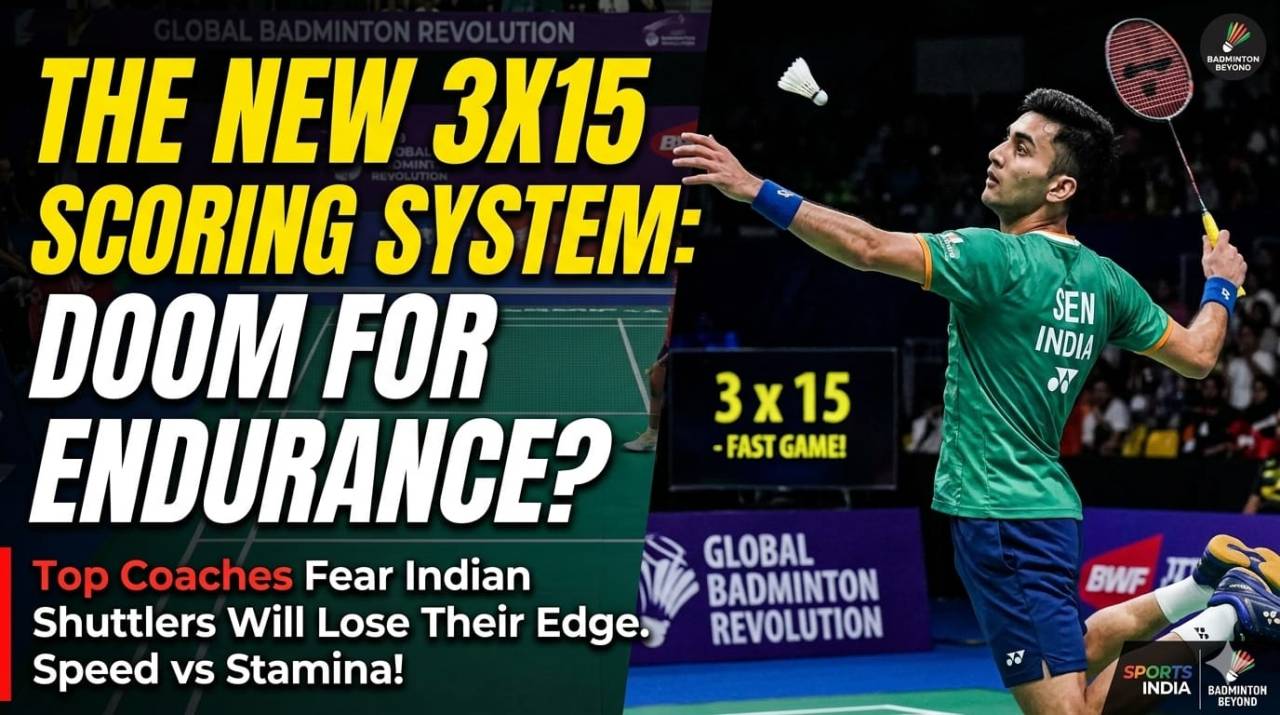
Badminton faces a defining shift. With BWF pushing a faster 3×15 format, players like Lakshya Sen may get less time to recover—and fans could lose the long, gripping rallies. Evolution, or a risk to the sport’s soul?
The world of badminton is approaching a defining moment. A sport long celebrated for its blend of endurance, precision, and tactical intelligence now finds itself in the middle of a philosophical tug-of-war. The Badminton World Federation (BWF) has proposed a shift to a 3×15 scoring system—a move it believes will modernize the game for a faster, more broadcast-friendly era.
But across India, where badminton’s rise has been built on discipline and long-form excellence, the reaction has been far from unanimous. For many players, coaches, and purists, this is not just a rule change—it is a redefinition of what badminton fundamentally stands for.
What the 3×15 Format Really Changes
Under the existing 3×21 format, badminton matches unfold like a test of endurance. Players have time to recover from slow starts, adjust strategies, and gradually wear down opponents. Momentum shifts are common, and comebacks are often what define great matches.
The proposed 3×15 system compresses that entire narrative.
With fewer points available, the margin for error shrinks dramatically. Matches are expected to become shorter, sharper, and far more unforgiving. A poor start could effectively decide the outcome before a player has the chance to settle into rhythm.
The implications are immediate:
- Faster openings become critical, with early leads carrying disproportionate weight
- Aggressive playstyles gain advantage, as players push for quick winners
- Physical strain may reduce, aligning with BWF’s argument of longer player careers
In essence, badminton risks shifting from a game of calculated construction to one of instant execution.
India’s Unease: Evolution or Dilution?
India’s badminton ecosystem—one that has produced world-class athletes through rigorous training and patience—is among the most vocal in questioning the change.
Coaches like Vimal Kumar argue that the sport’s depth lies in its ability to test not just skill, but resilience. Long rallies, strategic patience, and psychological endurance are not side elements—they are the essence.
Similarly, Anand Pawar has pointed out that endurance has historically acted as a “great equalizer.” In longer matches, tactical intelligence and stamina can neutralize raw power. Shortening the format, however, could tilt the balance toward high-risk, high-reward gameplay—where brute force and speed dominate.
The concern is subtle but significant:
If matches become too short, will there still be space for strategy to breathe?
What It Means for Players Like Lakshya Sen
Few players illustrate this dilemma better than Lakshya Sen.
Sen’s rise has been defined by his ability to endure and adapt over long matches. His marathon battles—whether against Viktor Axelsen or other top-tier opponents—have showcased not just physical stamina but mental resilience and tactical maturity.
In a 3×15 format, those extended battles may become rare.
The “endgame,” where matches are often decided through nerve and experience, will arrive much sooner. While this could make matches more immediately engaging, it risks erasing the slow-burn drama that has long been a hallmark of elite badminton.
For players like Sen, the challenge will not just be adaptation—it will be reinvention.
A Sport at a Crossroads
At its core, this debate reflects a larger question facing many global sports today:
Should tradition yield to the demands of modern consumption?
There is no denying that shorter formats can attract wider audiences, especially in an era dominated by shrinking attention spans and packed broadcast schedules. A quicker game is easier to package, promote, and consume.
Yet, the risk lies in overcorrection.
Badminton’s identity has never been about instant gratification. It is a sport where patience builds pressure, where rallies are constructed like chess moves, and where victory often belongs to the player who can endure just a little longer.
Strip that away, and the sport may gain speed—but lose substance.
Final Take
If implemented, the 3×15 system will not just change scorelines—it will reshape training philosophies, player archetypes, and even fan expectations. Academies in India and beyond may begin prioritizing explosiveness over endurance, aggression over patience.
A new generation of players could emerge—faster, sharper, and more attacking. But whether they will embody the same depth that defined their predecessors remains uncertain.
For now, badminton stands on the edge of transformation.
The question is not whether the sport will change—it already is.
The real question is whether, in becoming quicker and more modern, badminton risks leaving behind the very soul that made it compelling in the first place.
The world of badminton is approaching a defining moment. A sport long celebrated for its blend of endurance, precision, and tactical intelligence now finds itself in the middle of a philosophical tug-of-war. The Badminton World Federation (BWF) has proposed a shift to a 3×15 scoring system—a move it believes will modernize the game for a faster, more broadcast-friendly era.
But across India, where badminton’s rise has been built on discipline and long-form excellence, the reaction has been far from unanimous. For many players, coaches, and purists, this is not just a rule change—it is a redefinition of what badminton fundamentally stands for.
What the 3×15 Format Really Changes
Under the existing 3×21 format, badminton matches unfold like a test of endurance. Players have time to recover from slow starts, adjust strategies, and gradually wear down opponents. Momentum shifts are common, and comebacks are often what define great matches.
The proposed 3×15 system compresses that entire narrative.
With fewer points available, the margin for error shrinks dramatically. Matches are expected to become shorter, sharper, and far more unforgiving. A poor start could effectively decide the outcome before a player has the chance to settle into rhythm.
The implications are immediate:
- Faster openings become critical, with early leads carrying disproportionate weight
- Aggressive playstyles gain advantage, as players push for quick winners
- Physical strain may reduce, aligning with BWF’s argument of longer player careers
In essence, badminton risks shifting from a game of calculated construction to one of instant execution.
India’s Unease: Evolution or Dilution?
India’s badminton ecosystem—one that has produced world-class athletes through rigorous training and patience—is among the most vocal in questioning the change.
Coaches like Vimal Kumar argue that the sport’s depth lies in its ability to test not just skill, but resilience. Long rallies, strategic patience, and psychological endurance are not side elements—they are the essence.
Similarly, Anand Pawar has pointed out that endurance has historically acted as a “great equalizer.” In longer matches, tactical intelligence and stamina can neutralize raw power. Shortening the format, however, could tilt the balance toward high-risk, high-reward gameplay—where brute force and speed dominate.
The concern is subtle but significant:
If matches become too short, will there still be space for strategy to breathe?
What It Means for Players Like Lakshya Sen
Few players illustrate this dilemma better than Lakshya Sen.
Sen’s rise has been defined by his ability to endure and adapt over long matches. His marathon battles—whether against Viktor Axelsen or other top-tier opponents—have showcased not just physical stamina but mental resilience and tactical maturity.
In a 3×15 format, those extended battles may become rare.
The “endgame,” where matches are often decided through nerve and experience, will arrive much sooner. While this could make matches more immediately engaging, it risks erasing the slow-burn drama that has long been a hallmark of elite badminton.
For players like Sen, the challenge will not just be adaptation—it will be reinvention.
A Sport at a Crossroads
At its core, this debate reflects a larger question facing many global sports today:
Should tradition yield to the demands of modern consumption?
There is no denying that shorter formats can attract wider audiences, especially in an era dominated by shrinking attention spans and packed broadcast schedules. A quicker game is easier to package, promote, and consume.
Yet, the risk lies in overcorrection.
Badminton’s identity has never been about instant gratification. It is a sport where patience builds pressure, where rallies are constructed like chess moves, and where victory often belongs to the player who can endure just a little longer.
Strip that away, and the sport may gain speed—but lose substance.
Final Take
If implemented, the 3×15 system will not just change scorelines—it will reshape training philosophies, player archetypes, and even fan expectations. Academies in India and beyond may begin prioritizing explosiveness over endurance, aggression over patience.
A new generation of players could emerge—faster, sharper, and more attacking. But whether they will embody the same depth that defined their predecessors remains uncertain.
For now, badminton stands on the edge of transformation.
The question is not whether the sport will change—it already is.
The real question is whether, in becoming quicker and more modern, badminton risks leaving behind the very soul that made it compelling in the first place.


























Leave a Comment