
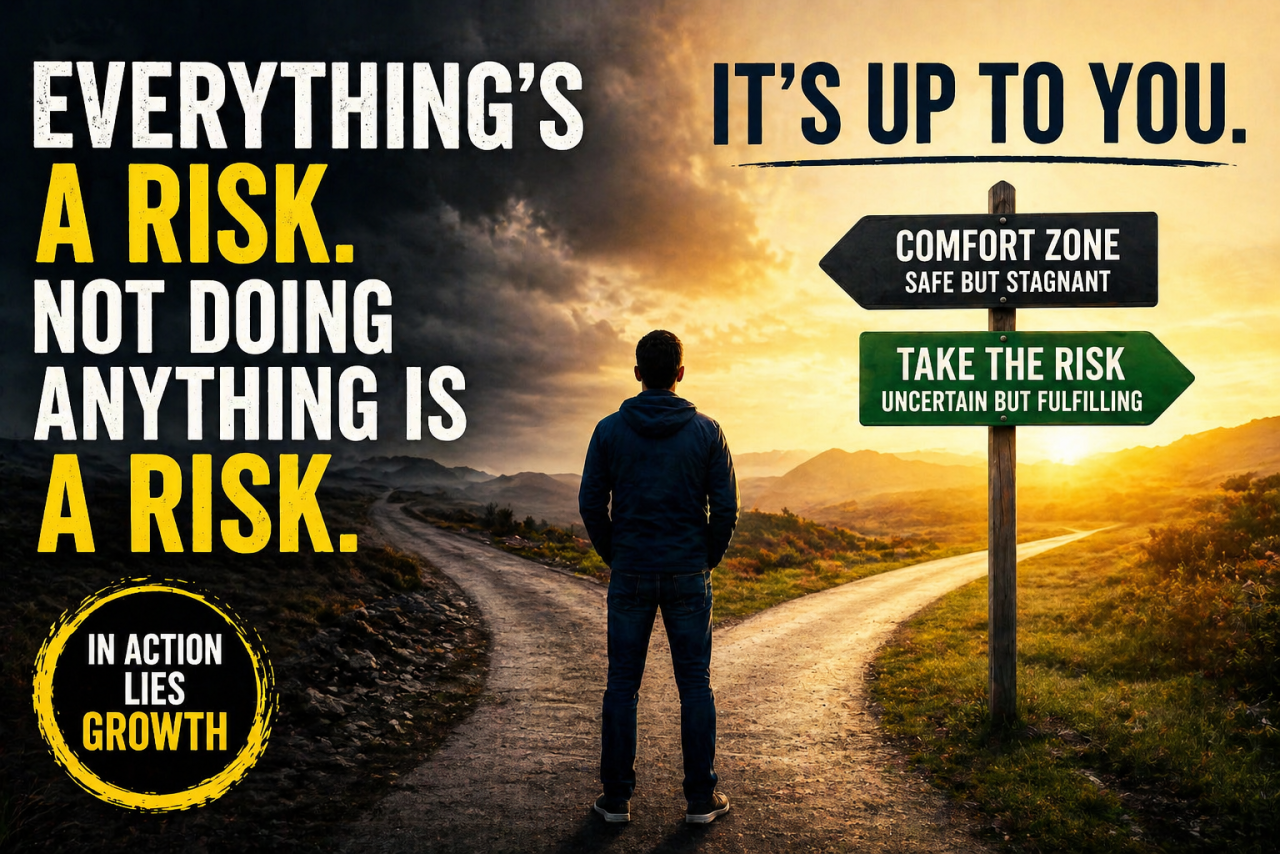
“Everything’s a risk. Not doing anything is also a risk. It’s up to you.”
At first glance, the quote feels simple—almost obvious. But look closer, and it quietly dismantles one of the most common myths we live by that staying still is safe.
It isn’t.
We often associate risk with bold moves—quitting a stable job, starting a business, speaking up when silence feels easier, or choosing a path that others don’t understand. These actions feel risky because they involve uncertainty, possible failure, and judgment. So, we hesitate. We wait. We convince ourselves that holding back is the smarter choice.
But what we fail to see is that inaction carries its own cost—one that is often invisible, slow, and deeply personal.
When you don’t act, you are still making a decision. You are choosing comfort over possibility, certainty over growth, and familiarity over change. That choice may protect you from immediate discomfort, but it also quietly closes doors you may never even realize existed.
Think about the opportunities you’ve postponed. The ideas you never pursued. The conversations you avoided. The risks you talked yourself out of. In each of those moments, doing nothing felt safe. But over time, those moments accumulate—not as failures, but as absences. And those absences shape the life you live just as much as your actions do.
The truth is, risk is unavoidable. Whether you act or not, you are exposed to uncertainty. The only difference is the kind of risk you choose.
Taking action risks failure, rejection, or loss. But inaction risks regret, stagnation, and unrealized potential. One is visible and immediate; the other is quiet and long-term. One hurts in the moment; the other lingers for years.
This is why the quote places responsibility back where it belongs: “It’s up to you.”
There is no risk-free path. No perfect timing. No guaranteed outcome. Waiting for certainty is, in itself, a form of avoidance. Life doesn’t reward those who wait endlessly for the right conditions—it responds to those who move despite uncertainty.
This doesn’t mean acting recklessly. It means understanding that calculated risks are often necessary for growth. It means acknowledging fear without allowing it to dictate your choices. It means recognizing that failure is not the opposite of success, but a part of the process that leads to it.
Every meaningful step forward carries some degree of risk. Starting something new. Changing direction. Choosing differently than before. These moments define progress, not because they guarantee success, but because they expand what is possible.
On the other hand, inaction often disguises itself as patience or practicality. “I’ll start later.” “I need more time.” “Now isn’t right.” While these reasons may sound rational, they can become a pattern—a way of delaying decisions indefinitely. And over time, delay turns into habit, and habit turns into a life that feels smaller than it could have been.
What makes this even more complex is that society often rewards stability. We are taught to minimize risk, to play it safe, to follow predictable paths. But history, innovation, and personal growth tell a different story. Progress—whether individual or collective—has always come from those willing to take risks others avoided.
The real question, then, is not whether you should take risks, but which risks you are willing to live with.
Are you more comfortable risking failure in pursuit of something meaningful? Or risking a life defined by what you never tried?
There is no universal answer. Each person must decide for themselves. But what the quote reminds us is that the decision cannot be avoided. Even choosing not to choose is, in itself, a choice—with consequences.
In the end, risk is not something to eliminate; it is something to understand and navigate. It is a constant presence, shaping every path we take—or don’t take.
So, the next time you hesitate, consider this: the cost of action may be visible, but the cost of inaction is often greater. It may not show up immediately, but it will reveal itself over time—in missed chances, in quiet regrets, in the lingering question of “what if.”
And that is a risk too.
The difference is, only one of those risks gives you a chance to change your story.
At first glance, the quote feels simple—almost obvious. But look closer, and it quietly dismantles one of the most common myths we live by that staying still is safe.
It isn’t.
We often associate risk with bold moves—quitting a stable job, starting a business, speaking up when silence feels easier, or choosing a path that others don’t understand. These actions feel risky because they involve uncertainty, possible failure, and judgment. So, we hesitate. We wait. We convince ourselves that holding back is the smarter choice.
But what we fail to see is that inaction carries its own cost—one that is often invisible, slow, and deeply personal.
When you don’t act, you are still making a decision. You are choosing comfort over possibility, certainty over growth, and familiarity over change. That choice may protect you from immediate discomfort, but it also quietly closes doors you may never even realize existed.
Think about the opportunities you’ve postponed. The ideas you never pursued. The conversations you avoided. The risks you talked yourself out of. In each of those moments, doing nothing felt safe. But over time, those moments accumulate—not as failures, but as absences. And those absences shape the life you live just as much as your actions do.
The truth is, risk is unavoidable. Whether you act or not, you are exposed to uncertainty. The only difference is the kind of risk you choose.
Taking action risks failure, rejection, or loss. But inaction risks regret, stagnation, and unrealized potential. One is visible and immediate; the other is quiet and long-term. One hurts in the moment; the other lingers for years.
This is why the quote places responsibility back where it belongs: “It’s up to you.”
There is no risk-free path. No perfect timing. No guaranteed outcome. Waiting for certainty is, in itself, a form of avoidance. Life doesn’t reward those who wait endlessly for the right conditions—it responds to those who move despite uncertainty.
This doesn’t mean acting recklessly. It means understanding that calculated risks are often necessary for growth. It means acknowledging fear without allowing it to dictate your choices. It means recognizing that failure is not the opposite of success, but a part of the process that leads to it.
Every meaningful step forward carries some degree of risk. Starting something new. Changing direction. Choosing differently than before. These moments define progress, not because they guarantee success, but because they expand what is possible.
On the other hand, inaction often disguises itself as patience or practicality. “I’ll start later.” “I need more time.” “Now isn’t right.” While these reasons may sound rational, they can become a pattern—a way of delaying decisions indefinitely. And over time, delay turns into habit, and habit turns into a life that feels smaller than it could have been.
What makes this even more complex is that society often rewards stability. We are taught to minimize risk, to play it safe, to follow predictable paths. But history, innovation, and personal growth tell a different story. Progress—whether individual or collective—has always come from those willing to take risks others avoided.
The real question, then, is not whether you should take risks, but which risks you are willing to live with.
Are you more comfortable risking failure in pursuit of something meaningful? Or risking a life defined by what you never tried?
There is no universal answer. Each person must decide for themselves. But what the quote reminds us is that the decision cannot be avoided. Even choosing not to choose is, in itself, a choice—with consequences.
In the end, risk is not something to eliminate; it is something to understand and navigate. It is a constant presence, shaping every path we take—or don’t take.
So, the next time you hesitate, consider this: the cost of action may be visible, but the cost of inaction is often greater. It may not show up immediately, but it will reveal itself over time—in missed chances, in quiet regrets, in the lingering question of “what if.”
And that is a risk too.
The difference is, only one of those risks gives you a chance to change your story.












Leave a Comment