
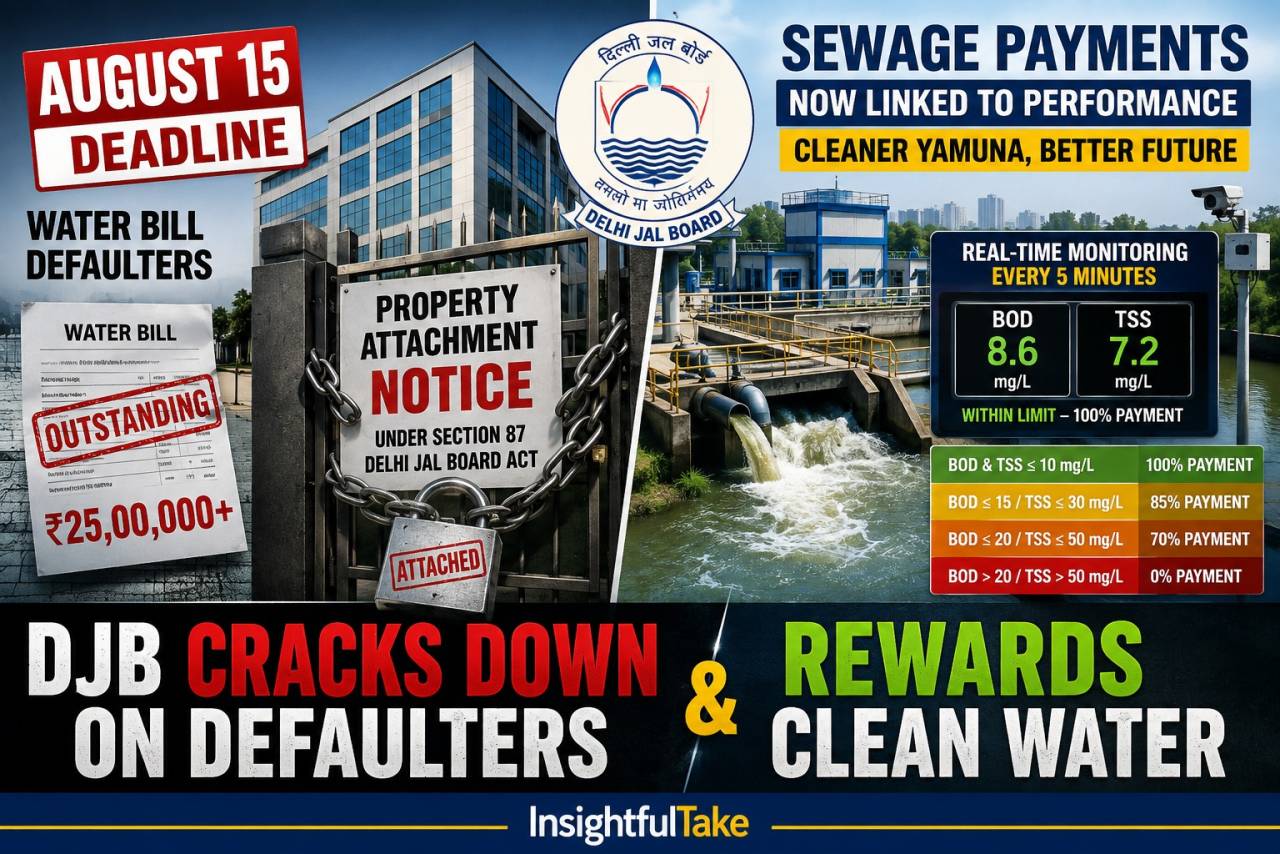
Delhi Jal Board is tightening enforcement on two fronts. Commercial defaulters could soon face property attachment, while sewage treatment contractors will now be paid only if they deliver cleaner water to the Yamuna.
The Delhi Jal Board (DJB) has unveiled a two-pronged strategy that combines financial discipline with environmental accountability. On one hand, it is preparing to initiate legal action against commercial consumers who have failed to clear large outstanding water bills. On the other, it has introduced a performance-based payment system for private operators managing sewage treatment plants to improve the quality of wastewater flowing into the Yamuna.
The twin initiatives signal a shift towards stricter governance where both consumers and contractors are expected to deliver measurable outcomes.
Commercial Defaulters Face Property Attachment After August 15
The DJB has fixed August 15, 2026, as the final deadline for consumers to benefit from its Late Payment Surcharge (LPSC) Waiver Scheme. Once the deadline expires, the utility plans to launch enforcement measures against major defaulters.
As part of the drive, legal demand notices have been issued to 1,125 commercial properties, each owing more than ₹25 lakh in unpaid water bills.
Under Section 87 of the Delhi Jal Board Act, the utility has the authority to attach and seal both movable and immovable properties if dues remain unpaid for 30 days after the demand notice is served. Delhi Water Minister Parvesh Verma has said that enforcement proceedings, including property attachment and recovery of assets, will begin once the waiver deadline ends.
LPSC Waiver Scheme at a Glance
Particulars
Details
Final deadline
August 15, 2026
Estimated recovery target
Around ₹5,000 crore
Total surcharge proposed for waiver
Around ₹11,000 crore
Eligible consumers
Around 14.6 lakh
Consumers who have availed the scheme
4,78,999
Participation rate
Approximately 32.6%
Principal amount recovered
₹641.11 crore
Late payment surcharge waived
₹1,709.72 crore
Despite offering a complete waiver of late payment surcharges on payment of the principal amount, consumer participation has remained modest. Officials say only about one-third of eligible consumers have taken advantage of the scheme since its launch in October 2025.
Sewage Contractors Will Now Be Paid Only for Performance
Alongside revenue recovery, the Delhi Jal Board has also introduced a performance-linked payment model for private agencies operating in-situ sewage treatment plants across 22 major drains flowing into the Yamuna.
Instead of receiving fixed operational payments, contractors will now be compensated according to the quality of treated wastewater discharged into the river.
Payment Linked to Water Quality
The payment structure will be based on two widely accepted pollution indicators:
- 100% payment if both Biochemical Oxygen Demand (BOD) and Total Suspended Solids (TSS) remain below 10 mg/L.
- 85% payment if BOD reaches 15 mg/L and TSS remains within 30 mg/L.
- 70% payment if BOD rises to 20 mg/L and TSS remains within 50 mg/L.
- No payment if pollution levels exceed these limits.
The objective is to ensure that contractors are rewarded only when they achieve measurable improvements in water quality.
Real-Time Monitoring to Ensure Transparency
To monitor compliance, the Delhi Jal Board has installed automated online sensors at both the inlet and outlet of sewage treatment plants. These systems will record BOD and TSS readings every five minutes and transmit the data directly to DJB servers.
The continuous monitoring system will generate daily and monthly performance reports, reducing the scope for manual intervention and making payments entirely data-driven.
Officials note that untreated sewage entering several city drains often records BOD levels between 400 mg/L and 800 mg/L, highlighting the scale of the treatment challenge.
A Shift Towards Accountability
The Delhi Jal Board's latest measures reflect a broader effort to strengthen governance through accountability. While the crackdown on commercial defaulters seeks to improve the utility's financial health, the new payment model aims to ensure that public funds are linked directly to environmental outcomes.
With the August 15 deadline approaching, commercial consumers still have an opportunity to settle outstanding dues under the waiver scheme. After that, the DJB has made it clear that legal recovery proceedings, including property attachment, will move ahead against persistent defaulters.
The Delhi Jal Board (DJB) has unveiled a two-pronged strategy that combines financial discipline with environmental accountability. On one hand, it is preparing to initiate legal action against commercial consumers who have failed to clear large outstanding water bills. On the other, it has introduced a performance-based payment system for private operators managing sewage treatment plants to improve the quality of wastewater flowing into the Yamuna.
The twin initiatives signal a shift towards stricter governance where both consumers and contractors are expected to deliver measurable outcomes.
Commercial Defaulters Face Property Attachment After August 15
The DJB has fixed August 15, 2026, as the final deadline for consumers to benefit from its Late Payment Surcharge (LPSC) Waiver Scheme. Once the deadline expires, the utility plans to launch enforcement measures against major defaulters.
As part of the drive, legal demand notices have been issued to 1,125 commercial properties, each owing more than ₹25 lakh in unpaid water bills.
Under Section 87 of the Delhi Jal Board Act, the utility has the authority to attach and seal both movable and immovable properties if dues remain unpaid for 30 days after the demand notice is served. Delhi Water Minister Parvesh Verma has said that enforcement proceedings, including property attachment and recovery of assets, will begin once the waiver deadline ends.
LPSC Waiver Scheme at a Glance
|
Particulars |
Details |
|
Final deadline |
August 15, 2026 |
|
Estimated recovery target |
Around ₹5,000 crore |
|
Total surcharge proposed for waiver |
Around ₹11,000 crore |
|
Eligible consumers |
Around 14.6 lakh |
|
Consumers who have availed the scheme |
4,78,999 |
|
Participation rate |
Approximately 32.6% |
|
Principal amount recovered |
₹641.11 crore |
|
Late payment surcharge waived |
₹1,709.72 crore |
Despite offering a complete waiver of late payment surcharges on payment of the principal amount, consumer participation has remained modest. Officials say only about one-third of eligible consumers have taken advantage of the scheme since its launch in October 2025.
Sewage Contractors Will Now Be Paid Only for Performance
Alongside revenue recovery, the Delhi Jal Board has also introduced a performance-linked payment model for private agencies operating in-situ sewage treatment plants across 22 major drains flowing into the Yamuna.
Instead of receiving fixed operational payments, contractors will now be compensated according to the quality of treated wastewater discharged into the river.
Payment Linked to Water Quality
The payment structure will be based on two widely accepted pollution indicators:
- 100% payment if both Biochemical Oxygen Demand (BOD) and Total Suspended Solids (TSS) remain below 10 mg/L.
- 85% payment if BOD reaches 15 mg/L and TSS remains within 30 mg/L.
- 70% payment if BOD rises to 20 mg/L and TSS remains within 50 mg/L.
- No payment if pollution levels exceed these limits.
The objective is to ensure that contractors are rewarded only when they achieve measurable improvements in water quality.
Real-Time Monitoring to Ensure Transparency
To monitor compliance, the Delhi Jal Board has installed automated online sensors at both the inlet and outlet of sewage treatment plants. These systems will record BOD and TSS readings every five minutes and transmit the data directly to DJB servers.
The continuous monitoring system will generate daily and monthly performance reports, reducing the scope for manual intervention and making payments entirely data-driven.
Officials note that untreated sewage entering several city drains often records BOD levels between 400 mg/L and 800 mg/L, highlighting the scale of the treatment challenge.
A Shift Towards Accountability
The Delhi Jal Board's latest measures reflect a broader effort to strengthen governance through accountability. While the crackdown on commercial defaulters seeks to improve the utility's financial health, the new payment model aims to ensure that public funds are linked directly to environmental outcomes.
With the August 15 deadline approaching, commercial consumers still have an opportunity to settle outstanding dues under the waiver scheme. After that, the DJB has made it clear that legal recovery proceedings, including property attachment, will move ahead against persistent defaulters.

























Leave a Comment