
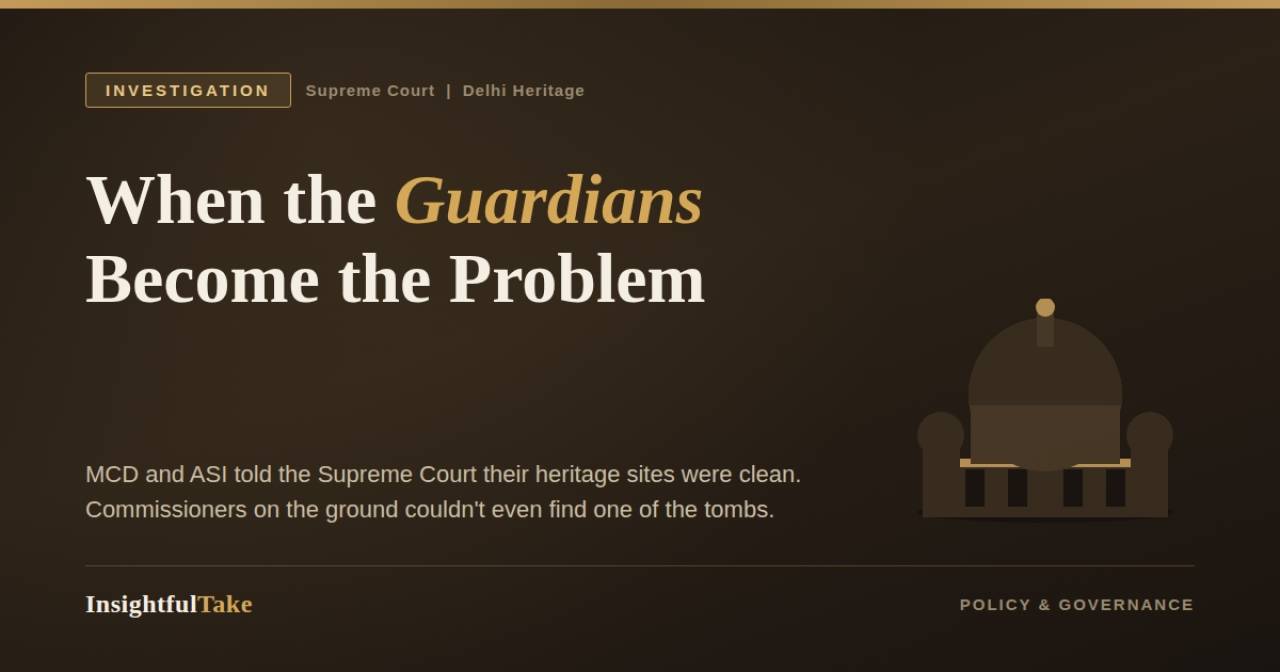
Delhi’s monuments survived empires, wars and centuries of change. Now, encroachment and administrative apathy threaten them. The Supreme Court’s latest rebuke to MCD and ASI exposes a system where paperwork can look better than reality.
The Supreme Court’s latest rebuke to the Municipal Corporation of Delhi (MCD) and the Archaeological Survey of India (ASI) is not just another hearing in a long-running heritage case. It offers a revealing snapshot of how Delhi’s monument-protection machinery can survive scrutiny without necessarily protecting the monuments it was created to preserve.
The case, arising from a petition filed by Delhi resident Rajeev Suri, has been monitored by the Supreme Court for years. During the latest hearing, a bench of Justices Ahsanuddin Amanullah and N Kotiswar Singh confronted the MCD with a striking contradiction.
In April, the civic body told the court in a status report that a survey of five Grade-I tombs in Zamrudpur had found four either encroached upon or littered, while one was in satisfactory condition.
But when court-appointed commissioners, senior advocate Gopal Sankaranarayanan along with advocates Nipun Saxena and Vishal Sinha, visited the area, they could not even locate one of the five monuments.
The bench took a serious view of the discrepancy, accusing the MCD of suppressing facts and summoning the MCD’s additional commissioner and the ASI Director General to personally explain the situation.
When paperwork and reality tell different stories
The Zamrudpur episode does not appear to be an isolated administrative lapse.
The court was also informed that two other Lodhi-era monuments, the tomb of Khan-i-Jahan Tilangani and Atgah Khan’s tomb along with Lal Chaubara and Gogabai’s Tomb, are completely encroached upon and being used as residential spaces.
One falls under the ASI’s watch, while the other comes under the MCD.
That raises a basic question. If people are visibly living inside a protected or heritage structure, how can official records show no encroachment?
The question exposes a deeper weakness in Delhi’s heritage-protection system. Agencies can produce reports, surveys and compliance documents, but there appears to be little mechanism to ensure that those records are consistently reconciled with what actually exists on the ground.
The loophole is procedural, not merely administrative
Delhi’s heritage is divided among multiple custodians, including the MCD, ASI and, in some cases, state tourism agencies. Each institution has its own responsibilities and reporting mechanisms.
The result can be a fragmented system in which compliance becomes more important than coordination.
The larger proceedings in this case have previously highlighted similar concerns. Monuments such as the Tughlaq-era Begumpuri Masjid and the Firoz Shah Kotla complex have reportedly seen showcause notices issued against encroachers over the years without corresponding enforcement.
A showcause notice is supposed to be the beginning of action. But when notices are repeatedly issued without meaningful follow-up, they risk becoming something else entirely, a piece of paperwork that demonstrates that an agency acted without actually changing the situation.
Issuing a notice is easier than removing an encroachment. It is less politically difficult, less administratively complicated and far less disruptive.
But heritage does not survive on notices.
Shaikh Ali Gumti and the price of institutional retreat
The episode involving Shaikh Ali Gumti offers an even more troubling example.
The Centre and the ASI had moved to declare the Lodhi-era structure a protected monument. That decision was later reversed after opposition from a resident welfare association.
The association had reportedly occupied the tomb since the 1960s and made alterations to the structure.
The Supreme Court considered the reversal serious enough to order a CBI inquiry into why the ASI had backed away from protecting the heritage structure.
The significance goes beyond one monument.
If a heritage designation can be challenged and ultimately withdrawn in the face of organised opposition, it raises uncomfortable questions about how much institutional authority heritage agencies actually exercise when conservation comes into conflict with existing occupants.
A monument may survive centuries of political upheaval, but its protection can still become vulnerable to contemporary administrative hesitation.
Compliance theatre over conservation
What connects Zamrudpur, Atgah Khan’s tomb and Shaikh Ali Gumti is not merely encroachment. It is a larger governance problem.
Heritage protection risks becoming a box-ticking exercise in which agencies respond to judicial scrutiny by producing reports rather than solving problems.
A survey is conducted. A notice is issued. A status report is filed. Another hearing follows.
Yet the monument remains encroached upon, altered, neglected or difficult to locate.
That is not conservation. It is compliance theatre.
The Supreme Court has previously questioned the practice of mobilising cleaning and maintenance efforts around the visits of dignitaries rather than maintaining monuments consistently. Such episodes reveal how heritage management can become reactive instead of institutional.
The purpose of judicial monitoring is not to create another layer of paperwork. It is to ensure that agencies entrusted with public assets actually perform the duties assigned to them.
Eight monuments and a familiar promise
The MCD has now told the court that it will begin restoration of eight Grade-I structures, including four Zamrudpur tombs, in consultation with conservation experts.
That is a welcome step.
But the timing matters.
The commitment has come after sustained judicial pressure rather than as evidence of a system that identified the problem, acted on it and reported the outcome independently.
That distinction is crucial.
Delhi’s monuments are not merely old buildings. They are physical records of the city’s political, architectural and cultural history. Once an original structure is altered, occupied, damaged or lost, no status report can restore what has disappeared.
The real test, therefore, is not how many reports the MCD or ASI can file. It is whether those reports match reality on the ground.
Until officials and agencies face meaningful consequences when compliance reports fail that basic test, Delhi’s heritage will remain caught in a peculiar bureaucratic paradox.
The monuments were built to outlast empires. The paperwork designed to protect them may outlast the monuments themselves.
The Supreme Court’s latest rebuke to the Municipal Corporation of Delhi (MCD) and the Archaeological Survey of India (ASI) is not just another hearing in a long-running heritage case. It offers a revealing snapshot of how Delhi’s monument-protection machinery can survive scrutiny without necessarily protecting the monuments it was created to preserve.
The case, arising from a petition filed by Delhi resident Rajeev Suri, has been monitored by the Supreme Court for years. During the latest hearing, a bench of Justices Ahsanuddin Amanullah and N Kotiswar Singh confronted the MCD with a striking contradiction.
In April, the civic body told the court in a status report that a survey of five Grade-I tombs in Zamrudpur had found four either encroached upon or littered, while one was in satisfactory condition.
But when court-appointed commissioners, senior advocate Gopal Sankaranarayanan along with advocates Nipun Saxena and Vishal Sinha, visited the area, they could not even locate one of the five monuments.
The bench took a serious view of the discrepancy, accusing the MCD of suppressing facts and summoning the MCD’s additional commissioner and the ASI Director General to personally explain the situation.
When paperwork and reality tell different stories
The Zamrudpur episode does not appear to be an isolated administrative lapse.
The court was also informed that two other Lodhi-era monuments, the tomb of Khan-i-Jahan Tilangani and Atgah Khan’s tomb along with Lal Chaubara and Gogabai’s Tomb, are completely encroached upon and being used as residential spaces.
One falls under the ASI’s watch, while the other comes under the MCD.
That raises a basic question. If people are visibly living inside a protected or heritage structure, how can official records show no encroachment?
The question exposes a deeper weakness in Delhi’s heritage-protection system. Agencies can produce reports, surveys and compliance documents, but there appears to be little mechanism to ensure that those records are consistently reconciled with what actually exists on the ground.
The loophole is procedural, not merely administrative
Delhi’s heritage is divided among multiple custodians, including the MCD, ASI and, in some cases, state tourism agencies. Each institution has its own responsibilities and reporting mechanisms.
The result can be a fragmented system in which compliance becomes more important than coordination.
The larger proceedings in this case have previously highlighted similar concerns. Monuments such as the Tughlaq-era Begumpuri Masjid and the Firoz Shah Kotla complex have reportedly seen showcause notices issued against encroachers over the years without corresponding enforcement.
A showcause notice is supposed to be the beginning of action. But when notices are repeatedly issued without meaningful follow-up, they risk becoming something else entirely, a piece of paperwork that demonstrates that an agency acted without actually changing the situation.
Issuing a notice is easier than removing an encroachment. It is less politically difficult, less administratively complicated and far less disruptive.
But heritage does not survive on notices.
Shaikh Ali Gumti and the price of institutional retreat
The episode involving Shaikh Ali Gumti offers an even more troubling example.
The Centre and the ASI had moved to declare the Lodhi-era structure a protected monument. That decision was later reversed after opposition from a resident welfare association.
The association had reportedly occupied the tomb since the 1960s and made alterations to the structure.
The Supreme Court considered the reversal serious enough to order a CBI inquiry into why the ASI had backed away from protecting the heritage structure.
The significance goes beyond one monument.
If a heritage designation can be challenged and ultimately withdrawn in the face of organised opposition, it raises uncomfortable questions about how much institutional authority heritage agencies actually exercise when conservation comes into conflict with existing occupants.
A monument may survive centuries of political upheaval, but its protection can still become vulnerable to contemporary administrative hesitation.
Compliance theatre over conservation
What connects Zamrudpur, Atgah Khan’s tomb and Shaikh Ali Gumti is not merely encroachment. It is a larger governance problem.
Heritage protection risks becoming a box-ticking exercise in which agencies respond to judicial scrutiny by producing reports rather than solving problems.
A survey is conducted. A notice is issued. A status report is filed. Another hearing follows.
Yet the monument remains encroached upon, altered, neglected or difficult to locate.
That is not conservation. It is compliance theatre.
The Supreme Court has previously questioned the practice of mobilising cleaning and maintenance efforts around the visits of dignitaries rather than maintaining monuments consistently. Such episodes reveal how heritage management can become reactive instead of institutional.
The purpose of judicial monitoring is not to create another layer of paperwork. It is to ensure that agencies entrusted with public assets actually perform the duties assigned to them.
Eight monuments and a familiar promise
The MCD has now told the court that it will begin restoration of eight Grade-I structures, including four Zamrudpur tombs, in consultation with conservation experts.
That is a welcome step.
But the timing matters.
The commitment has come after sustained judicial pressure rather than as evidence of a system that identified the problem, acted on it and reported the outcome independently.
That distinction is crucial.
Delhi’s monuments are not merely old buildings. They are physical records of the city’s political, architectural and cultural history. Once an original structure is altered, occupied, damaged or lost, no status report can restore what has disappeared.
The real test, therefore, is not how many reports the MCD or ASI can file. It is whether those reports match reality on the ground.
Until officials and agencies face meaningful consequences when compliance reports fail that basic test, Delhi’s heritage will remain caught in a peculiar bureaucratic paradox.
The monuments were built to outlast empires. The paperwork designed to protect them may outlast the monuments themselves.


























Leave a Comment