
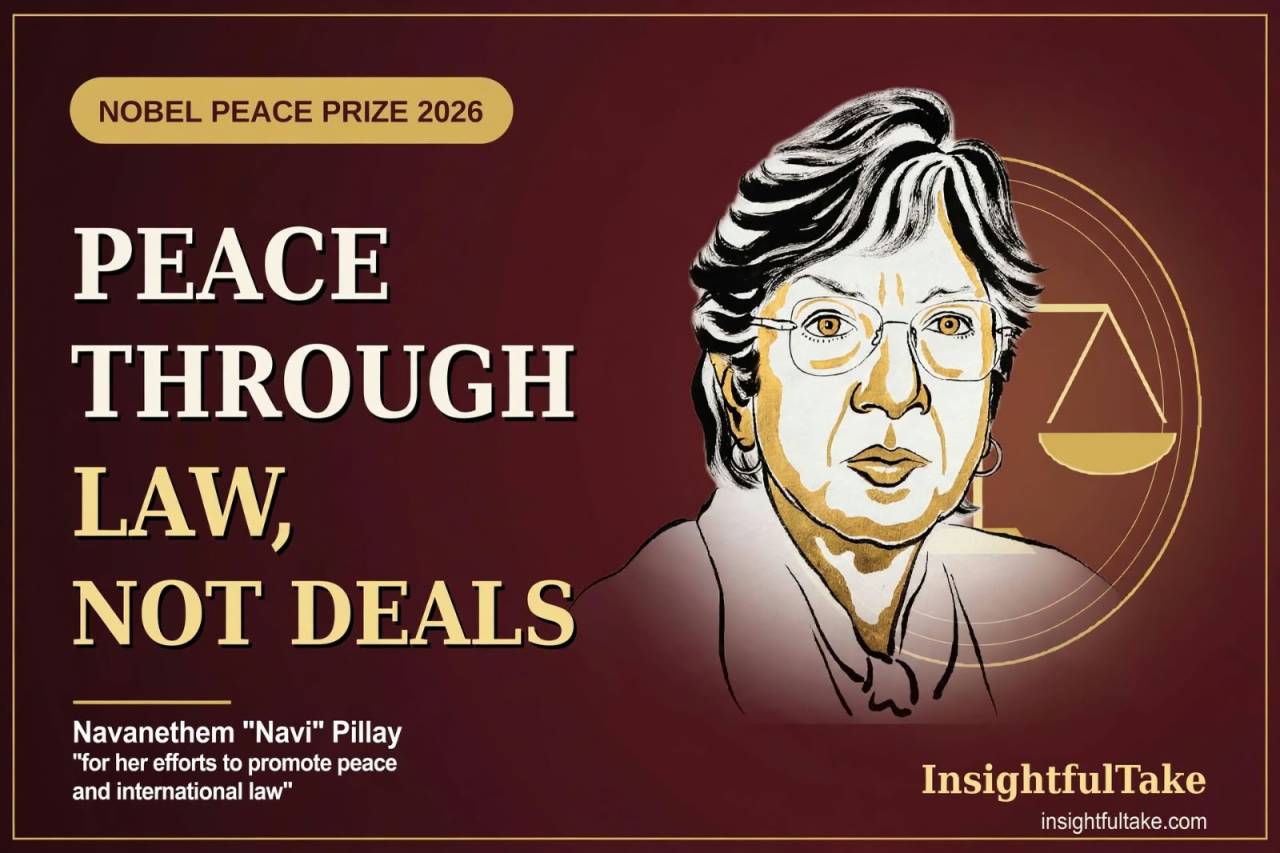
Navi Pillay's Nobel Peace Prize puts international law and accountability in the spotlight, raising questions about Trump's vision of peace and the role of global institutions.
The Nobel Peace Prize is not just an award for an individual. It also reflects the values the world chooses to recognise. This year, the Norwegian Nobel Committee has honoured Navanethem “Navi” Pillay, a South African jurist of Indian Tamil origin, for her efforts to promote peace and international law.
The decision comes at a time when international institutions are facing growing political pressure and the use of military and economic power is reshaping global relations. It also invites comparisons with US President Donald Trump, who has repeatedly claimed that he deserves the Nobel Peace Prize.
The committee has not described its decision as a message to Trump. But its emphasis on international law raises a question that goes beyond one president: can lasting peace be built through political deals alone, or does it also require laws that apply to the powerful?
Who Is Navi Pillay?
Born in Durban, South Africa, Navi Pillay grew up under apartheid, a system that enforced racial segregation and denied basic rights to the country's non-white population.
In 1967, she became the first woman to establish a law practice in Natal and the first non-white woman to serve on South Africa's High Court. As a lawyer, she defended anti-apartheid activists, including Nelson Mandela and others who challenged racial discrimination.
Her career later took her into international justice. Pillay served as a judge at the International Criminal Tribunal for Rwanda, where her work helped establish that rape could constitute an act of genocide under international law. She subsequently served as a judge at the International Criminal Court.
From 2008 to 2014, she was the United Nations High Commissioner for Human Rights. She has also played a prominent role in international investigations into alleged human rights violations and mass atrocities.
Her career has centred on a principle that remains fundamental to international justice: governments and political leaders must be accountable for their actions, regardless of their power.
The Trump Factor
Donald Trump has made no secret of his desire to win the Nobel Peace Prize. He has repeatedly argued that his diplomatic initiatives and efforts to end conflicts deserve recognition.
His supporters cite the Abraham Accords, which established diplomatic relations between Israel and several Arab states, as an important achievement of his first administration. Trump has also claimed credit for helping to ease tensions and secure agreements in other conflicts. Pakistan's government nominated him for the 2026 prize.
However, his record remains contested. Critics question whether some of the agreements he has claimed as achievements have produced lasting peace. India, for example, has rejected Trump's claims of mediating between India and Pakistan, maintaining that issues between the two countries must be resolved bilaterally.
Trump's relationship with international legal institutions has also been contentious. His administration has imposed sanctions on officials of the International Criminal Court and challenged the authority of several multilateral institutions.
Pillay's Nobel recognition therefore comes against a background of disagreement over the role of international law and the institutions established to uphold it.
Why the Choice Could Sting Trump
There is no need to assume that the Nobel Committee selected Pillay specifically to insult Trump. Its stated reason for the award is her work promoting peace and international law. Nevertheless, the contrast between her career and Trump's approach to international affairs is difficult to ignore.
1. Law versus dealmaking
Trump's case for the Nobel Peace Prize has largely rested on negotiations, ceasefires, diplomatic agreements and his claims of having prevented or ended conflicts.
Pillay's career represents a different approach. Her work has focused on courts, legal accountability and the principle that international rules should apply to all states and individuals.
The two approaches are not necessarily incompatible. Diplomacy can stop fighting, while legal institutions can help prevent future violence and hold perpetrators accountable. But an agreement between political leaders does not automatically resolve the underlying causes of a conflict.
The emphasis on international law suggests that peace should be judged not only by the agreements leaders announce, but also by whether those agreements produce justice, stability and respect for human rights.
2. International institutions under pressure
Pillay has spent decades working within international judicial and human rights institutions. Trump, by contrast, has repeatedly questioned or challenged the authority of several such bodies.
The International Criminal Court has been a particular point of conflict. The Trump administration has imposed sanctions on ICC officials, while Trump has called on countries to withdraw from the court.
By honouring Pillay, the Nobel Committee has highlighted the importance of international legal institutions at a time when their authority is under pressure.
This does not mean that every decision made by an international court or organisation is beyond criticism. These institutions must also be scrutinised. The central issue is whether disagreements should be resolved through established legal processes or through the unilateral exercise of power.
3. A jurist rather than a political leader
Pillay is not a president, party leader or elected politician. Her recognition rests on a career devoted to law, human rights and accountability.
It makes the award significant in a political climate where international recognition is often linked to the power and influence of national leaders.
Her career also demonstrates that the work of peacebuilding extends beyond summit meetings and diplomatic announcements. Judges, lawyers, investigators and human rights advocates can help create the conditions in which violence becomes harder to justify and victims have a chance to seek justice.
4. Another year of waiting for Trump
Trump's repeated claims that he deserves the Nobel Peace Prize have turned the award into a recurring subject of political debate.
His supporters argue that his diplomatic initiatives merit recognition. His critics point to continuing conflicts, controversial foreign policy decisions and his administration's confrontation with international institutions.
Pillay's selection will renew that debate. But the absence of a Nobel Prize does not, by itself, settle the question of Trump's diplomatic record. That requires a closer examination of individual agreements, their consequences and whether they have delivered lasting peace.
The Other Side of the Debate
A fair assessment must consider the arguments made by Trump's supporters.
They contend that diplomacy should be judged by its results, not simply by the institutions or methods used to achieve them. Bringing opposing sides to the negotiating table, securing a ceasefire or establishing diplomatic relations can be meaningful achievements, even when the outcomes remain imperfect.
Critics respond that a signed agreement is not necessarily a lasting settlement. Some deals leave major disputes unresolved, fail to protect vulnerable populations or collapse when political circumstances change.
There is also a legitimate debate about the role and effectiveness of international institutions. Courts and multilateral bodies can make mistakes, and their decisions may face questions about jurisdiction, consistency or impartiality. Their authority should not exempt them from scrutiny.
Yet criticism of these institutions is different from rejecting the principle that states and leaders should be accountable under international law.
The Nobel Committee's decision brings this distinction into focus. It places the importance of legal frameworks and accountability at the centre of the global peace debate.
What It Means for India
For Indian readers, Pillay's background gives the announcement an additional dimension.
She is South African, not an Indian citizen, but her family has Indian Tamil roots. Her achievement is likely to resonate with people in Tamil Nadu and across the Indian diaspora.
Her story also reflects the wider contribution of people of Indian origin to international public life. Their achievements extend across law, science, literature, politics and human rights.
At the same time, Pillay's recognition deserves to be understood on the strength of her own work. Her Indian ancestry is part of her personal history, but her contribution to international justice is what the Nobel Committee has recognised.
For India, the award also raises a broader question about the place of international law in a world increasingly shaped by strategic competition. As a major power with growing global ambitions, India has an interest in a system where disputes can be managed through rules and institutions rather than force alone.
That principle becomes particularly important for countries that seek to protect their sovereignty while participating in a wider international order.
Final Take
The Nobel Peace Prize is not an award reserved for the most powerful person in the room. Its recipients have included diplomats, activists, political leaders and people who have worked to build institutions capable of preventing violence and protecting human dignity.
Diplomacy can bring enemies to the negotiating table. But lasting peace also requires accountability, respect for human rights and rules that powerful states cannot simply ignore when those rules become inconvenient.
Navi Pillay's career embodies that idea. From challenging apartheid in South Africa to serving in international courts and leading the UN human rights office, she has worked to strengthen the principle that justice should not depend on the identity or influence of the accused.
The Nobel Committee's choice does not automatically settle the debate over Trump's foreign policy, nor does it mean that diplomacy and international law must compete with each other. Both have a role in preventing conflict.
But the award offers a clear reminder of what political dealmaking alone cannot guarantee. A ceasefire may stop the guns temporarily. A credible system of law can help ensure that violence does not become an acceptable instrument of power.
Whether Trump sees the decision as an insult is a separate question. The larger message is about the kind of international order the world wants to build.
The Nobel Peace Prize is not just an award for an individual. It also reflects the values the world chooses to recognise. This year, the Norwegian Nobel Committee has honoured Navanethem “Navi” Pillay, a South African jurist of Indian Tamil origin, for her efforts to promote peace and international law.
The decision comes at a time when international institutions are facing growing political pressure and the use of military and economic power is reshaping global relations. It also invites comparisons with US President Donald Trump, who has repeatedly claimed that he deserves the Nobel Peace Prize.
The committee has not described its decision as a message to Trump. But its emphasis on international law raises a question that goes beyond one president: can lasting peace be built through political deals alone, or does it also require laws that apply to the powerful?
Who Is Navi Pillay?
Born in Durban, South Africa, Navi Pillay grew up under apartheid, a system that enforced racial segregation and denied basic rights to the country's non-white population.
In 1967, she became the first woman to establish a law practice in Natal and the first non-white woman to serve on South Africa's High Court. As a lawyer, she defended anti-apartheid activists, including Nelson Mandela and others who challenged racial discrimination.
Her career later took her into international justice. Pillay served as a judge at the International Criminal Tribunal for Rwanda, where her work helped establish that rape could constitute an act of genocide under international law. She subsequently served as a judge at the International Criminal Court.
From 2008 to 2014, she was the United Nations High Commissioner for Human Rights. She has also played a prominent role in international investigations into alleged human rights violations and mass atrocities.
Her career has centred on a principle that remains fundamental to international justice: governments and political leaders must be accountable for their actions, regardless of their power.
The Trump Factor
Donald Trump has made no secret of his desire to win the Nobel Peace Prize. He has repeatedly argued that his diplomatic initiatives and efforts to end conflicts deserve recognition.
His supporters cite the Abraham Accords, which established diplomatic relations between Israel and several Arab states, as an important achievement of his first administration. Trump has also claimed credit for helping to ease tensions and secure agreements in other conflicts. Pakistan's government nominated him for the 2026 prize.
However, his record remains contested. Critics question whether some of the agreements he has claimed as achievements have produced lasting peace. India, for example, has rejected Trump's claims of mediating between India and Pakistan, maintaining that issues between the two countries must be resolved bilaterally.
Trump's relationship with international legal institutions has also been contentious. His administration has imposed sanctions on officials of the International Criminal Court and challenged the authority of several multilateral institutions.
Pillay's Nobel recognition therefore comes against a background of disagreement over the role of international law and the institutions established to uphold it.
Why the Choice Could Sting Trump
There is no need to assume that the Nobel Committee selected Pillay specifically to insult Trump. Its stated reason for the award is her work promoting peace and international law. Nevertheless, the contrast between her career and Trump's approach to international affairs is difficult to ignore.
1. Law versus dealmaking
Trump's case for the Nobel Peace Prize has largely rested on negotiations, ceasefires, diplomatic agreements and his claims of having prevented or ended conflicts.
Pillay's career represents a different approach. Her work has focused on courts, legal accountability and the principle that international rules should apply to all states and individuals.
The two approaches are not necessarily incompatible. Diplomacy can stop fighting, while legal institutions can help prevent future violence and hold perpetrators accountable. But an agreement between political leaders does not automatically resolve the underlying causes of a conflict.
The emphasis on international law suggests that peace should be judged not only by the agreements leaders announce, but also by whether those agreements produce justice, stability and respect for human rights.
2. International institutions under pressure
Pillay has spent decades working within international judicial and human rights institutions. Trump, by contrast, has repeatedly questioned or challenged the authority of several such bodies.
The International Criminal Court has been a particular point of conflict. The Trump administration has imposed sanctions on ICC officials, while Trump has called on countries to withdraw from the court.
By honouring Pillay, the Nobel Committee has highlighted the importance of international legal institutions at a time when their authority is under pressure.
This does not mean that every decision made by an international court or organisation is beyond criticism. These institutions must also be scrutinised. The central issue is whether disagreements should be resolved through established legal processes or through the unilateral exercise of power.
3. A jurist rather than a political leader
Pillay is not a president, party leader or elected politician. Her recognition rests on a career devoted to law, human rights and accountability.
It makes the award significant in a political climate where international recognition is often linked to the power and influence of national leaders.
Her career also demonstrates that the work of peacebuilding extends beyond summit meetings and diplomatic announcements. Judges, lawyers, investigators and human rights advocates can help create the conditions in which violence becomes harder to justify and victims have a chance to seek justice.
4. Another year of waiting for Trump
Trump's repeated claims that he deserves the Nobel Peace Prize have turned the award into a recurring subject of political debate.
His supporters argue that his diplomatic initiatives merit recognition. His critics point to continuing conflicts, controversial foreign policy decisions and his administration's confrontation with international institutions.
Pillay's selection will renew that debate. But the absence of a Nobel Prize does not, by itself, settle the question of Trump's diplomatic record. That requires a closer examination of individual agreements, their consequences and whether they have delivered lasting peace.
The Other Side of the Debate
A fair assessment must consider the arguments made by Trump's supporters.
They contend that diplomacy should be judged by its results, not simply by the institutions or methods used to achieve them. Bringing opposing sides to the negotiating table, securing a ceasefire or establishing diplomatic relations can be meaningful achievements, even when the outcomes remain imperfect.
Critics respond that a signed agreement is not necessarily a lasting settlement. Some deals leave major disputes unresolved, fail to protect vulnerable populations or collapse when political circumstances change.
There is also a legitimate debate about the role and effectiveness of international institutions. Courts and multilateral bodies can make mistakes, and their decisions may face questions about jurisdiction, consistency or impartiality. Their authority should not exempt them from scrutiny.
Yet criticism of these institutions is different from rejecting the principle that states and leaders should be accountable under international law.
The Nobel Committee's decision brings this distinction into focus. It places the importance of legal frameworks and accountability at the centre of the global peace debate.
What It Means for India
For Indian readers, Pillay's background gives the announcement an additional dimension.
She is South African, not an Indian citizen, but her family has Indian Tamil roots. Her achievement is likely to resonate with people in Tamil Nadu and across the Indian diaspora.
Her story also reflects the wider contribution of people of Indian origin to international public life. Their achievements extend across law, science, literature, politics and human rights.
At the same time, Pillay's recognition deserves to be understood on the strength of her own work. Her Indian ancestry is part of her personal history, but her contribution to international justice is what the Nobel Committee has recognised.
For India, the award also raises a broader question about the place of international law in a world increasingly shaped by strategic competition. As a major power with growing global ambitions, India has an interest in a system where disputes can be managed through rules and institutions rather than force alone.
That principle becomes particularly important for countries that seek to protect their sovereignty while participating in a wider international order.
Final Take
The Nobel Peace Prize is not an award reserved for the most powerful person in the room. Its recipients have included diplomats, activists, political leaders and people who have worked to build institutions capable of preventing violence and protecting human dignity.
Diplomacy can bring enemies to the negotiating table. But lasting peace also requires accountability, respect for human rights and rules that powerful states cannot simply ignore when those rules become inconvenient.
Navi Pillay's career embodies that idea. From challenging apartheid in South Africa to serving in international courts and leading the UN human rights office, she has worked to strengthen the principle that justice should not depend on the identity or influence of the accused.
The Nobel Committee's choice does not automatically settle the debate over Trump's foreign policy, nor does it mean that diplomacy and international law must compete with each other. Both have a role in preventing conflict.
But the award offers a clear reminder of what political dealmaking alone cannot guarantee. A ceasefire may stop the guns temporarily. A credible system of law can help ensure that violence does not become an acceptable instrument of power.
Whether Trump sees the decision as an insult is a separate question. The larger message is about the kind of international order the world wants to build.





















Leave a Comment