
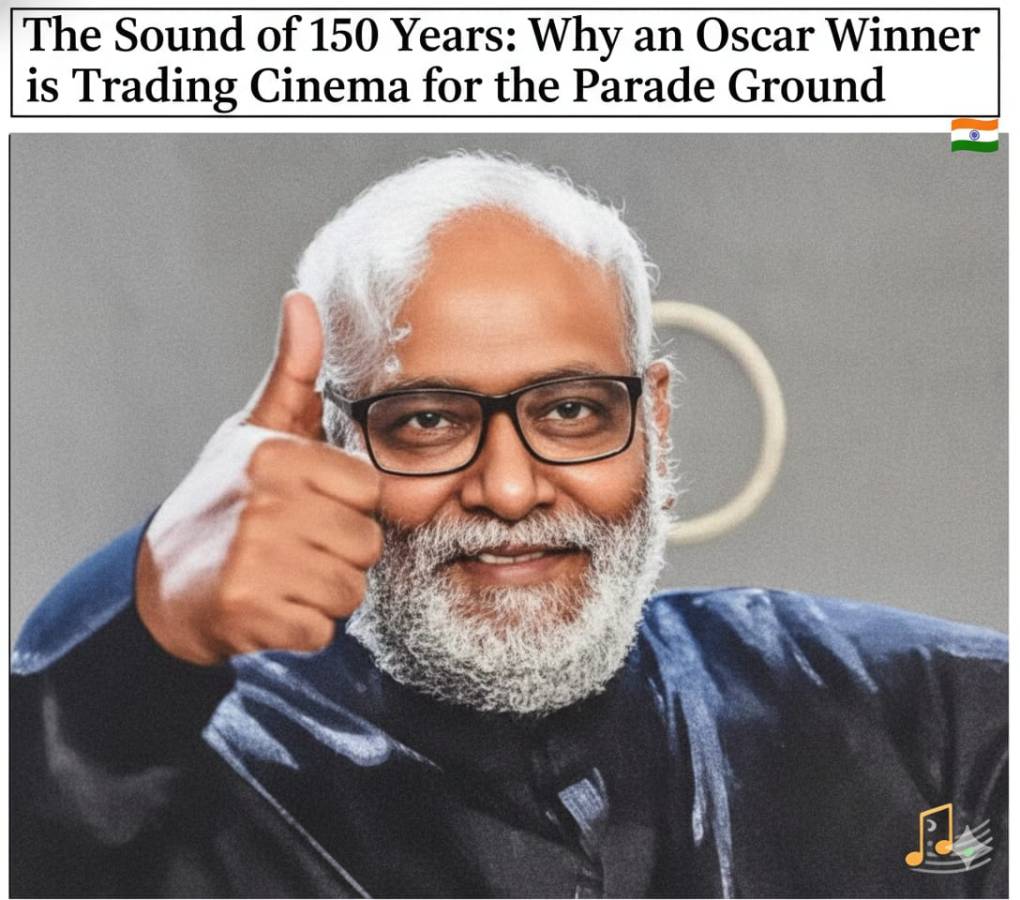
When a 150-year-old national song meets a modern musical legend, the Republic Day parade becomes more than a ceremony…
When MM Keeravani’s name comes up, it usually evokes images of red carpets, orchestras swelling beneath cinematic climaxes, and a standing ovation at the Academy Awards. His music has travelled far beyond India, carrying emotion across languages and borders. Yet in January 2026, Keeravani will step away from cinema’s controlled frames and into a far larger, more symbolic arena: Kartavya Path in New Delhi.
The Oscar-winning composer has been commissioned to create the musical score for India’s 77th Republic Day Parade. The assignment is significant not only because of its scale, but because it coincides with a historic milestone — 150 years of “Vande Mataram”, the national song that has shaped India’s emotional and political imagination since the freedom movement.
A Moment Where History Meets Reinvention
Republic Day music has traditionally followed a familiar grammar: military bands, ceremonial precision, and tunes designed to underline discipline and strength. This time, the Ministry of Culture has chosen a different approach. By bringing Keeravani on board, the parade’s soundscape is being reimagined as a living cultural performance rather than a fixed ritual.
Vande Mataram is not an easy composition to reinterpret. Its words are deeply etched into collective memory, carrying echoes of resistance, sacrifice, and awakening. Any deviation risks controversy; any repetition risks stagnation. Keeravani’s task is to walk this fine line — to preserve reverence while introducing a contemporary musical language that speaks to today’s India.
Rather than leaning solely on traditional brass arrangements, the 2026 score is expected to blend orchestral depth with Indian musical textures, performed by nearly 2,500 artists drawn from across the country. In effect, Kartavya Path will become one of the largest live performance stages India has ever seen.
Why Keeravani Fits This Moment
Choosing a film composer for a national ceremony might appear unconventional, but Keeravani’s career explains the decision. Known also as MM Kreem and Maragathamani, he has spent decades composing for stories rooted in sacrifice, heroism, and identity. His work consistently balances intimacy with scale — a rare skill when addressing something as vast as national sentiment.
If “Naatu Naatu” demonstrated that Indian rhythm could capture global imagination, this project turns that success inward. It is about using the language of modern music to reconnect citizens with an idea that predates the Republic itself. The message is subtle but clear: India’s traditions are not frozen in time; they evolve without losing their core.
A Parade Watched by the World
The music will unfold against a backdrop of high-profile diplomacy. The chief guests at the 2026 Republic Day celebrations are European Council President António Luís Santos da Costa and European Commission President Ursula von der Leyen. As discussions around trade, clean energy, and strategic cooperation continue offstage, the parade will present India’s cultural confidence on full display.
There is symbolism in this setting. An Oscar-winning Indian composer leading a reinterpretation of a 150-year-old national song, performed before global leaders, reflects how India increasingly projects its soft power — not through assertion alone, but through culture, creativity, and continuity.
The Faces the Music Is Meant For
Beyond dignitaries and television cameras, the Republic Day audience itself is evolving. Among the 10,000 special guests invited by the Ministry of Defence are individuals who represent contemporary India’s quiet transformations. ISRO scientists involved in Chandrayaan and Gaganyaan missions will sit alongside women entrepreneurs, self-help group members, natural farmers, medical innovators, and international sports achievers.
For many of them, the parade is a rare moment of public recognition. Keeravani’s music becomes the emotional backdrop to that acknowledgment, elevating the experience from ceremonial formality to collective celebration.
Beyond Marching Bands
Republic Day has always been about strength and sovereignty. The 2026 edition, however, aims to add another dimension — soul. By placing Vande Mataram at the centre of the celebration and entrusting its sound to a composer shaped by both tradition and modernity, the event signals a broader cultural shift.
The national song is not being treated as a relic, but as a living idea capable of renewal. As the January fog lifts over New Delhi and the first notes fill the air, the sound will not merely mark the rhythm of marching boots. It will reflect a nation listening to its past, reinterpreting it, and carrying it forward with confidence.
In that moment, MM Keeravani’s music will do what it has always done best — turn emotion into memory, and memory into meaning.
















Leave a Comment