
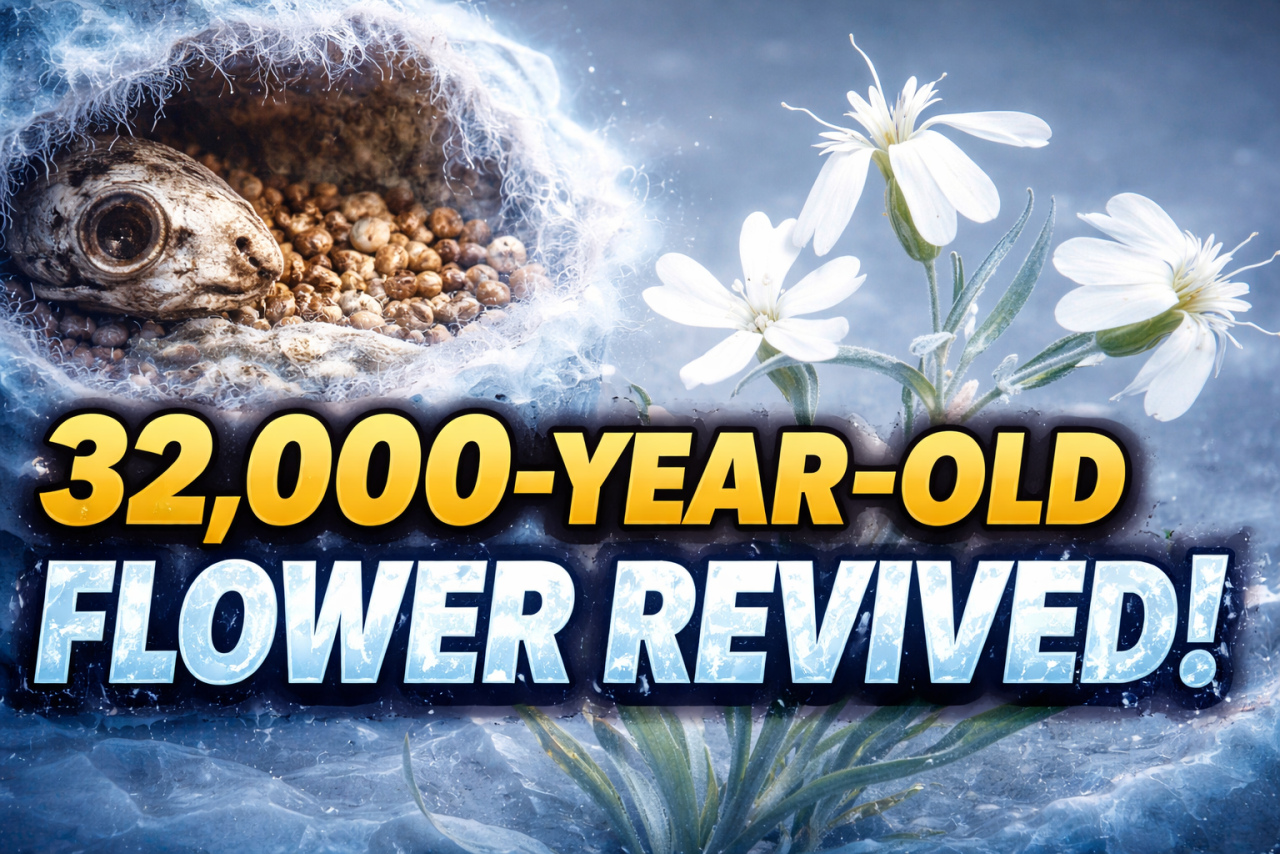
A squirrel buried these seeds during the Ice Age—32,000 years later, scientists brought the flower back to life.
In the frozen silence of Siberia’s permafrost, time sometimes pauses in extraordinary ways. More than thirty millennia after the last Ice Age squirrels buried their winter food, a forgotten seed cache has produced one of the most astonishing botanical revivals ever recorded.
Scientists successfully regenerated a flowering plant from tissues preserved for nearly 32,000 years, making it the oldest plant ever revived from ancient biological material. The plant belongs to the species Silene stenophylla, a delicate white-flowered wild plant native to the harsh tundra landscapes of northeastern Siberia.
The discovery traces back to excavations near the banks of the Kolyma River, where researchers investigating ancient permafrost layers stumbled upon fossilized burrows of Ice Age ground squirrels. These animals, much like their modern descendants, stored food underground to survive harsh winters.
What they left behind turned out to be an accidental time capsule.
Inside the frozen burrows were fruits and seeds buried roughly 38 meters beneath the surface, perfectly preserved by permanently frozen soil. Radiocarbon dating confirmed the age of the material at around 31,800 years, placing it firmly within the late Pleistocene epoch—an era when mammoths, woolly rhinoceroses, and giant bison still roamed the northern plains.
The research team, led by scientists from the Russian Academy of Sciences, faced a challenge: most of the ancient seeds had been damaged and could not germinate normally. But the scientists took a different approach.
Instead of trying to sprout the seeds themselves, they extracted viable tissue from the fruits—specifically the placenta, the part where seeds attach inside the fruit. Using tissue-culture techniques and a nutrient-rich growth medium, they carefully stimulated the cells to grow.
Remarkably, the cells responded.
Roots and shoots began to develop, eventually forming a full plant that looked strikingly similar to modern examples of the same species. After months of growth under controlled conditions, the resurrected plant did something even more astonishing—it produced flowers and viable seeds of its own, demonstrating that the revived organism was fully functional and fertile.
The bloom itself was modest: small white petals arranged around a slender stem. Yet scientifically, it represented a milestone. Never before had plant material this ancient been successfully regenerated into a living organism.
The experiment revealed something profound about Earth’s frozen regions. Permafrost, it appears, can function as a natural cryogenic vault capable of preserving biological material for tens of thousands of years. In effect, the Arctic tundra may be holding a vast archive of ancient genetic information waiting to be studied.
For scientists, the implications extend far beyond botanical curiosity. Studying ancient plants like Silene stenophylla could help researchers understand how vegetation adapted to prehistoric climates—knowledge that may prove valuable as the modern world confronts rapid environmental change.
Some researchers believe such work could even aid efforts to preserve endangered plant species by improving long-term seed storage techniques.
Ironically, the same permafrost that protected these ancient seeds for millennia is now thawing due to global warming. As frozen ground melts, it may reveal more relics from Earth’s distant past—plants, microbes, and genetic material locked away since before human civilization.
For now, the revived Ice Age flower stands as a quiet symbol of nature’s resilience.
Buried by a squirrel during the age of mammoths, frozen through thousands of winters, and awakened in a modern laboratory, this fragile bloom reminds us that life sometimes waits patiently—across the span of entire epochs—for the chance to begin again.


























Leave a Comment