
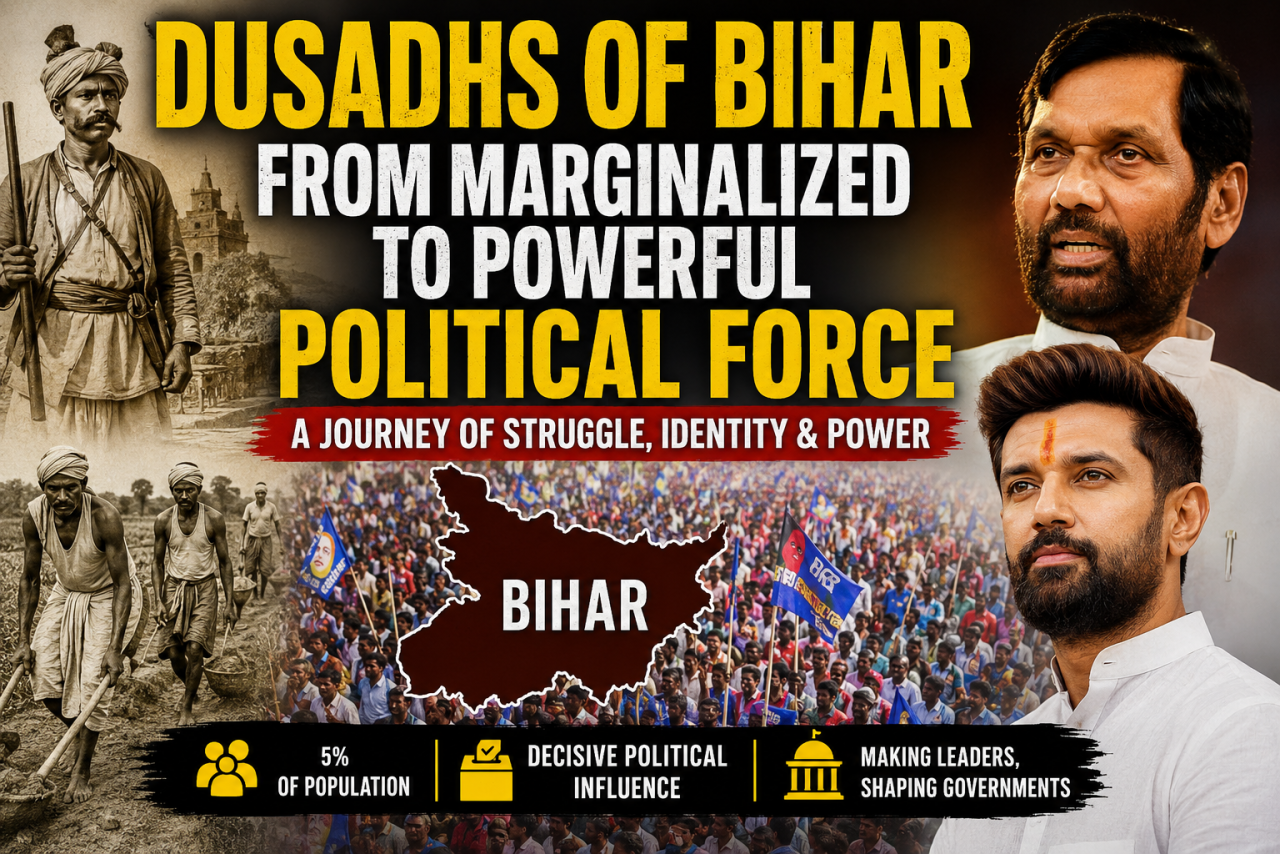
The Dusadhs are only 5% of Bihar's population—but their political influence is far greater.
In Bihar's complex caste landscape, few communities have undergone a transformation as dramatic as the Dusadhs, also known as Paswans. Once associated with village security duties, agricultural labor, and social exclusion, the community today occupies a unique position in Bihar's politics. Though constituting only about 5.3% of Bihar's population, the Dusadhs have exercised political influence far greater than their numbers, producing chief ministers, cabinet ministers, and one of India's most recognizable Dalit political dynasties. Their rise is a story of social mobility, political organization, and electoral bargaining power.
A Community of Warriors, Watchmen and Folk Heroes
The origins of the Dusadh community remain debated. Like many Indian castes, their history is preserved through a mix of folklore, oral traditions, and scattered historical records.
Many community narratives trace their roots to warrior traditions. Some scholars argue that the term "Dusadh" derives from "Dussadhya," meaning "difficult to defeat." Others connect the community to village defense and frontier security roles. The word "Paswan," now widely used as a surname, literally means "bodyguard" or "protector."
For centuries, Dusadhs served as village guards, chowkidars, messengers, and protectors of agricultural settlements across Bihar and eastern Uttar Pradesh. Their cultural identity remains deeply tied to folk heroes such as Baba Chauharmal and Raja Salhesh, whose stories celebrate resistance, courage, and social dignity.
The Numbers Behind the Community
The political significance of the Dusadhs becomes clear when one looks at the numbers.
According to Census-based Scheduled Caste data, Bihar has around 1.3 crore Scheduled Caste residents. Among them, Dusadhs number approximately 40.29 lakh, making up 30.88% of the state's Scheduled Caste population. Only the Chamar-Ravidas community is slightly larger at 31.34%. Together, these two communities account for nearly two-thirds of Bihar's Dalit population.
The Bihar caste survey and subsequent political analyses place the Dusadh population at roughly 5.3% of Bihar's total population. This may seem modest, but in a state where elections are often won by narrow margins, a consolidated 5% voting bloc can significantly influence outcomes.
From Social Exclusion to Political Assertion
Historically, Dusadhs occupied a low position in the caste hierarchy and faced many of the barriers experienced by Scheduled Castes across northern India. Land ownership remained limited, literacy levels were low, and economic opportunities were scarce.
However, unlike many other marginalized groups, the Dusadh community gradually developed a strong political consciousness. Community organizations, local leadership networks, and a shared cultural identity helped build collective solidarity.
The first major breakthrough came with the rise of Bhola Paswan Shastri, who became Bihar's Chief Minister three times between 1968 and 1972. His elevation was symbolically significant because it demonstrated that a member of a Scheduled Caste community could reach the highest political office in the state.
Yet the real transformation would come in the decades that followed.
Ram Vilas Paswan and the Making of a Political Powerhouse
No individual shaped the modern political identity of the Dusadh community more than Ram Vilas Paswan.
Born in a modest family in Khagaria district, Ram Vilas Paswan entered the Bihar Assembly in 1969 before rising to national prominence. In the 1977 Lok Sabha election, he won from Hajipur with a record margin of over 4.24 lakh votes, a feat that entered political history.
Over the next four decades, Paswan became one of India's most durable politicians. He served in governments led by different prime ministers and earned the nickname "political weatherman" because of his ability to remain relevant across changing political coalitions.
More importantly, he transformed the Dusadhs from a scattered Scheduled Caste community into a politically organized vote bank.
Through the Lok Janshakti Party, he created a political platform that gave the community statewide visibility and bargaining power. For the first time, major political parties had to actively court Dusadh voters rather than merely count them.
Why the Dusadhs Became Bihar's Most Influential Dalit Group
Several factors explain the community's political success.
First, demographic concentration. Unlike many Dalit groups that are geographically dispersed, Dusadh populations are concentrated in several electorally important districts.
Second, leadership continuity. From Bhola Paswan Shastri to Ram Vilas Paswan and now Chirag Paswan, the community has consistently produced leaders with statewide recognition.
Third, political unity. While other caste groups often split across multiple parties, a significant section of Dusadh voters has historically shown strong loyalty to leaders identified with community interests.
Fourth, electoral arithmetic. Bihar's Scheduled Castes account for nearly 19.65% of the state's population. Within this segment, the Dusadhs represent one of the largest and most politically mobilized communities, giving them influence disproportionate to their population size.
The Chirag Era
Following Ram Vilas Paswan's death in 2020, many observers questioned whether the community's political influence would decline.
Instead, leadership passed to Chirag Paswan, who has emerged as one of Bihar's most visible young politicians. His party remains a significant player in state politics, and virtually every major alliance in Bihar continues to view the Dusadh vote as strategically important. Recent electoral analyses continue to identify the community as one of the state's most influential Dalit constituencies.
Beyond Politics
Yet the story of the Dusadhs is larger than elections.
It is the story of a community that moved from village outposts to Parliament, from social exclusion to political negotiation, and from being subjects of power to participants in power. While challenges of poverty, education, and employment remain, the Dusadh experience has become one of the most significant examples of political empowerment among Dalit communities in North India.
In modern Bihar, the rise of the Dusadhs demonstrates a simple political truth: numbers matter, but organization matters even more. A community that represents just over five percent of the population has succeeded in becoming one of the most consequential forces in the state's politics—a transformation that few could have imagined a century ago.
In Bihar's complex caste landscape, few communities have undergone a transformation as dramatic as the Dusadhs, also known as Paswans. Once associated with village security duties, agricultural labor, and social exclusion, the community today occupies a unique position in Bihar's politics. Though constituting only about 5.3% of Bihar's population, the Dusadhs have exercised political influence far greater than their numbers, producing chief ministers, cabinet ministers, and one of India's most recognizable Dalit political dynasties. Their rise is a story of social mobility, political organization, and electoral bargaining power.
A Community of Warriors, Watchmen and Folk Heroes
The origins of the Dusadh community remain debated. Like many Indian castes, their history is preserved through a mix of folklore, oral traditions, and scattered historical records.
Many community narratives trace their roots to warrior traditions. Some scholars argue that the term "Dusadh" derives from "Dussadhya," meaning "difficult to defeat." Others connect the community to village defense and frontier security roles. The word "Paswan," now widely used as a surname, literally means "bodyguard" or "protector."
For centuries, Dusadhs served as village guards, chowkidars, messengers, and protectors of agricultural settlements across Bihar and eastern Uttar Pradesh. Their cultural identity remains deeply tied to folk heroes such as Baba Chauharmal and Raja Salhesh, whose stories celebrate resistance, courage, and social dignity.
The Numbers Behind the Community
The political significance of the Dusadhs becomes clear when one looks at the numbers.
According to Census-based Scheduled Caste data, Bihar has around 1.3 crore Scheduled Caste residents. Among them, Dusadhs number approximately 40.29 lakh, making up 30.88% of the state's Scheduled Caste population. Only the Chamar-Ravidas community is slightly larger at 31.34%. Together, these two communities account for nearly two-thirds of Bihar's Dalit population.
The Bihar caste survey and subsequent political analyses place the Dusadh population at roughly 5.3% of Bihar's total population. This may seem modest, but in a state where elections are often won by narrow margins, a consolidated 5% voting bloc can significantly influence outcomes.
From Social Exclusion to Political Assertion
Historically, Dusadhs occupied a low position in the caste hierarchy and faced many of the barriers experienced by Scheduled Castes across northern India. Land ownership remained limited, literacy levels were low, and economic opportunities were scarce.
However, unlike many other marginalized groups, the Dusadh community gradually developed a strong political consciousness. Community organizations, local leadership networks, and a shared cultural identity helped build collective solidarity.
The first major breakthrough came with the rise of Bhola Paswan Shastri, who became Bihar's Chief Minister three times between 1968 and 1972. His elevation was symbolically significant because it demonstrated that a member of a Scheduled Caste community could reach the highest political office in the state.
Yet the real transformation would come in the decades that followed.
Ram Vilas Paswan and the Making of a Political Powerhouse
No individual shaped the modern political identity of the Dusadh community more than Ram Vilas Paswan.
Born in a modest family in Khagaria district, Ram Vilas Paswan entered the Bihar Assembly in 1969 before rising to national prominence. In the 1977 Lok Sabha election, he won from Hajipur with a record margin of over 4.24 lakh votes, a feat that entered political history.
Over the next four decades, Paswan became one of India's most durable politicians. He served in governments led by different prime ministers and earned the nickname "political weatherman" because of his ability to remain relevant across changing political coalitions.
More importantly, he transformed the Dusadhs from a scattered Scheduled Caste community into a politically organized vote bank.
Through the Lok Janshakti Party, he created a political platform that gave the community statewide visibility and bargaining power. For the first time, major political parties had to actively court Dusadh voters rather than merely count them.
Why the Dusadhs Became Bihar's Most Influential Dalit Group
Several factors explain the community's political success.
First, demographic concentration. Unlike many Dalit groups that are geographically dispersed, Dusadh populations are concentrated in several electorally important districts.
Second, leadership continuity. From Bhola Paswan Shastri to Ram Vilas Paswan and now Chirag Paswan, the community has consistently produced leaders with statewide recognition.
Third, political unity. While other caste groups often split across multiple parties, a significant section of Dusadh voters has historically shown strong loyalty to leaders identified with community interests.
Fourth, electoral arithmetic. Bihar's Scheduled Castes account for nearly 19.65% of the state's population. Within this segment, the Dusadhs represent one of the largest and most politically mobilized communities, giving them influence disproportionate to their population size.
The Chirag Era
Following Ram Vilas Paswan's death in 2020, many observers questioned whether the community's political influence would decline.
Instead, leadership passed to Chirag Paswan, who has emerged as one of Bihar's most visible young politicians. His party remains a significant player in state politics, and virtually every major alliance in Bihar continues to view the Dusadh vote as strategically important. Recent electoral analyses continue to identify the community as one of the state's most influential Dalit constituencies.
Beyond Politics
Yet the story of the Dusadhs is larger than elections.
It is the story of a community that moved from village outposts to Parliament, from social exclusion to political negotiation, and from being subjects of power to participants in power. While challenges of poverty, education, and employment remain, the Dusadh experience has become one of the most significant examples of political empowerment among Dalit communities in North India.
In modern Bihar, the rise of the Dusadhs demonstrates a simple political truth: numbers matter, but organization matters even more. A community that represents just over five percent of the population has succeeded in becoming one of the most consequential forces in the state's politics—a transformation that few could have imagined a century ago.




















Leave a Comment