
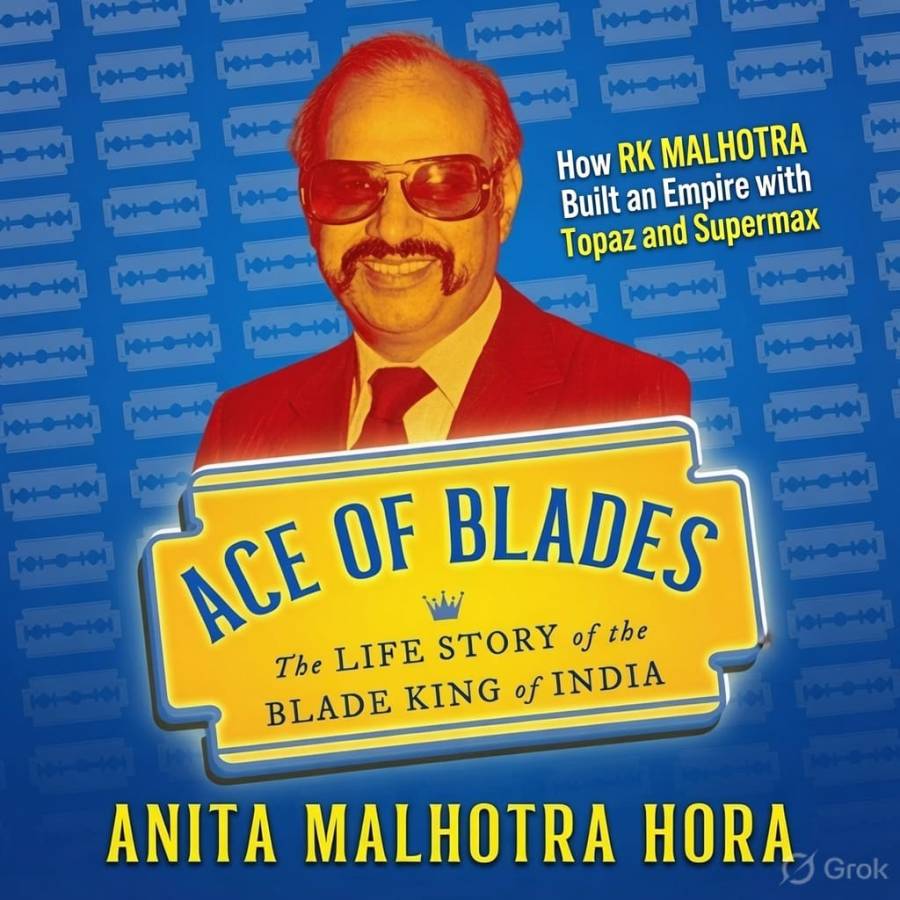
He built a razor empire, challenged Gillette, and left behind a legacy shaped as much by ambition as by family conflict. Ace of Blades tells the story behind one of India's most remarkable business journeys.
Business biographies often celebrate success without spending enough time on the conflicts, compromises, and contradictions that shape it. Ace of Blades: The Life Story of the Blade King of India chooses a different path. Reenita Malhotra Hora tells the story of her father, Rajinder Kumar (RK) Malhotra, not as a larger-than-life industrial icon but as a complex man whose extraordinary achievements came with equally significant personal costs.
For many Indians, brands like Topaz and Supermax were simply household names. Few knew the story of the man behind them. Hora reconstructs that journey with the eye of a journalist and the perspective of a daughter who witnessed both the public triumphs and the private struggles.
The opening chapters transport readers to a time when building a manufacturing business in India demanded ingenuity, resilience, and patience. RK Malhotra believed that dependence on suppliers or imported machinery weakened a business. He therefore invested in making almost everything in-house, from steel to production equipment. That philosophy of self-reliance became the backbone of an enterprise that would dominate India's razor blade market for decades.
The book also sheds light on the remarkable distribution network that powered the business. Before supermarkets and e-commerce reshaped retail, Malhotra's blades had already reached thousands of neighbourhood shops across the country. Hora explains how disciplined execution and an understanding of local markets helped brands like Topaz and Supermax become familiar names in millions of Indian homes.
Among the book's most compelling chapters is the prolonged contest between RK Malhotra and Gillette. Rather than portraying it as a simple battle between an Indian company and a multinational giant, Hora presents it as a contest of strategy. Gillette relied on its global scale and resources, while Malhotra trusted manufacturing efficiency, pricing discipline, and an unmatched distribution network. The result is an engaging account of how a homegrown company defended its position against one of the world's biggest consumer brands.
Yet Ace of Blades is not merely a business story. Hora writes with notable honesty about her father's demanding personality, his uncompromising standards, and the emotional strain these qualities placed on his family. The conflicts within the family business receive as much attention as its commercial victories, giving the narrative a depth often missing from corporate biographies. It becomes a story about ambition, authority, succession, and the fragile balance between professional success and personal relationships.
One of the book's greatest strengths is its restraint. Hora neither idolises nor judges her father. She acknowledges his vision and determination while remaining candid about his shortcomings. This balanced approach lends authenticity to the narrative and allows readers to draw their own conclusions.
The writing remains accessible throughout. Even discussions of manufacturing processes, business strategy, and corporate rivalries are presented in a way that keeps the story moving. Readers with little knowledge of business history will still find themselves absorbed by the human drama behind the rise of an industrial empire.
By the time the book ends, Ace of Blades has achieved something rare. It documents an important chapter in India's manufacturing history while offering an intimate portrait of the man who shaped it. It is not simply the story of a successful entrepreneur but of a family, a legacy, and the personal cost of relentless ambition.
For readers interested in entrepreneurship, family-run businesses, Indian industry, or biographies that resist easy hero worship, Ace of Blades is a thoughtful and rewarding read.
Business biographies often celebrate success without spending enough time on the conflicts, compromises, and contradictions that shape it. Ace of Blades: The Life Story of the Blade King of India chooses a different path. Reenita Malhotra Hora tells the story of her father, Rajinder Kumar (RK) Malhotra, not as a larger-than-life industrial icon but as a complex man whose extraordinary achievements came with equally significant personal costs.
For many Indians, brands like Topaz and Supermax were simply household names. Few knew the story of the man behind them. Hora reconstructs that journey with the eye of a journalist and the perspective of a daughter who witnessed both the public triumphs and the private struggles.
The opening chapters transport readers to a time when building a manufacturing business in India demanded ingenuity, resilience, and patience. RK Malhotra believed that dependence on suppliers or imported machinery weakened a business. He therefore invested in making almost everything in-house, from steel to production equipment. That philosophy of self-reliance became the backbone of an enterprise that would dominate India's razor blade market for decades.
The book also sheds light on the remarkable distribution network that powered the business. Before supermarkets and e-commerce reshaped retail, Malhotra's blades had already reached thousands of neighbourhood shops across the country. Hora explains how disciplined execution and an understanding of local markets helped brands like Topaz and Supermax become familiar names in millions of Indian homes.
Among the book's most compelling chapters is the prolonged contest between RK Malhotra and Gillette. Rather than portraying it as a simple battle between an Indian company and a multinational giant, Hora presents it as a contest of strategy. Gillette relied on its global scale and resources, while Malhotra trusted manufacturing efficiency, pricing discipline, and an unmatched distribution network. The result is an engaging account of how a homegrown company defended its position against one of the world's biggest consumer brands.
Yet Ace of Blades is not merely a business story. Hora writes with notable honesty about her father's demanding personality, his uncompromising standards, and the emotional strain these qualities placed on his family. The conflicts within the family business receive as much attention as its commercial victories, giving the narrative a depth often missing from corporate biographies. It becomes a story about ambition, authority, succession, and the fragile balance between professional success and personal relationships.
One of the book's greatest strengths is its restraint. Hora neither idolises nor judges her father. She acknowledges his vision and determination while remaining candid about his shortcomings. This balanced approach lends authenticity to the narrative and allows readers to draw their own conclusions.
The writing remains accessible throughout. Even discussions of manufacturing processes, business strategy, and corporate rivalries are presented in a way that keeps the story moving. Readers with little knowledge of business history will still find themselves absorbed by the human drama behind the rise of an industrial empire.
By the time the book ends, Ace of Blades has achieved something rare. It documents an important chapter in India's manufacturing history while offering an intimate portrait of the man who shaped it. It is not simply the story of a successful entrepreneur but of a family, a legacy, and the personal cost of relentless ambition.
For readers interested in entrepreneurship, family-run businesses, Indian industry, or biographies that resist easy hero worship, Ace of Blades is a thoughtful and rewarding read.

























Leave a Comment