
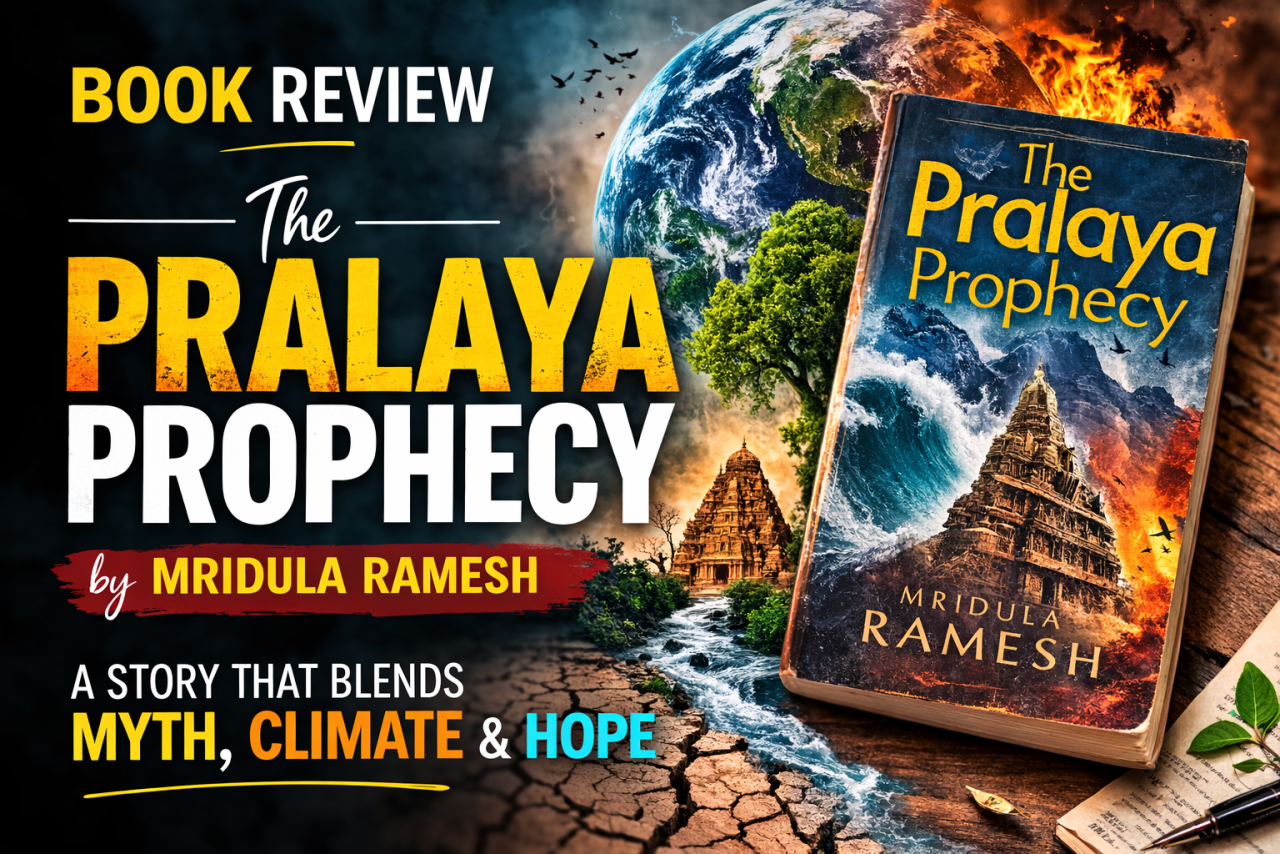
What if ancient prophecy held clues to saving the planet? The Pralaya Prophecy blends mythology, climate science, and human courage into a powerful environmental thriller.
In a time when climate change is often discussed through scientific reports and policy debates, The Pralaya Prophecy by climate researcher and author Mridula Ramesh offers a different, more imaginative route into the conversation. Blending mythology, environmental science, and human drama, the novel attempts to explore one of the most urgent crises of our time through the lens of storytelling. The result is a work that is both reflective and cautionary, asking readers to reconsider their relationship with nature and responsibility toward the planet.
The novel opens with a world on the brink of ecological collapse. Oceans are warming, forests are burning, and an unusually powerful El Niño threatens to intensify global climate disruptions. Amid this unsettling backdrop, an ancient prophecy hidden within a temple in southern India begins to surface. Passed down through generations of priests, the prophecy speaks of pralaya—a cosmic dissolution in Hindu thought that symbolizes destruction followed by renewal.
At the heart of the narrative is Rajan, a man born into a priestly family but distanced from the traditional path expected of him. Struggling with grief and personal disappointments, Rajan becomes an unlikely protagonist. Alongside him is Lakshmi, his brilliant daughter, and a small group of companions including Swati, a local schoolteacher, and Arjun, a cousin who serves as protector and confidant. These characters form an ensemble that represents ordinary individuals suddenly caught in extraordinary circumstances.
One of the novel’s strengths lies in how it intertwines mythological elements with contemporary environmental concerns. Ramesh uses the idea of ancient temple clues and traditional wisdom not merely as a narrative device but as a metaphor for forgotten knowledge. The novel suggests that ancient cultures may have understood ecological balance more deeply than modern societies often acknowledge. When the harmony between body, mind, earth, and the universe is disrupted, chaos follows—a concept deeply rooted in Indian philosophical traditions.
Ramesh’s background as a climate researcher clearly informs the narrative. Before writing fiction, she authored non-fiction works on climate change and water management, including The Climate Solution: India’s Climate-Change Crisis and What We Can Do and Watershed: How We Destroyed India’s Water and How We Can Save It. In The Pralaya Prophecy, she carries that knowledge into the fictional realm, weaving scientific ideas into the plot without making the story feel like a lecture.
The novel’s environmental message is clear: climate change is not merely a distant global issue but a deeply personal one. The characters gradually realize that the crisis unfolding around them cannot be left to governments or institutions alone. Each person must see the problem as “my problem,” something that requires individual engagement and responsibility. This shift in perspective—moving from helplessness to ownership—forms the emotional core of the story.
Another compelling aspect of the book is its setting. The narrative remains firmly rooted in the Indian context, drawing from temples, local traditions, and rural landscapes. By doing so, Ramesh demonstrates that climate fiction does not need to rely on distant dystopian futures. Instead, it can emerge from familiar places and cultural narratives, making the subject more accessible to readers.
However, the novel is not without its challenges. At times, the mix of mythology, science, and thriller-like storytelling can feel dense. Readers who expect a purely fast-paced adventure might find themselves navigating philosophical reflections and environmental explanations along the way. Yet for those willing to engage with these layers, the complexity becomes part of the book’s appeal.
Ramesh also raises interesting questions about power and responsibility. In the story, a powerful group driven by profit threatens ecological stability. Though fictional, the portrayal reflects real-world anxieties about unchecked economic growth and the environmental costs of development. By placing ordinary individuals against such powerful forces, the novel emphasizes courage and moral clarity in the face of overwhelming odds.
Perhaps the most striking element of The Pralaya Prophecy is its underlying optimism. Despite the looming threat of environmental collapse, the story refuses to surrender to despair. Instead, it argues that meaningful change begins with awareness and action at the individual and community levels. The prophecy itself becomes less about inevitable destruction and more about the possibility of renewal if humanity chooses a different path.
In that sense, the novel stands at the intersection of storytelling and activism. It invites readers not only to follow a gripping narrative but also to reflect on their own relationship with nature. The “magic” in the story is not supernatural power but a shift in perspective—the realization that solutions begin when individuals accept responsibility for the world around them.
Ultimately, The Pralaya Prophecy is an ambitious work of climate fiction that blends mythology, science, and human resilience. Through a distinctly Indian narrative, Mridula Ramesh offers a thoughtful meditation on environmental balance and the urgent need for collective action. While the novel may challenge readers with its layered themes, it rewards them with a story that is both intellectually engaging and emotionally resonant.
In an era defined by climate uncertainty, this book reminds us that the future of the planet may depend as much on imagination and belief as on policy and technology. And sometimes, the first step toward change is simply seeing the crisis not as someone else’s problem, but as our own.



























Leave a Comment