
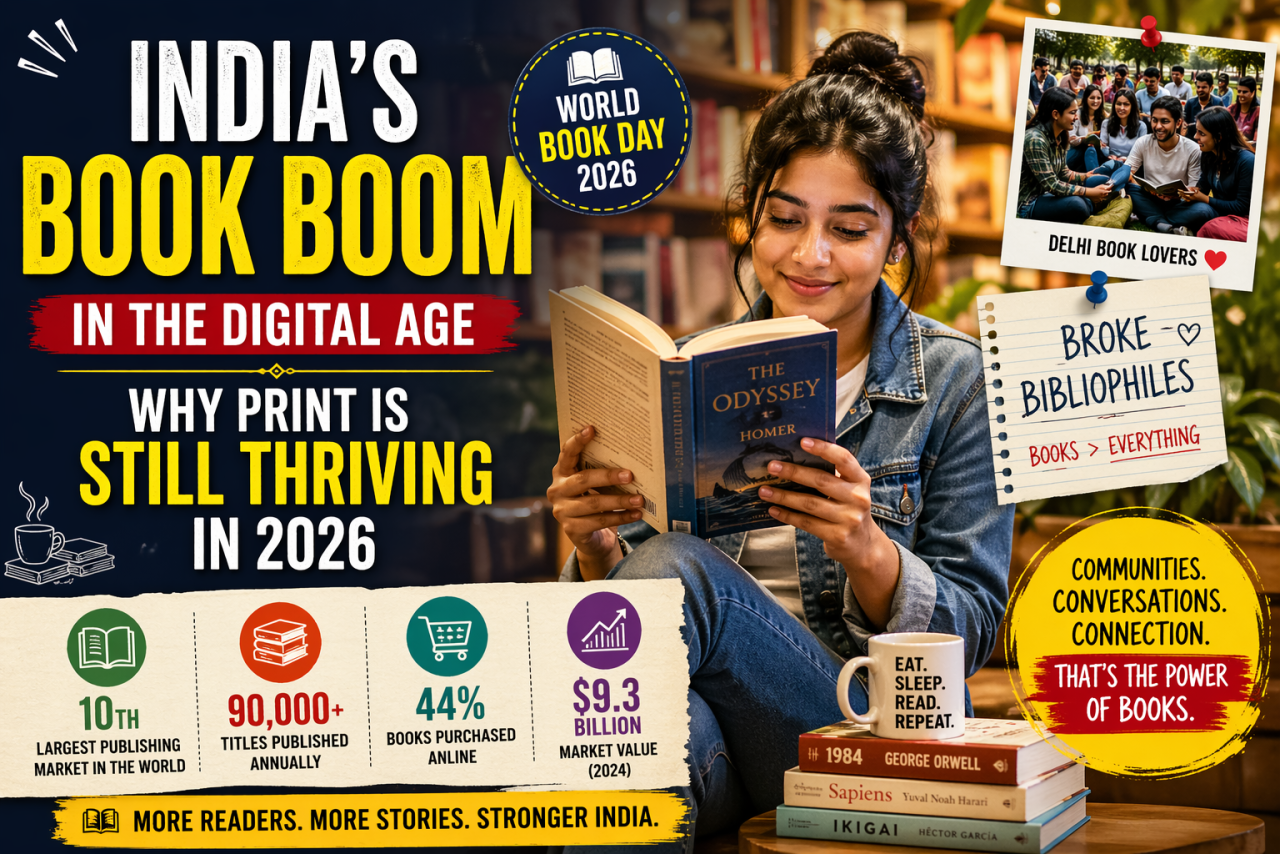
As the world scrolls endlessly, India pauses—turning pages, building communities, and proving that books are far from obsolete.
On this World Book Day 2026, a walk through Delhi’s bustling parks or the quiet corners of Mumbai’s cafés reveals an unexpected reality. In an age dominated by reels, algorithms, and streaming platforms, the physical book has not merely endured—it has staged a confident resurgence.
From communities like “Delhi Book Lovers” to “Broke Bibliophiles,” reading circles are growing rapidly, signalling that the simple act of turning a page continues to hold deep cultural relevance in India.
A Renaissance in Print
Contrary to long-standing predictions of decline, India’s publishing industry is witnessing a remarkable expansion. The country now ranks as the 10th largest publishing market globally, producing over 90,000 titles annually.
This growth is not limited to English-language publishing. With books emerging in more than 24 regional languages, India’s literary ecosystem reflects a renewed engagement with linguistic and cultural diversity.
The much-debated “digital versus print” narrative has, in reality, evolved into one of coexistence and mutual reinforcement:
- Print Still Leads: Physical books continue to dominate, accounting for over 70% of market share. The tactile experience—the texture of paper, the immersion of undistracted reading—remains unmatched.
- Digital as Enabler: Online platforms have expanded access, with over 44% of book purchases occurring digitally, bringing literature closer to readers across geographies.
- Sustained Growth: Valued at approximately $9.3 billion (₹80,000 crore) in 2024, the Indian book market continues to grow steadily, with rising readership across demographics.
The New Social Hubs
The archetype of the solitary reader is fading. Book clubs are emerging as vibrant social spaces, redefining reading as a shared cultural activity.
From “Bring Your Own Book” gatherings to city-based reading groups, these communities are becoming modern intellectual hubs. They foster dialogue, debate, and connection—qualities often missing in digital interactions.
Readers today move fluidly between genres—from the expansive fantasy worlds of Brandon Sanderson to the enduring dystopian warnings of George Orwell’s 1984. For India’s youth, identifying as a “bibliophile” is no longer niche—it is a marker of curiosity and cultural engagement.
By the Numbers: India’s Reading Landscape
Metric
Status (2025–26)
Global Rank
10th in Publishing
Annual Publications
90,000+ Books
Market Value
~$9.3 Billion
Preferred Format
72.6% Print
Top Languages
English, Hindi, Tamil, Bengali, Marathi
The New Cultural Capital of Books
Books in 2026 are no longer confined to academic or intellectual spaces—they have evolved into cultural and lifestyle symbols.
Social media trends such as “Bookstagram” and “BookTok” have transformed reading into a visually curated and socially shared experience. Carefully arranged bookshelves, annotated pages, and aesthetic reading corners now form part of a larger cultural expression.
At the same time, reading is increasingly associated with mental well-being—a deliberate escape from constant digital noise and “doom-scrolling.”
Even communities like “Broke Bibliophiles” highlight an important shift: in a cost-conscious environment, the demand for stories continues to outweigh financial constraints. Publishers, in response, are investing in premium and collectible editions, blending content with visual appeal.
Final Take
India’s reading culture tells a story of resilience and reinvention. Readers are not only consuming more literature but also engaging with it in new, collective ways.
Digital platforms may have expanded access, but the printed word remains central to the experience. From timeless classics like The Odyssey to contemporary bestsellers, books continue to anchor imagination and thought.
As India celebrates World Book Day, one message stands clear: the book is not merely surviving—it is thriving, evolving, and continuing to shape minds, one page at a time.
“Books are a uniquely portable magic.”
In India today, that magic feels more alive than ever.
On this World Book Day 2026, a walk through Delhi’s bustling parks or the quiet corners of Mumbai’s cafés reveals an unexpected reality. In an age dominated by reels, algorithms, and streaming platforms, the physical book has not merely endured—it has staged a confident resurgence.
From communities like “Delhi Book Lovers” to “Broke Bibliophiles,” reading circles are growing rapidly, signalling that the simple act of turning a page continues to hold deep cultural relevance in India.
A Renaissance in Print
Contrary to long-standing predictions of decline, India’s publishing industry is witnessing a remarkable expansion. The country now ranks as the 10th largest publishing market globally, producing over 90,000 titles annually.
This growth is not limited to English-language publishing. With books emerging in more than 24 regional languages, India’s literary ecosystem reflects a renewed engagement with linguistic and cultural diversity.
The much-debated “digital versus print” narrative has, in reality, evolved into one of coexistence and mutual reinforcement:
- Print Still Leads: Physical books continue to dominate, accounting for over 70% of market share. The tactile experience—the texture of paper, the immersion of undistracted reading—remains unmatched.
- Digital as Enabler: Online platforms have expanded access, with over 44% of book purchases occurring digitally, bringing literature closer to readers across geographies.
- Sustained Growth: Valued at approximately $9.3 billion (₹80,000 crore) in 2024, the Indian book market continues to grow steadily, with rising readership across demographics.
The New Social Hubs
The archetype of the solitary reader is fading. Book clubs are emerging as vibrant social spaces, redefining reading as a shared cultural activity.
From “Bring Your Own Book” gatherings to city-based reading groups, these communities are becoming modern intellectual hubs. They foster dialogue, debate, and connection—qualities often missing in digital interactions.
Readers today move fluidly between genres—from the expansive fantasy worlds of Brandon Sanderson to the enduring dystopian warnings of George Orwell’s 1984. For India’s youth, identifying as a “bibliophile” is no longer niche—it is a marker of curiosity and cultural engagement.
By the Numbers: India’s Reading Landscape
|
Metric |
Status (2025–26) |
|
Global Rank |
10th in Publishing |
|
Annual Publications |
90,000+ Books |
|
Market Value |
~$9.3 Billion |
|
Preferred Format |
72.6% Print |
|
Top Languages |
English, Hindi, Tamil, Bengali, Marathi |
The New Cultural Capital of Books
Books in 2026 are no longer confined to academic or intellectual spaces—they have evolved into cultural and lifestyle symbols.
Social media trends such as “Bookstagram” and “BookTok” have transformed reading into a visually curated and socially shared experience. Carefully arranged bookshelves, annotated pages, and aesthetic reading corners now form part of a larger cultural expression.
At the same time, reading is increasingly associated with mental well-being—a deliberate escape from constant digital noise and “doom-scrolling.”
Even communities like “Broke Bibliophiles” highlight an important shift: in a cost-conscious environment, the demand for stories continues to outweigh financial constraints. Publishers, in response, are investing in premium and collectible editions, blending content with visual appeal.
Final Take
India’s reading culture tells a story of resilience and reinvention. Readers are not only consuming more literature but also engaging with it in new, collective ways.
Digital platforms may have expanded access, but the printed word remains central to the experience. From timeless classics like The Odyssey to contemporary bestsellers, books continue to anchor imagination and thought.
As India celebrates World Book Day, one message stands clear: the book is not merely surviving—it is thriving, evolving, and continuing to shape minds, one page at a time.
“Books are a uniquely portable magic.”
In India today, that magic feels more alive than ever.















Leave a Comment