
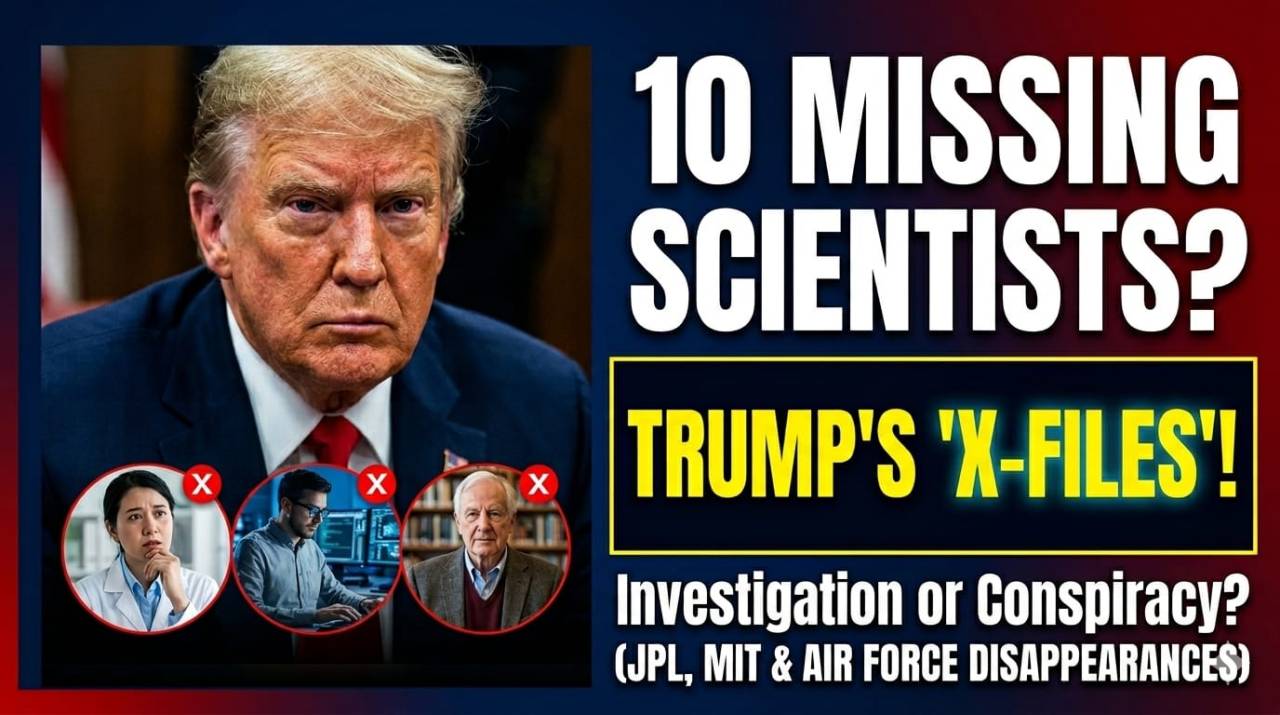
A chilling pattern of disappearances among top US scientists has sparked a federal probe—raising urgent questions about national security, secret research, and whether these cases are truly coincidental.
A series of mysterious disappearances and deaths involving top-tier American scientists has triggered a high-level federal investigation, with Donald Trump calling the situation “pretty serious stuff.” The probe, announced this week, follows growing alarm from lawmakers who suggest that these experts—many of whom held high-level security clearances—may have been targeted due to their sensitive research into aerospace, defense, and Unidentified Anomalous Phenomena (UAPs).
A Pattern of Disappearances
The investigation focuses on at least 10 prominent researchers and scientists whose cases span from mid-2023 to early 2026. While some incidents were initially treated as isolated, the number of high-profile individuals involved has raised serious concerns. Representative Eric Burlison (R-MO) and other members of the House Oversight Committee have called for urgent answers.
“This is too coincidental,” Burlison said in a recent interview. “The fate of these scientists is almost certainly linked to the access they had to classified aerospace and UFO-related information. We need the FBI and every relevant agency involved.”
Notable Cases Under Review
The timeline presents a troubling picture of loss across multiple scientific disciplines:
- Michael David Hicks: A physicist at NASA’s Jet Propulsion Laboratory (JPL), known for his work on comets and asteroids, passed away on July 30, 2023. The absence of a publicly disclosed cause of death has fueled speculation.
- Maj. Gen. William McCasland: One of the most high-profile cases, the former Air Force commander reportedly vanished without a trace in February 2025. Lawmakers claim he had attempted to share information related to UAP research prior to his disappearance.
- Professor Nuno Loureiro: A leading nuclear physicist and director at MIT’s Plasma Science and Fusion Center, Loureiro was shot dead at his residence near Boston on December 15, 2025. His work carried major national security implications.
- Los Alamos and JPL Links: Other cases include Anthony Chavez, a former Los Alamos employee who disappeared in May 2025, and Monica Jacinto Reza, a JPL employee who vanished during a hike in June 2025.
Rising National Security Concerns
The White House investigation aims to uncover whether a “common thread” connects these cases. Lawmakers have raised the possibility of foreign adversaries—such as China, Russia, or Iran—attempting to disrupt American technological and defense advancements.
Donald Trump, who was briefed earlier this week, indicated that more details could be made public within days. “Some of these people were very important,” he said, underscoring the urgency of determining whether the incidents are random or part of a coordinated effort.
The Search for Answers
Despite the launch of a federal probe, many questions remain unanswered. For the families, the uncertainty is deeply personal. For the scientific community, the loss of key minds represents a serious blow to innovation and national progress.
As federal agencies begin a deeper investigation into the backgrounds and final days of these scientists, everyone watches closely. Whether this unfolding mystery reveals a logical explanation or something more complex such as protecting those at the forefront of critical research has become an urgent national priority.
A series of mysterious disappearances and deaths involving top-tier American scientists has triggered a high-level federal investigation, with Donald Trump calling the situation “pretty serious stuff.” The probe, announced this week, follows growing alarm from lawmakers who suggest that these experts—many of whom held high-level security clearances—may have been targeted due to their sensitive research into aerospace, defense, and Unidentified Anomalous Phenomena (UAPs).
A Pattern of Disappearances
The investigation focuses on at least 10 prominent researchers and scientists whose cases span from mid-2023 to early 2026. While some incidents were initially treated as isolated, the number of high-profile individuals involved has raised serious concerns. Representative Eric Burlison (R-MO) and other members of the House Oversight Committee have called for urgent answers.
“This is too coincidental,” Burlison said in a recent interview. “The fate of these scientists is almost certainly linked to the access they had to classified aerospace and UFO-related information. We need the FBI and every relevant agency involved.”
Notable Cases Under Review
The timeline presents a troubling picture of loss across multiple scientific disciplines:
- Michael David Hicks: A physicist at NASA’s Jet Propulsion Laboratory (JPL), known for his work on comets and asteroids, passed away on July 30, 2023. The absence of a publicly disclosed cause of death has fueled speculation.
- Maj. Gen. William McCasland: One of the most high-profile cases, the former Air Force commander reportedly vanished without a trace in February 2025. Lawmakers claim he had attempted to share information related to UAP research prior to his disappearance.
- Professor Nuno Loureiro: A leading nuclear physicist and director at MIT’s Plasma Science and Fusion Center, Loureiro was shot dead at his residence near Boston on December 15, 2025. His work carried major national security implications.
- Los Alamos and JPL Links: Other cases include Anthony Chavez, a former Los Alamos employee who disappeared in May 2025, and Monica Jacinto Reza, a JPL employee who vanished during a hike in June 2025.
Rising National Security Concerns
The White House investigation aims to uncover whether a “common thread” connects these cases. Lawmakers have raised the possibility of foreign adversaries—such as China, Russia, or Iran—attempting to disrupt American technological and defense advancements.
Donald Trump, who was briefed earlier this week, indicated that more details could be made public within days. “Some of these people were very important,” he said, underscoring the urgency of determining whether the incidents are random or part of a coordinated effort.
The Search for Answers
Despite the launch of a federal probe, many questions remain unanswered. For the families, the uncertainty is deeply personal. For the scientific community, the loss of key minds represents a serious blow to innovation and national progress.
As federal agencies begin a deeper investigation into the backgrounds and final days of these scientists, everyone watches closely. Whether this unfolding mystery reveals a logical explanation or something more complex such as protecting those at the forefront of critical research has become an urgent national priority.















Leave a Comment