
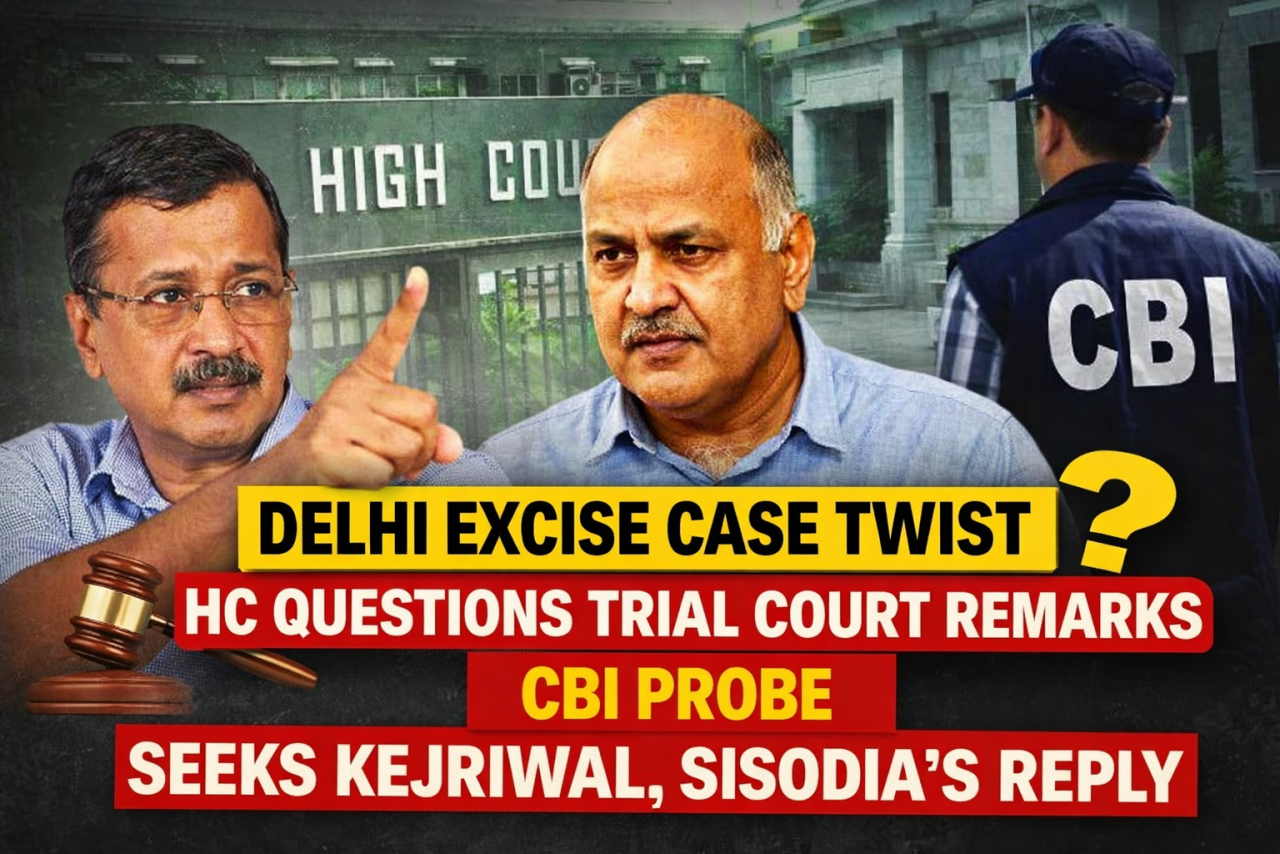
What looked like a major relief for Arvind Kejriwal and other accused in the Delhi excise policy case has quickly turned into a fresh courtroom battle after the Delhi High Court raised doubts about the trial court’s criticism of the Central Bureau of Investigation investigation.
A fresh legal twist has emerged in the controversial Delhi excise policy case after the Delhi High Court questioned certain observations made by a trial court while discharging several accused, including former Delhi Chief Minister Arvind Kejriwal.
The High Court has said that the trial court’s remarks about the investigation conducted by the Central Bureau of Investigation (CBI) appear “prima facie erroneous.” At the same time, the court has temporarily stayed parts of the earlier order and asked the accused to respond to the CBI’s appeal.
For many readers, the legal developments may seem complicated. But in simple terms, the High Court has not yet decided the final outcome—it has only raised serious doubts about the reasoning behind the trial court’s decision.
How the Controversy Began
The case is linked to the now-scrapped Delhi Excise Policy 2021–22, introduced by the Delhi government to reform liquor sales in the national capital.
The policy aimed to change the way liquor shops were operated by increasing the role of private retailers and boosting government revenue. However, allegations soon surfaced that the policy was manipulated to benefit certain businesses.
Following these accusations, the Central Bureau of Investigation began an investigation into possible corruption and irregularities. The Enforcement Directorate also launched a parallel probe focusing on possible money laundering.
Several political leaders and officials were named during the investigation, including Arvind Kejriwal and former Delhi Deputy Chief Minister Manish Sisodia.
What the Trial Court Had Ruled
On February 27, a trial court delivered a significant order in the case. It discharged Kejriwal, Sisodia, and more than twenty other accused.
In legal terms, discharge means that the court believes there is not enough evidence to even start a trial.
The trial court also made strong remarks about the investigation. It said the CBI’s material did not establish a prima facie case, meaning there was insufficient evidence at the initial stage to justify proceeding with criminal charges.
In addition, the trial court directed action against the investigating officer, suggesting that the probe may have been unfair or flawed.
This order triggered immediate reactions because it raised serious questions about the credibility of the investigation itself.
Why the High Court Stepped In
Soon after the order, the Central Bureau of Investigation challenged the decision before the Delhi High Court.
While hearing the appeal, the High Court observed that the trial court’s comments about the investigation appeared “prima facie erroneous.”
In simple terms, this means that at first glance the High Court believes the trial court may have made mistakes in its reasoning.
The High Court also noted that the trial court may have gone beyond its legal limits while evaluating the evidence.
What the High Court Has Ordered Now
The High Court has taken several important steps while hearing the appeal.
First, it has stayed parts of the trial court’s order, particularly those directing departmental action against the CBI’s investigating officer.
Second, the court has issued notices to Arvind Kejriwal, Manish Sisodia, and other accused persons, asking them to file responses to the CBI’s challenge.
Third, the case will now be heard again in the coming weeks, when the court will examine arguments from both sides before taking a final view.
A Key Legal Question
One of the main issues before the High Court is whether the trial court evaluated the evidence too deeply at an early stage of the case.
In criminal law, courts normally follow a clear principle. At the stage when charges are considered, the judge only needs to determine whether there is some evidence suggesting a possible offence.
A detailed examination of evidence generally happens later during the full trial when witnesses testify and documents are closely scrutinized.
The High Court appears to believe the trial court may have overstepped by making strong conclusions before the trial even began.
What Happens Next
The High Court’s observations do not mean that anyone has been declared guilty or innocent. Instead, the case has entered another stage of judicial scrutiny.
Three possible outcomes could emerge in the future:
- The High Court may uphold the trial court’s discharge order.
- It may overturn the discharge and allow the criminal trial to proceed.
- Or it may issue new directions on how the investigation and case should move forward.
Why This Case Matters
The Delhi excise policy case has become one of the most closely watched legal and political battles in the country. It involves senior political leaders, central investigative agencies, and serious allegations of corruption.
For citizens, the case also highlights an important feature of the Indian judicial system: higher courts can review and correct decisions made by lower courts.
This layered system—trial courts, High Courts, and the Supreme Court—helps ensure that legal decisions are carefully examined before they become final.
For now, the Delhi High Court has made it clear that the trial court’s observations require closer scrutiny. The next hearing will therefore be crucial in determining whether the excise policy case will move toward a full trial or end at this stage.



















Leave a Comment