
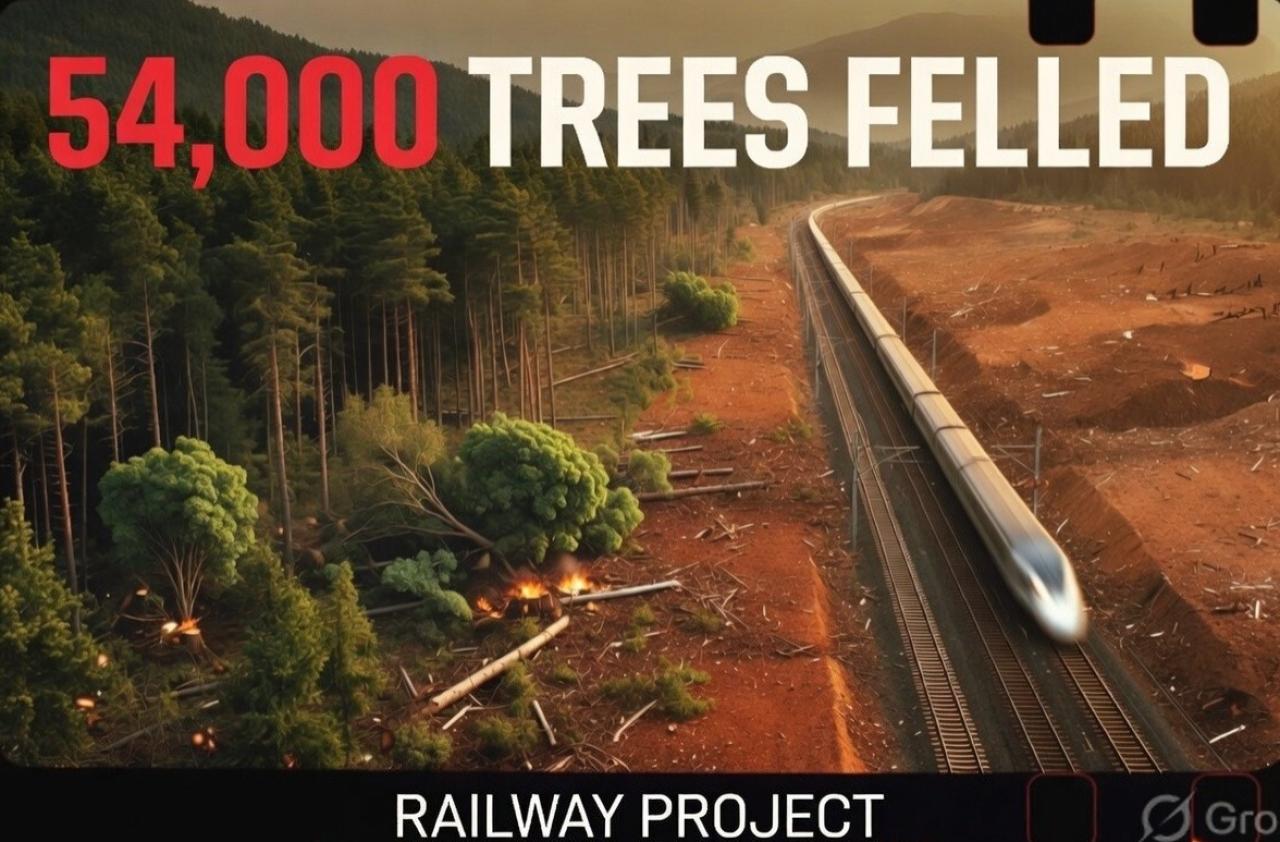
More than 54,000 trees were cut for a railway line in Madhya Pradesh, only for officials to later declare the route unsafe and begin redesigning it. The episode raises difficult questions about planning, accountability, and the true cost of development.
When governments talk about development, they often present it as a choice between progress and preservation. But the recent revelation from Madhya Pradesh shows something even more troubling: what happens when environmental destruction takes place not because it is unavoidable, but because of poor planning.
According to reports, more than 54,000 trees were cut for the proposed Khajuraho–Panna railway line in Madhya Pradesh. Now, after years of planning and extensive environmental damage, Indian Railways has ordered an inquiry into the project's alignment, calling the original route "dangerous" because it contained six sharp curves that violated railway safety norms.
The development raises an uncomfortable question: if the route was flawed from the beginning, why were tens of thousands of trees sacrificed before the problem was identified?
The railway project was approved in 2021 and received forest clearance for diverting over 300 hectares of forest land. Tree felling continued for years as preparations moved forward. Yet officials now admit that concerns about the alignment were serious enough to scrap the route entirely and design a new one.
This is not merely a technical error. It is a failure of governance.
Infrastructure projects require years of surveys, environmental assessments, engineering studies, and administrative approvals. Every stage exists to ensure that public money, natural resources, and human effort are not wasted. The fact that a route can progress through all these layers of scrutiny only to be declared unsafe later suggests deep weaknesses in the planning process.
What makes the situation even more alarming is that the environmental cost cannot simply be reversed.
Railway tracks can be shifted. Engineering drawings can be redone. Committees can investigate. But a mature forest cannot be recreated overnight.
The 54,000 trees that were cut represented far more than timber. They formed part of an ecosystem supporting birds, insects, animals, groundwater recharge, soil stability, and carbon absorption. Many of these forests lie close to the sensitive Panna landscape, an area known for its biodiversity and ecological significance.
Officials now estimate that the revised alignment may require the cutting of around 50,000 additional trees. If that happens, the total environmental loss could exceed 100,000 trees for a single railway project.
Such numbers should concern every citizen, regardless of whether they support the railway line.
India undoubtedly needs better infrastructure. Railways connect remote regions, create jobs, boost tourism, and support economic growth. The issue is not whether development should happen. The issue is whether development should happen through negligence.
A well-planned project balances economic benefits with environmental responsibility. It minimizes ecological damage before construction begins. What has happened in Madhya Pradesh appears to be the opposite. The environment has already paid a massive price, while authorities are only now questioning whether the project was designed correctly.
Equally troubling is the message this sends about accountability.
When ordinary citizens make mistakes, they often face immediate consequences. Yet in large public projects, responsibility frequently becomes difficult to identify. Files move between departments, committees are formed, reports are prepared, and eventually public attention shifts elsewhere.
The inquiry announced by the Railways must therefore go beyond identifying technical flaws. It should answer a fundamental question: who approved an alignment that is now considered dangerous? If errors were made during planning, why were they not detected before environmental clearances were granted and forests were cleared?
Without accountability, inquiries risk becoming exercises in damage control rather than instruments of reform.
This episode also exposes a larger problem in India's development model. Environmental approvals are often treated as procedural hurdles rather than serious safeguards. Forests are frequently viewed as obstacles standing in the way of projects instead of valuable national assets deserving protection.
The result is a recurring pattern: trees are cut first, questions are asked later.
The Madhya Pradesh railway controversy should become a turning point. It should force policymakers to strengthen environmental reviews, improve project planning, and ensure that ecological costs are considered with the same seriousness as financial costs.
Because the true tragedy here is not simply that 54,000 trees were felled.
It is that they may have been felled for a route that should never have been approved in the first place.
Development should leave behind railways, roads, and opportunities—not a trail of avoidable environmental losses created by administrative carelessness. The forests of Madhya Pradesh deserved better, and so do the people whose future depends on them.
When governments talk about development, they often present it as a choice between progress and preservation. But the recent revelation from Madhya Pradesh shows something even more troubling: what happens when environmental destruction takes place not because it is unavoidable, but because of poor planning.
According to reports, more than 54,000 trees were cut for the proposed Khajuraho–Panna railway line in Madhya Pradesh. Now, after years of planning and extensive environmental damage, Indian Railways has ordered an inquiry into the project's alignment, calling the original route "dangerous" because it contained six sharp curves that violated railway safety norms.
The development raises an uncomfortable question: if the route was flawed from the beginning, why were tens of thousands of trees sacrificed before the problem was identified?
The railway project was approved in 2021 and received forest clearance for diverting over 300 hectares of forest land. Tree felling continued for years as preparations moved forward. Yet officials now admit that concerns about the alignment were serious enough to scrap the route entirely and design a new one.
This is not merely a technical error. It is a failure of governance.
Infrastructure projects require years of surveys, environmental assessments, engineering studies, and administrative approvals. Every stage exists to ensure that public money, natural resources, and human effort are not wasted. The fact that a route can progress through all these layers of scrutiny only to be declared unsafe later suggests deep weaknesses in the planning process.
What makes the situation even more alarming is that the environmental cost cannot simply be reversed.
Railway tracks can be shifted. Engineering drawings can be redone. Committees can investigate. But a mature forest cannot be recreated overnight.
The 54,000 trees that were cut represented far more than timber. They formed part of an ecosystem supporting birds, insects, animals, groundwater recharge, soil stability, and carbon absorption. Many of these forests lie close to the sensitive Panna landscape, an area known for its biodiversity and ecological significance.
Officials now estimate that the revised alignment may require the cutting of around 50,000 additional trees. If that happens, the total environmental loss could exceed 100,000 trees for a single railway project.
Such numbers should concern every citizen, regardless of whether they support the railway line.
India undoubtedly needs better infrastructure. Railways connect remote regions, create jobs, boost tourism, and support economic growth. The issue is not whether development should happen. The issue is whether development should happen through negligence.
A well-planned project balances economic benefits with environmental responsibility. It minimizes ecological damage before construction begins. What has happened in Madhya Pradesh appears to be the opposite. The environment has already paid a massive price, while authorities are only now questioning whether the project was designed correctly.
Equally troubling is the message this sends about accountability.
When ordinary citizens make mistakes, they often face immediate consequences. Yet in large public projects, responsibility frequently becomes difficult to identify. Files move between departments, committees are formed, reports are prepared, and eventually public attention shifts elsewhere.
The inquiry announced by the Railways must therefore go beyond identifying technical flaws. It should answer a fundamental question: who approved an alignment that is now considered dangerous? If errors were made during planning, why were they not detected before environmental clearances were granted and forests were cleared?
Without accountability, inquiries risk becoming exercises in damage control rather than instruments of reform.
This episode also exposes a larger problem in India's development model. Environmental approvals are often treated as procedural hurdles rather than serious safeguards. Forests are frequently viewed as obstacles standing in the way of projects instead of valuable national assets deserving protection.
The result is a recurring pattern: trees are cut first, questions are asked later.
The Madhya Pradesh railway controversy should become a turning point. It should force policymakers to strengthen environmental reviews, improve project planning, and ensure that ecological costs are considered with the same seriousness as financial costs.
Because the true tragedy here is not simply that 54,000 trees were felled.
It is that they may have been felled for a route that should never have been approved in the first place.
Development should leave behind railways, roads, and opportunities—not a trail of avoidable environmental losses created by administrative carelessness. The forests of Madhya Pradesh deserved better, and so do the people whose future depends on them.



















Leave a Comment