
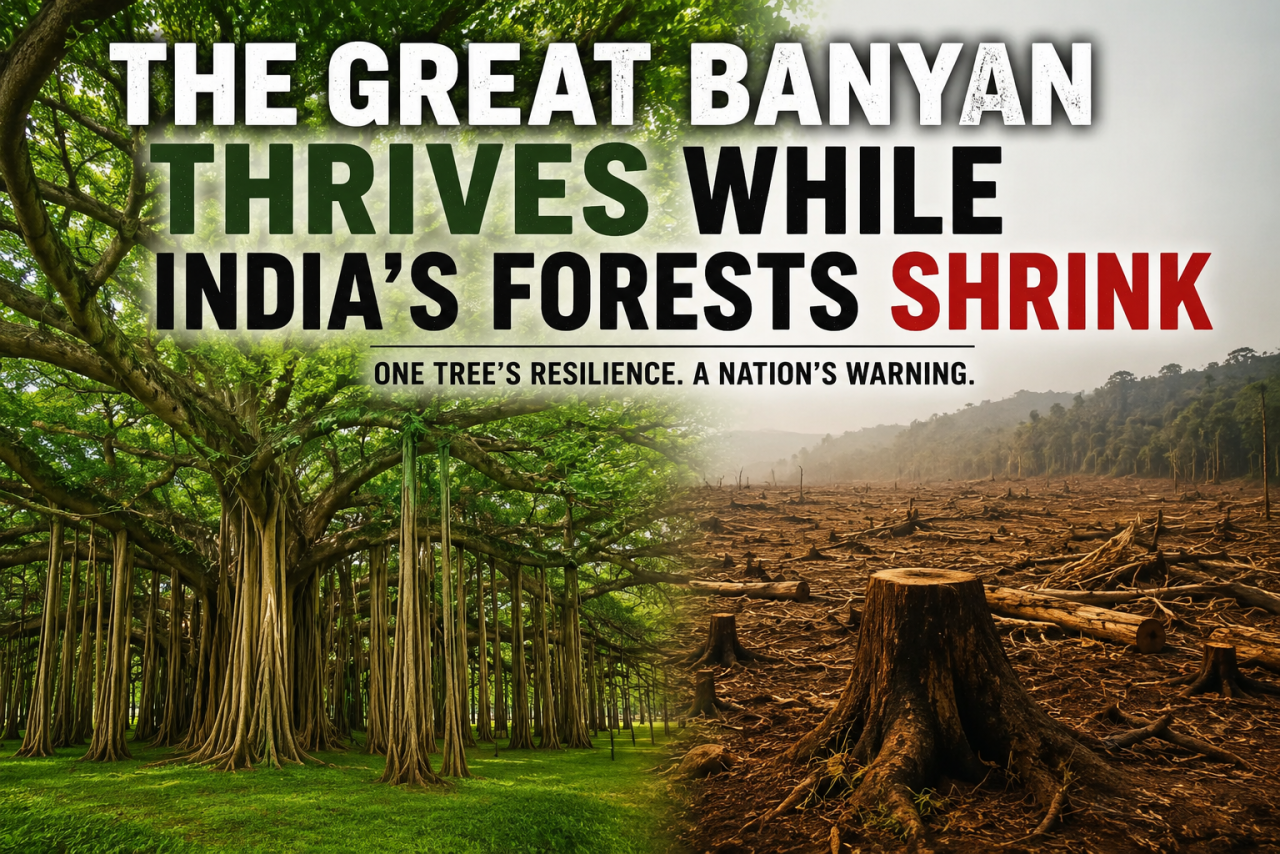
A 250-year-old banyan tree continues to expand against all odds. Beyond its canopy, however, India's natural forests are shrinking, exposing a widening gap between resilience and reality.
In the Acharya Jagadish Chandra Bose Indian Botanic Garden in Howrah stands a tree that appears to be an entire forest. The Great Banyan spreads across nearly 1.9 hectares, covering an area equivalent to four or five football fields. What seem like thousands of individual trunks are actually aerial roots belonging to a single banyan tree. Over more than 250 years, these roots have descended from branches, thickened into woody pillars, and supported an ever-expanding canopy. In 1989, the Great Banyan earned a place in the Guinness Book of World Records as the world's largest tree by area covered.
Its history is one of remarkable endurance. Two cyclones in the nineteenth century damaged the tree's original trunk, leaving it vulnerable to fungal infection. By 1925, the trunk had deteriorated so badly that it was removed entirely. Yet the tree survived and continued growing through its vast network of root pillars. When another powerful cyclone struck in 2020, damaging several branches, the Great Banyan endured once again. A road built decades ago around its perimeter to allow visitors to view its full circumference has since become too small for its expanding reach.
The Great Banyan is often celebrated as a symbol of nature's resilience, and rightly so. But its story also highlights a troubling reality. While one tree continues to flourish within the safety of a protected botanical garden, India's natural forests are facing a very different future.
A 2023 analysis based on data compiled by Our World in Data estimated that India lost an average of 668,400 hectares of forest every year between 2015 and 2020, making it the second-highest annual forest loser after Brazil. The figure marked a significant increase from the average annual loss of 384,000 hectares recorded between 1990 and 2000. Independent monitoring platforms such as Global Forest Watch have reported similar trends, particularly in biodiversity-rich northeastern states including Assam, Mizoram, Arunachal Pradesh, Nagaland and Manipur.
At first glance, these numbers seem to contradict the findings of the biennial State of Forest Report released by the Forest Survey of India, which often shows forest cover remaining stable or even increasing. The discrepancy lies largely in how forests are defined.
Under official methodology, any land area larger than one hectare with at least 10 percent tree canopy density qualifies as forest cover. This includes commercial plantations, orchards and even roadside tree belts. Independent researchers, however, focus on natural forests and native ecosystems. As a result, official reports can show growth in overall tree cover while ecologically important forests continue to disappear.
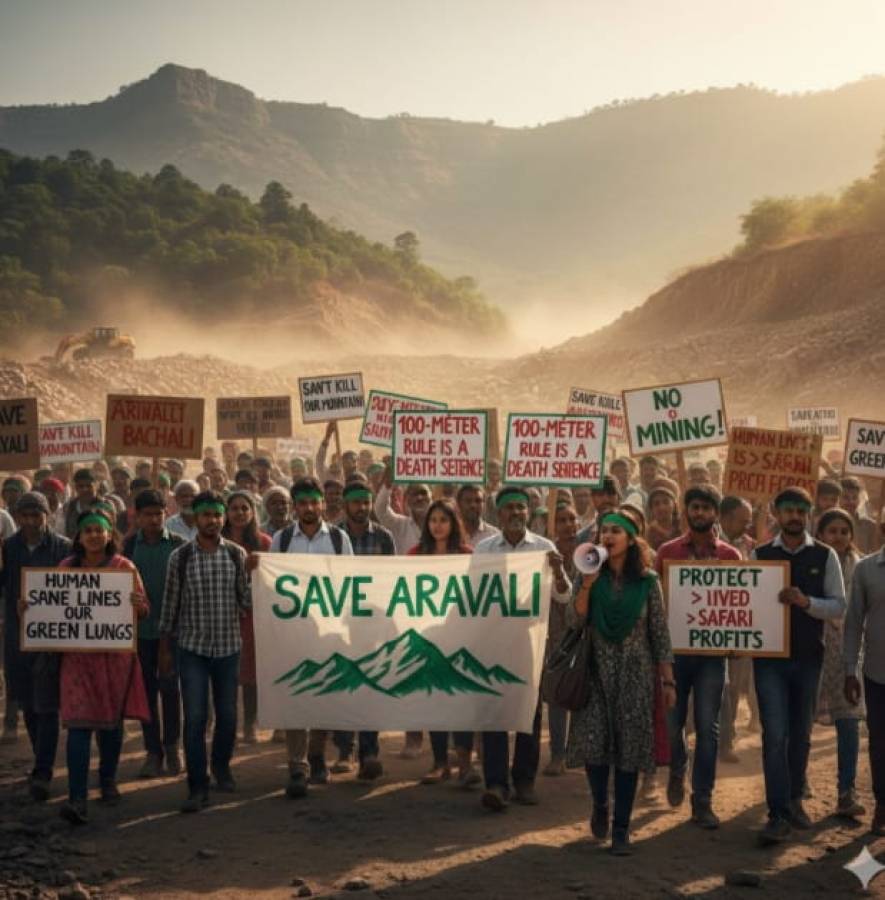
This debate is no longer confined to environmental circles. It has increasingly reached the courts. The Supreme Court's Central Empowered Committee, established to assist in forest-related matters, has dealt with disputes involving mining in the Aravalli Range, questions surrounding the definition of forests after amendments to the Forest Conservation Act, and controversies involving large-scale tree felling. One recent example involved public protests over the cutting of hundreds of trees on land near the University of Hyderabad, prompting strong observations from the Supreme Court.
The consequences of forest loss extend far beyond environmental statistics. Forests act as carbon sinks, regulate rainfall, protect biodiversity and support the livelihoods of millions of people. They are particularly important for tribal and forest-dwelling communities whose rights and access to land continue to evolve under legislation such as the Forest Rights Act.
The environmental costs are becoming increasingly visible. As climate change intensifies, forests provide natural protection against floods, soil erosion, extreme heat and unpredictable weather patterns. Their decline weakens the country's ability to cope with the very climate-related disasters that are becoming more frequent and severe.
Against this backdrop, the Great Banyan offers both inspiration and warning. Its survival demonstrates what nature can achieve when given sufficient space, protection and time. The tree has endured cyclones, disease and even the loss of its original trunk. It continues to expand because the conditions around it have allowed it to do so.
India's forests, however, do not enjoy the same security.
The contrast is striking. A single tree, safeguarded within a botanical garden, continues to spread across generations. Beyond its canopy, vast stretches of natural forest face mounting pressure from development, extraction and changing land-use priorities. The Great Banyan remains a living monument to resilience, but it also raises an uncomfortable question: if one tree can thrive for centuries when protected, why are so many of India's forests struggling to survive?
The answer will not be found in nature alone. It will depend on the policies, legal decisions and conservation choices being made today. The Great Banyan's story is ultimately a reminder of what is possible. Whether India's forests get the same chance remains a challenge that the country can no longer afford to ignore.
In the Acharya Jagadish Chandra Bose Indian Botanic Garden in Howrah stands a tree that appears to be an entire forest. The Great Banyan spreads across nearly 1.9 hectares, covering an area equivalent to four or five football fields. What seem like thousands of individual trunks are actually aerial roots belonging to a single banyan tree. Over more than 250 years, these roots have descended from branches, thickened into woody pillars, and supported an ever-expanding canopy. In 1989, the Great Banyan earned a place in the Guinness Book of World Records as the world's largest tree by area covered.
Its history is one of remarkable endurance. Two cyclones in the nineteenth century damaged the tree's original trunk, leaving it vulnerable to fungal infection. By 1925, the trunk had deteriorated so badly that it was removed entirely. Yet the tree survived and continued growing through its vast network of root pillars. When another powerful cyclone struck in 2020, damaging several branches, the Great Banyan endured once again. A road built decades ago around its perimeter to allow visitors to view its full circumference has since become too small for its expanding reach.
The Great Banyan is often celebrated as a symbol of nature's resilience, and rightly so. But its story also highlights a troubling reality. While one tree continues to flourish within the safety of a protected botanical garden, India's natural forests are facing a very different future.
A 2023 analysis based on data compiled by Our World in Data estimated that India lost an average of 668,400 hectares of forest every year between 2015 and 2020, making it the second-highest annual forest loser after Brazil. The figure marked a significant increase from the average annual loss of 384,000 hectares recorded between 1990 and 2000. Independent monitoring platforms such as Global Forest Watch have reported similar trends, particularly in biodiversity-rich northeastern states including Assam, Mizoram, Arunachal Pradesh, Nagaland and Manipur.
At first glance, these numbers seem to contradict the findings of the biennial State of Forest Report released by the Forest Survey of India, which often shows forest cover remaining stable or even increasing. The discrepancy lies largely in how forests are defined.
Under official methodology, any land area larger than one hectare with at least 10 percent tree canopy density qualifies as forest cover. This includes commercial plantations, orchards and even roadside tree belts. Independent researchers, however, focus on natural forests and native ecosystems. As a result, official reports can show growth in overall tree cover while ecologically important forests continue to disappear.
This debate is no longer confined to environmental circles. It has increasingly reached the courts. The Supreme Court's Central Empowered Committee, established to assist in forest-related matters, has dealt with disputes involving mining in the Aravalli Range, questions surrounding the definition of forests after amendments to the Forest Conservation Act, and controversies involving large-scale tree felling. One recent example involved public protests over the cutting of hundreds of trees on land near the University of Hyderabad, prompting strong observations from the Supreme Court.
The consequences of forest loss extend far beyond environmental statistics. Forests act as carbon sinks, regulate rainfall, protect biodiversity and support the livelihoods of millions of people. They are particularly important for tribal and forest-dwelling communities whose rights and access to land continue to evolve under legislation such as the Forest Rights Act.
The environmental costs are becoming increasingly visible. As climate change intensifies, forests provide natural protection against floods, soil erosion, extreme heat and unpredictable weather patterns. Their decline weakens the country's ability to cope with the very climate-related disasters that are becoming more frequent and severe.
Against this backdrop, the Great Banyan offers both inspiration and warning. Its survival demonstrates what nature can achieve when given sufficient space, protection and time. The tree has endured cyclones, disease and even the loss of its original trunk. It continues to expand because the conditions around it have allowed it to do so.
India's forests, however, do not enjoy the same security.
The contrast is striking. A single tree, safeguarded within a botanical garden, continues to spread across generations. Beyond its canopy, vast stretches of natural forest face mounting pressure from development, extraction and changing land-use priorities. The Great Banyan remains a living monument to resilience, but it also raises an uncomfortable question: if one tree can thrive for centuries when protected, why are so many of India's forests struggling to survive?
The answer will not be found in nature alone. It will depend on the policies, legal decisions and conservation choices being made today. The Great Banyan's story is ultimately a reminder of what is possible. Whether India's forests get the same chance remains a challenge that the country can no longer afford to ignore.























Leave a Comment