
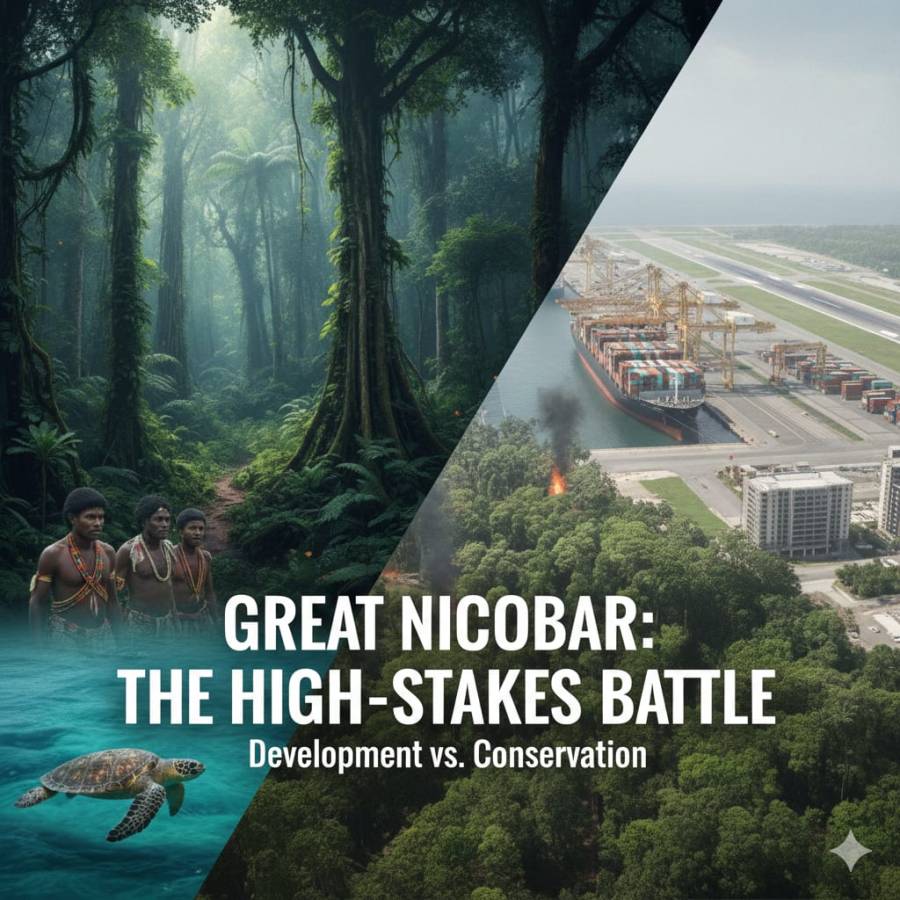
At the edge of India’s map, where ancient rainforests breathe and tribal communities live in quiet isolation, a billion-dollar question is unfolding: should Great Nicobar remain a sanctuary of biodiversity and indigenous heritage, or become India’s next strategic and economic powerhouse?
In the far southern edge of India, where dense rainforests meet restless seas, Great Nicobar Island stands at a historic crossroads. The island is quiet, remote and largely untouched. Yet today, it sits at the center of one of the most consequential development debates in modern India.
The Union government has proposed a massive transformation of this island under what it calls the Sustainable Development of Great Nicobar Island project. With an estimated cost running into tens of thousands of crores, the plan promises to turn this distant territory into a global gateway. Supporters call it visionary. Critics call it irreversible.
The proposal includes a major transshipment port near the Malacca Strait, one of the busiest shipping routes in the world. There are plans for an international airport that would serve both tourism and defence needs. A power plant would energise the new infrastructure. A greenfield township would rise to house workers and future residents. On paper, it is a blueprint for rapid economic growth.
But on the ground, the picture is far more complex.
Large portions of forest land would need to be diverted to make way for the project. A significant share of this land falls within tribal reserves. This has placed the island’s indigenous communities, especially the Shompen and the Nicobarese, at the heart of the controversy.
Questions have emerged about whether proper consent was obtained. Reports indicate that the Nicobar Tribal Council had earlier issued a No Objection Certificate. Later, concerns were raised about whether that consent still stands. Sena MP Priyanka Chaturvedi publicly questioned the consultation process and asked whether safeguards under the Forest Rights Act were fully respected. The law requires that tribal communities give free and informed consent before their land is diverted.
For many observers, this is not only a legal issue but a moral one. The Shompen community, in particular, has lived in relative isolation for generations. Their connection to the forest is not merely economic. It is cultural and spiritual. Any disruption could alter their way of life in ways that cannot be reversed.
Beyond the human dimension lies an ecological treasure. Great Nicobar is part of the Sundaland Biodiversity Hotspot. Its rainforests shelter rare and endemic species found nowhere else. The leatherback sea turtle nests along its shores. The Nicobar megapode builds its unique mound nests in its forests. Scientists warn that large scale construction could fragment habitats and disrupt delicate ecological balances that have evolved over thousands of years.
The government argues that environmental safeguards and compensatory afforestation will be implemented. Yet ecologists remain cautious. They point out that tropical island ecosystems cannot simply be recreated elsewhere. A rainforest shaped by centuries of isolation carries complexities that saplings planted in distant states may never replicate.
At the same time, the strategic argument carries weight. Great Nicobar sits close to key international sea lanes. In an era of shifting geopolitical alignments and rising maritime competition in the Indo Pacific, its location offers undeniable strategic value. Strengthening infrastructure here could enhance India’s security footprint and secure vital trade routes. For policymakers, this is not just a development project. It is a statement of national intent.
The matter has also entered the legal arena, with challenges before environmental forums and courts. The pause created by these proceedings has slowed momentum, but it has also opened space for reflection.
What makes Great Nicobar different from many other infrastructure debates is the scale of what is at stake. This is not an empty tract of land waiting for investment. It is a living landscape with history, culture and biodiversity woven into its soil.
India now faces a defining choice. Can it craft a model of development that respects tribal voices and ecological limits while advancing strategic goals. Can growth be inclusive rather than imposed.
The future of Great Nicobar will send a signal far beyond its shores. It will reveal how a rising nation balances ambition with responsibility. In that balance lies not only the fate of an island, but the moral direction of development in the decades to come.






















Leave a Comment