
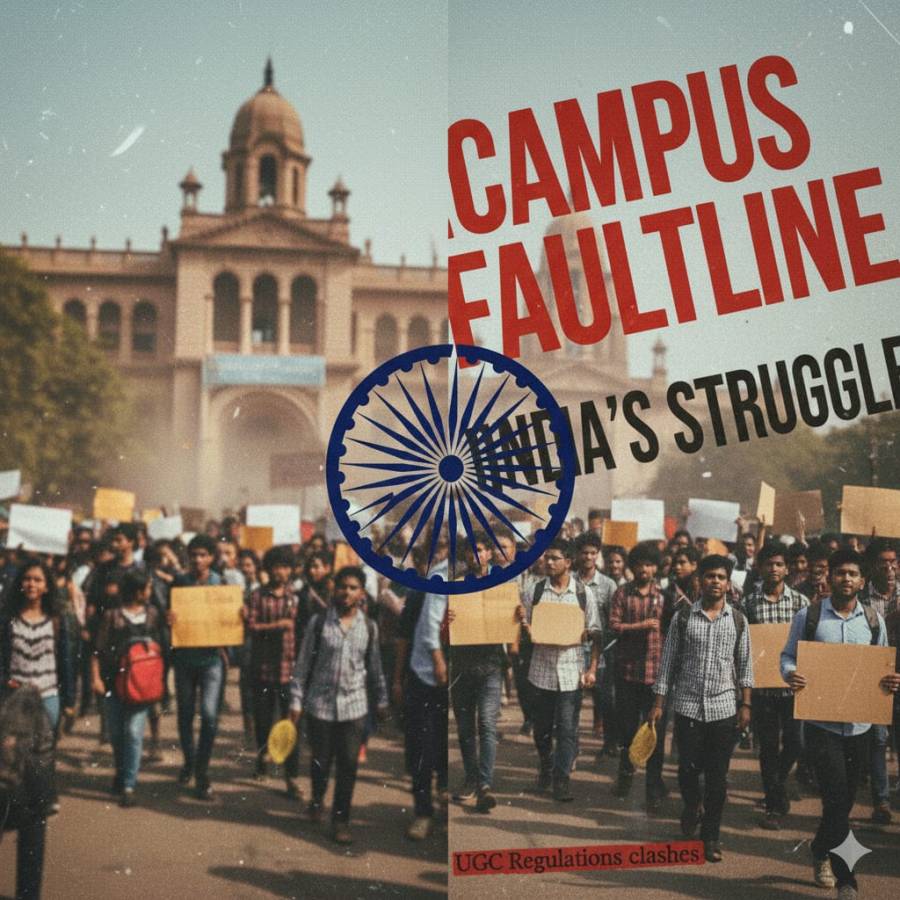
What began as a protest over university rules quickly turned into something larger—an unsettling reminder that India’s campuses carry the weight of the country’s politics, social divides, and economic anxieties.
The recent confrontation at Delhi University over new University Grants Commission (UGC) regulations is more than a routine campus disturbance. It is a reflection of the layered tensions shaping contemporary India—where politics, social identity, economic aspiration, and digital amplification converge within university walls.
What unfolded was not merely a clash between rival student groups. It was a moment that revealed how educational spaces have increasingly become arenas for ideological contestation and social anxiety.
Politics in the Classroom
Indian universities have historically served as nurseries of political leadership. From independence-era movements to post-Emergency mobilisations, campuses have often mirrored national currents. Today, that tradition continues—though not without friction.
Student organizations aligned with broader political ideologies frequently shape campus discourse. When policy debates escalate into confrontation, universities risk becoming microcosms of national political polarization. The recent DU episode illustrates how party-linked rivalries can spill into academic spaces, shifting focus from scholarship to ideological assertion.
While political engagement is an essential feature of democratic education, the normalization of hostility undermines the very purpose of a university—to encourage critical thinking, debate, and dialogue without fear.
The Persistence of Social Hierarchies
The clash also surfaced allegations linked to caste identity. This is a reminder that despite constitutional safeguards and decades of reform, social hierarchies remain deeply embedded in India’s public life.
For many students from marginalized communities, higher education represents mobility, dignity, and a break from structural disadvantage. When campus tensions appear to align along caste lines, the message can be deeply unsettling. It signals that the promise of equal opportunity remains fragile.
Universities are meant to be spaces where merit and ideas prevail over inherited status. Yet, as the incident suggests, societal divisions do not dissolve at the campus gate.
Economic Anxiety Behind Policy Protests
At the heart of the protest were changes related to UGC regulations. In India, education is not merely an intellectual pursuit; it is an economic investment. Families often commit significant financial resources in the hope that a university degree will secure stable employment and upward mobility.
In an intensely competitive job market, policy changes affecting admissions, curriculum, or institutional governance are viewed with heightened sensitivity. Students interpret such shifts not as abstract administrative reforms but as potential disruptions to their career trajectories.
This economic undercurrent fuels the emotional intensity of campus demonstrations. For many, the debate is not theoretical—it concerns survival, opportunity, and the narrowing pathways to success.
The Amplification Effect of Social Media
Another defining feature of the DU clash was the rapid spread of information online. Social media platforms such as X have transformed local incidents into national debates within minutes.
The involvement of influencers and viral narratives can place immediate pressure on authorities to respond. However, this acceleration often comes at a cost. Fragmented clips, partial accounts, and ideological framing can harden public opinion before facts are fully established.
The digital sphere has become an extension of campus politics—magnifying tensions and sometimes complicating resolution.
Safety, Dialogue, and Institutional Responsibility
The Vice Chancellor’s characterization of the episode as a “matter of concern” underscores a broader issue. Educational institutions must remain safe spaces. Violence—physical or rhetorical—erodes public trust and discourages families from sending students to metropolitan universities.
India’s demographic dividend depends heavily on the strength of its higher education system. If campuses become synonymous with instability, the consequences will extend beyond individual institutions.
Constructive mechanisms for debate—structured forums, transparent policy consultations, and inclusive representation—are essential. Disagreement is intrinsic to democracy; disorder is not.
A Mirror to a Nation in Transition
India stands at a pivotal moment. It aspires to global economic leadership while continuing to navigate complex social legacies. The events at Delhi University are emblematic of this transition. They reveal the friction between aspiration and anxiety, reform and resistance, identity and opportunity.
Universities should function as bridges—linking diverse communities through shared learning and collective progress. When they instead resemble battlegrounds, the warning is clear.
The DU clash is not an isolated campus dispute. It is a signal that India must address its political polarization, social inequalities, and policy communication gaps with maturity and foresight.
Education must remain a pathway to empowerment—not a frontline in ideological warfare.





















Leave a Comment