
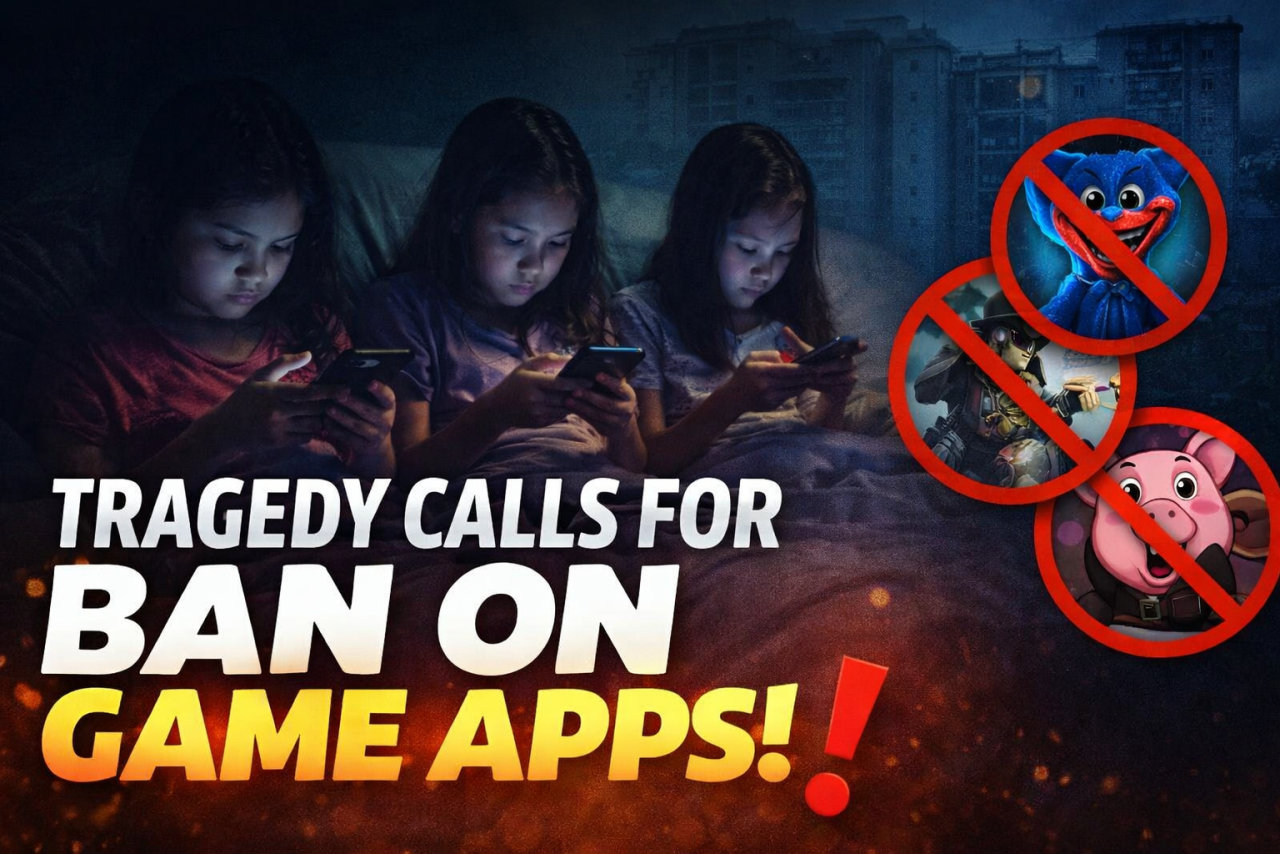
The Ghaziabad case forces an uncomfortable truth: India has no real system to prevent digital addiction among children.
The recent incident in Ghaziabad, where three minor sisters died by suicide, is not just a tragic family matter. It is a serious warning for policymakers, regulators, and institutions responsible for child welfare. Treating this only as a case of personal tragedy or blaming a few mobile apps will miss the real problem.
According to police reports, the girls were heavily dependent on mobile phones, online games, and digital content. When their father took away their phones, they allegedly felt distressed enough to take their lives. The police have now urged the Uttar Pradesh government to ban five gaming apps. While this response may appear decisive, it is incomplete and risks oversimplifying a much deeper issue.
The real concern is not just these five apps. The concern is the absence of a strong system to protect children from digital addiction, unregulated online content, and excessive screen exposure. Today, children are growing up in an environment where smartphones act as babysitters, teachers, and companions, often without supervision, limits, or guidance.
India currently has no effective national framework to monitor children’s screen time, gaming habits, or exposure to harmful digital content. Schools increasingly rely on phones and apps for homework and communication, while parents—especially in urban and semi-urban areas—struggle to manage children’s digital behaviour. In many homes, both parents work long hours, leaving phones as the easiest way to keep children occupied.
Blaming Korean pop culture, online games, or foreign content alone is misleading. Millions of children consume similar content without facing such extreme outcomes. What makes children vulnerable is isolation, lack of emotional support, absence of counselling in schools, and unchecked addiction patterns. These are failures of systems, not just individual choices.
Another serious gap is the lack of trained counsellors in schools. Mental health support for children remains largely ignored in policy discussions. Schools focus on attendance and marks but rarely track emotional well-being, behavioural changes, or signs of addiction. When warning signs appear, parents and teachers often do not know how to respond.
Banning apps after a tragedy may offer temporary political reassurance, but children will simply move to new platforms. Technology changes faster than bans. Regulation must therefore focus on usage patterns, age-appropriate access, content warnings, parental controls, and digital literacy—not just prohibition.
Policymakers must also acknowledge that children today are spending more time online than ever before, often without physical play, social interaction, or routine. This imbalance is affecting attention spans, emotional resilience, and coping mechanisms. When a phone is suddenly taken away, some children experience anxiety similar to withdrawal, which should itself be treated as a health concern.
This incident should push governments to act in four clear areas. First, introduce national guidelines on children’s screen time and digital consumption. Second, make counselling and mental health education mandatory in schools. Third, hold digital platforms accountable for age verification, addictive design features, and content moderation. Fourth, support parents through awareness programmes, not blame.
Most importantly, policymakers must stop reacting only after loss of life. Children’s mental health and digital safety need preventive policy, not post-tragedy bans. If this incident is reduced to a headline and forgotten, more families will face similar heartbreak.
This is not about apps alone. It is about how society is failing to protect children in a rapidly changing digital world. Ignoring this reality is no longer an option.


























Leave a Comment