
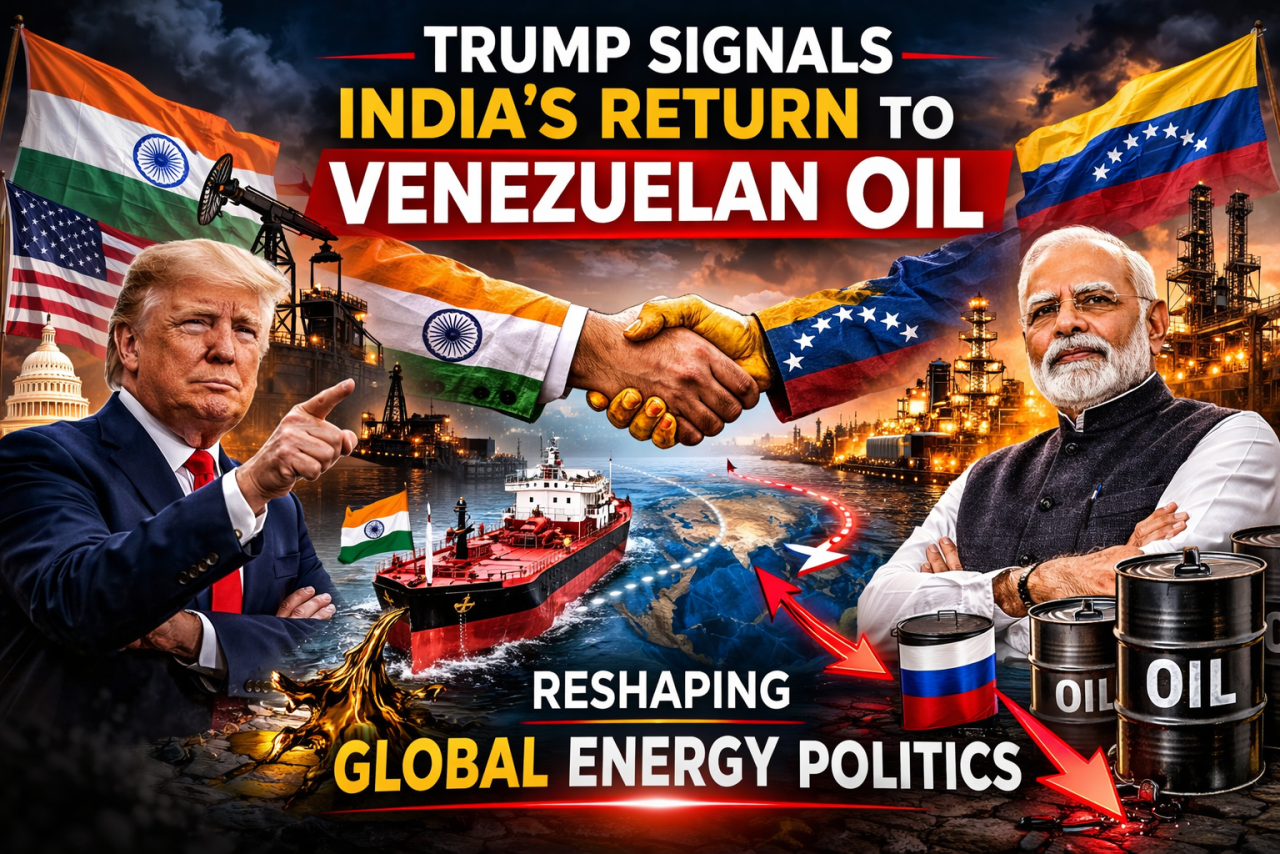
Trump Signals India’s Return to Venezuelan Oil as Global Energy Politics Shift
The global energy landscape is undergoing another shift as changing geopolitics and energy demands reshape old alliances and trade routes. Recent remarks by former US President Donald Trump have brought fresh attention to India’s oil strategy, particularly the possibility of India resuming large-scale oil imports from Venezuela.
At first glance, the idea appears to be a commercial decision driven by supply and pricing. However, it carries broader implications for international diplomacy, global energy security, and power equations involving the United States, Russia, and emerging economies like India.
Venezuela possesses some of the world’s largest proven oil reserves but has remained largely excluded from international markets for several years due to US sanctions. These restrictions were imposed to pressure the Venezuelan government but also resulted in a sharp decline in the country’s oil exports. As global energy demand has increased and supply chains have been disrupted by the Ukraine conflict, Western policymakers are now reassessing earlier positions.
According to reports, Trump has indicated that a potential arrangement could allow India to purchase Venezuelan oil again. From the US perspective, such a move serves multiple objectives. One key aim is to reduce India’s dependence on Russian crude, which has increased significantly due to discounted prices following Western sanctions on Moscow. Redirecting some of India’s oil imports toward Venezuela could help limit Russia’s influence in the global energy market. Another objective is to stabilise global oil prices by bringing additional supply back into circulation, which would benefit both international markets and domestic consumers in the US.
For India, the issue is largely about energy security. As the world’s third-largest oil consumer, India imports nearly 80 percent of its crude oil requirements. Ensuring a steady and affordable supply is crucial for sustaining economic growth. India stopped importing Venezuelan oil in 2019 after US sanctions made transactions difficult. Since then, Russian crude has filled much of the gap.
A return to Venezuelan oil would allow India to diversify its sources and reduce over-reliance on any single supplier. It would also give Indian refiners greater flexibility in negotiating prices and managing supply risks, especially at a time when global energy markets remain volatile.
Alongside the Venezuela discussions, reports have also drawn attention to Trump’s renewed interest in Greenland, which he has previously described as important for US national security. While the two issues appear unrelated, they reflect a broader foreign policy approach focused on securing strategic resources and geopolitical advantages. Whether through energy supply routes or control over mineral-rich territories, the emphasis is on strengthening national leverage while managing alliances.
This approach has not been without criticism. Protests in Denmark, including demonstrations by veterans opposing discussions around Greenland, underline concerns among US allies about the transactional nature of such diplomacy. Critics argue that while deal-making may deliver short-term gains, it can strain long-standing diplomatic relationships and create uncertainty.
If India does resume oil imports from Venezuela, it could mark a significant shift in global energy flows. India could benefit from competitive pricing, Venezuela could gain much-needed revenue, and the US would reinforce its role as a central player in shaping energy trade dynamics. However, challenges remain. Venezuela’s oil infrastructure has suffered from years of underinvestment, and restoring production capacity will require time and significant financial input.
Ultimately, the pace and success of any such deal will depend on political decisions in Washington and New Delhi, as well as conditions on the ground in Venezuela. What is clear is that global energy politics continue to evolve, driven less by ideology and more by strategic and economic interests.






















Leave a Comment