
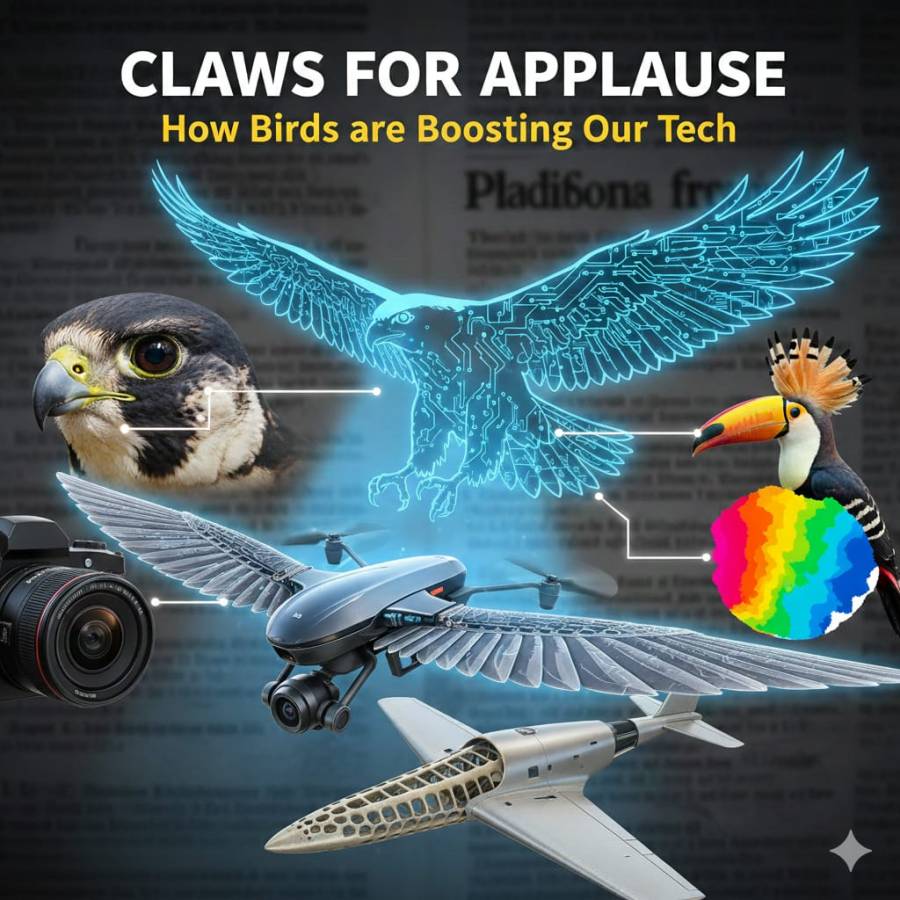
Nature has influenced human technology for centuries, but birds are now playing a more direct role in shaping modern innovation. Scientists and engineers across the world are studying how birds fly, see, and move to improve technologies such as drones, cameras, wind turbines, and advanced materials. Instead of copying the outer shape of wings or feathers, researchers are focusing on how birds function and adapt in real-world conditions.
This approach is often described as deep biomimicry. It involves understanding the behavior, structure, and decision-making processes of living organisms and applying those principles to machines. Birds are especially valuable in this research because they have evolved over millions of years to handle complex environments with speed and efficiency.
One major area of impact is drone technology. At the University of Surrey, researchers are developing unmanned aerial vehicles that can respond dynamically while in flight. Traditional drones usually follow fixed paths and rely on constant external controls. This makes them less effective in strong winds, crowded urban areas, or natural environments such as forests.
Birds, by contrast, continuously adjust their wings, feathers, and body position to stay balanced. By studying these movements and combining the data with machine learning, engineers are teaching drones to make similar adjustments on their own. This allows drones to navigate narrow spaces, avoid obstacles, and remain stable in unpredictable air conditions. Owls are of particular interest because they can fly quietly and maintain control even in turbulent air.
Bird vision is also influencing modern imaging technology. Birds of prey such as eagles have highly developed eyesight, supported by a structure in the eye called a fovea. This allows them to see distant objects with great clarity. Engineers are using this biological principle to improve camera systems, especially in zoom and focus performance.
Smartphone cameras and surveillance systems are now adopting sensors that process light in ways similar to bird vision. These systems improve image quality by capturing details in both bright and dark areas of a scene. As a result, photos and videos appear clearer and more balanced without heavy digital processing.
Noise reduction is another area where birds are guiding innovation. Owls are known for their silent flight, which is caused by the unique shape of their wing feathers. The feather edges break up airflow in a way that reduces sound. Engineers are applying this design to wind turbines, cooling fans, and air circulation systems. These changes help reduce noise levels while keeping machines efficient, an important benefit in cities and data centers.
Birds also provide lessons in building strong yet lightweight structures. Their bones are not solid but contain air pockets and internal supports that give strength without adding weight. This natural design is being used in aerospace engineering through advanced 3D-printing methods. Aircraft components built using this approach are lighter and consume less fuel while remaining structurally safe.
Even bird colors are being studied for technological use. Many bright feather colors are created by microscopic structures that reflect light rather than by pigments. These colors do not fade over time and do not rely on chemicals. Scientists are using this idea to develop long-lasting paints and coatings that are environmentally safer.
As technology continues to advance, engineers are increasingly turning to nature for practical solutions. Birds offer proven models for efficiency, adaptability, and sustainability. By learning from avian biology, modern technology is becoming more responsive, quieter, and better suited to real-world challenges. What once belonged only to nature is now helping shape the future of human innovation.

























Leave a Comment