
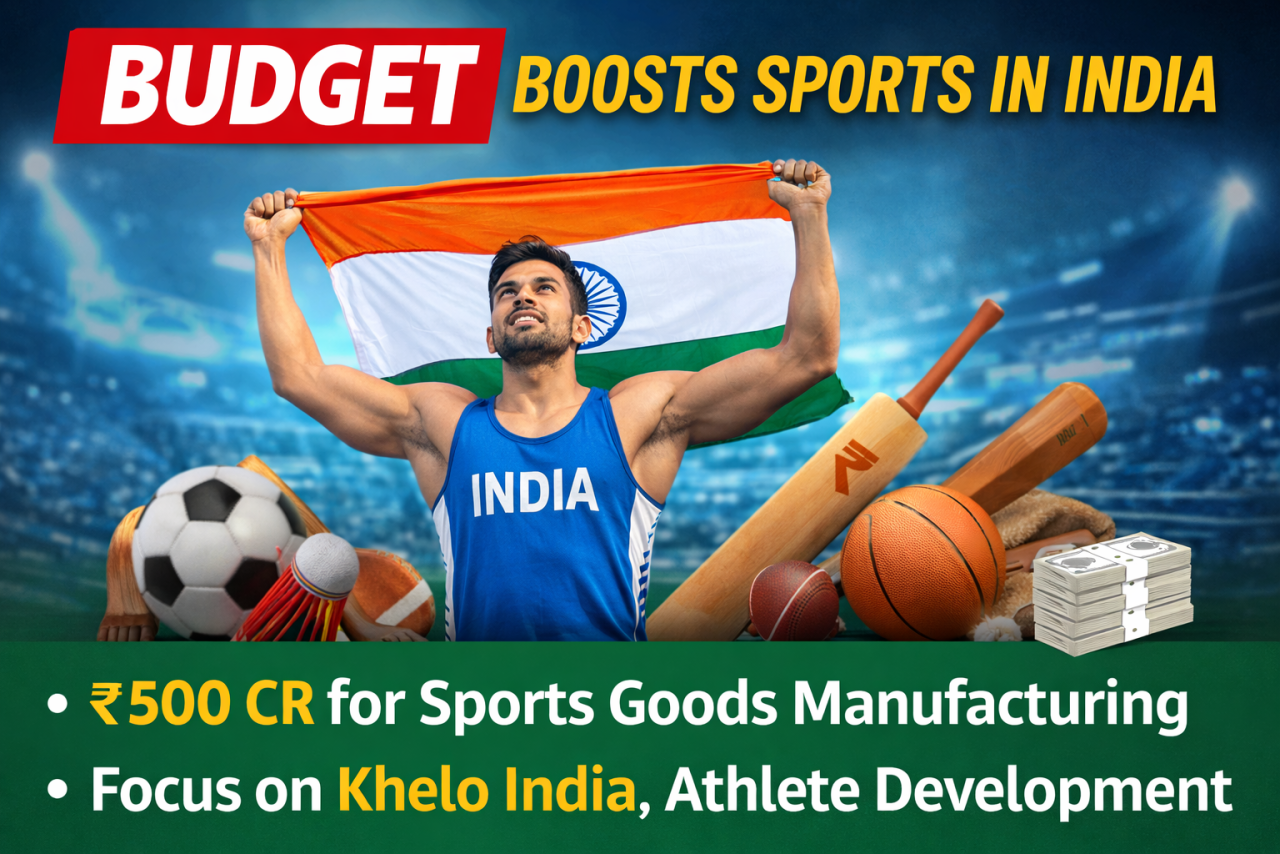
A single budget decision could shape the future of Indian sports—by backing athletes, building world-class infrastructure, and turning India into a global hub for sports goods manufacturing.
The Union Budget has brought encouraging news for sports in India. For the first time, the government has clearly focused not only on athletes and competitions but also on the sports goods manufacturing industry. This move is expected to strengthen India’s sports ecosystem, create jobs, and help the country grow as a global sports hub.
One of the most important announcements in the budget is the allocation of ₹500 crore for the promotion of the sports goods industry. This is a historic step, as the sector has never received a dedicated allocation before. The government believes that India has the potential to become a global center for high-quality and affordable sports equipment. With proper support, Indian-made sports goods can compete in international markets.
The finance minister highlighted that the new initiative will support manufacturing, research, and innovation in sports equipment. It will also focus on better design and the use of advanced materials. This means Indian companies can improve the quality of products like cricket bats, footballs, rackets, and fitness equipment, making them more durable and internationally acceptable.
Another major change is that the sports goods manufacturing sector will now come under the Ministry of Youth Affairs and Sports. Earlier, the industry did not fall directly under any ministry, which limited focused policy support. Now, manufacturers can directly engage with the sports ministry to discuss growth plans, branding, and export opportunities. This shift is expected to help build strong Indian sports brands and promote “Brand India” in global sports markets.
The budget also talks about setting up clusters for sports goods manufacturing. These clusters will bring manufacturers, suppliers, designers, and researchers together in one place. Such clusters can reduce costs, improve efficiency, and encourage innovation. Small and medium enterprises (MSMEs), which form the backbone of the sports goods industry, are likely to benefit the most from this approach.
Along with industry support, the budget continues to focus on athlete development. The government has announced the launch of a Khelo India Mission with an emphasis on integrated talent development. Training centers will be developed at foundational, intermediate, and elite levels. This is important as India prepares for major international events like the Asian Games and the Commonwealth Games.
The total allocation for the Ministry of Youth Affairs and Sports has been increased to ₹4,479.88 crore. This is a rise of over ₹1,133 crore compared to the revised estimates of the previous year. Such an increase shows that sports is becoming a serious national priority, not just an optional activity.
However, the budget has also raised some concerns. There has been a cut in funding for the National Anti-Doping Agency (NADA), from ₹24.30 crore to ₹20.30 crore. The allocation for the National Dope Testing Laboratory (NDTL) has also been reduced. This is worrying at a time when India is facing serious challenges related to doping. According to the latest World Anti-Doping Agency report, India topped the global list in adverse analytical findings in 2024. Strong anti-doping systems are essential to protect clean athletes and India’s sporting reputation.
The allocation for the Khelo India Scheme has also seen a reduction. It has been set at ₹924.35 crore, compared to ₹1,000 crore in the previous budget, which was later revised to ₹700 crore. While the focus on infrastructure and training remains important, experts believe that stable and adequate funding is necessary to ensure long-term success.
Despite these concerns, industry leaders have welcomed the budget. They believe that support for infrastructure, MSMEs, and manufacturing can bring long-term benefits. Currently, India holds less than one percent of the global sports goods market, but the potential for growth is huge. With the right policies and timely implementation, the industry can expand rapidly and create employment across many regions.
Overall, the budget marks an important step in strengthening sports in India. By supporting both athletes and the sports goods industry, the government is trying to build a complete sports ecosystem. If these plans are implemented effectively, they can help India perform better in international sports and become a trusted global supplier of sports equipment.













Leave a Comment