
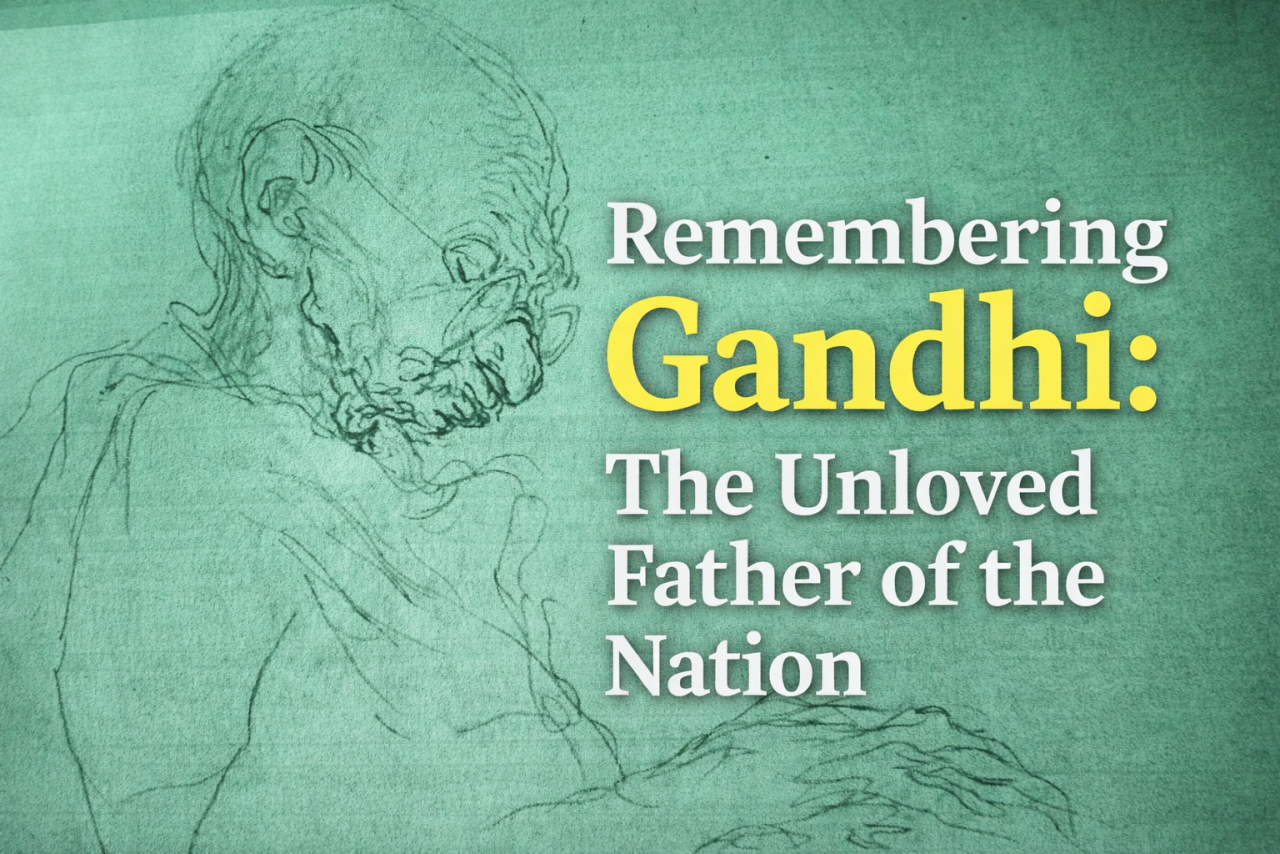
India pauses every January 30 to honour Mahatma Gandhi. The rest of the year, it debates, diminishes, and often dismisses him—revealing an uneasy relationship with the very ideals that shaped the nation.
January 30, observed as Martyrs’ Day, marks the assassination of Mahatma Gandhi in 1948. The day is marked by official tributes, ceremonial wreaths, and solemn remembrance across the country. Yet beyond this annual ritual lies a more uncomfortable reality. For much of the year, Gandhi—formally revered as the Father of the Nation—remains one of the most contested and casually dismissed figures in Indian public life. This contradiction defines his legacy in contemporary India: a founder honoured in name, but increasingly rejected in spirit.
Globally, Mahatma Gandhi is remembered as the architect of non-violent resistance, a moral force whose philosophy of satyagraha reshaped political movements across continents. His contribution to India’s freedom struggle is historically indisputable. Gandhi transformed the fight against colonial rule into a mass movement, instilling political agency in millions and redefining resistance itself. Yet within India, this achievement is often minimised, reframed as outdated, or quietly sidelined. What once formed the nation’s moral foundation now struggles to retain relevance in public memory.
Instead, present-day discourse frequently reduces Gandhi to a catalogue of alleged failures. Persistent challenges—caste discrimination, reservation politics, minority rights, and even his use of the term “Harijan”—are routinely attributed to him. He is blamed for the trauma of Partition, criticised as impractical, and mocked for his personal asceticism. Questioning Gandhi has become fashionable, often used as a marker of political sophistication or ideological allegiance. More disturbingly, Nathuram Godse, the man who assassinated Gandhi, finds occasional glorification in extremist spaces—an unsettling indicator of how far public discourse has drifted from constitutional and moral consensus.
Why does this happen? Why does India repeatedly interrogate and undermine the man it continues to call its father?
The answer lies in the country’s unresolved struggles over identity, power, and moral direction.
First, Gandhi remains an uncomfortable moral mirror. His life was anchored in uncompromising principles—truth, non-violence, restraint, and self-sacrifice. In an era shaped by competitive politics, material aspiration, and social polarisation, this legacy is deeply unsettling. Gandhi exposes the distance between the values India claims to uphold and the realities it practices. Rejecting Gandhi, therefore, becomes easier than confronting that gap. Criticism offers relief from collective discomfort.
Second, Gandhi’s vision of India clashes with the dominant strain of majoritarian nationalism today. His idea of the nation was plural, ethically demanding, and inclusive by design. His understanding of Hinduism emphasised moral introspection rather than political dominance. Contemporary nationalism, by contrast, often prioritises consolidation and assertion. From this perspective, Gandhi is not merely outdated; he is ideologically inconvenient. His unwavering commitment to Hindu-Muslim unity—maintained even in the face of personal danger—places him at odds with narratives that seek clarity through exclusion.
Third, Gandhi has become a convenient scapegoat for India’s unfinished social project. The realities of caste hierarchy and social injustice are undeniable. Gandhi’s approach to caste reform—radical in its rejection of untouchability yet gradual in its method—was shaped by his belief in moral transformation rather than coercive restructuring. Today, that nuance is frequently erased. Gandhi is reduced to a symbol of an oppressive past, flattening complex historical debates into usable political shorthand. This simplification allows contemporary actors to invoke his legacy without engaging with deeper structural failures.
Finally, there is a growing rebellion against the institutionalised Gandhi. Decades of state-sanctioned reverence—his image on currency, ritual invocations in speeches, textbook repetition without context—have fossilised a revolutionary thinker into a static icon. When reverence becomes compulsory, backlash is inevitable. For newer generations and insurgent political movements, rejecting Gandhi functions as a declaration of autonomy from what is perceived as inherited moral orthodoxy.
This uneasy relationship may be uniquely Indian. Other democracies critically examine the contradictions of their founders without negating their foundational achievements. The United States debates the legacy of its slave-owning founders without denying the Revolution. South Africa continues to uphold Nelson Mandela’s ethic of reconciliation despite ongoing inequality. India, however, often appears engaged in questioning the moral legitimacy of the very figure who shaped its freedom.
In this politicised contest, the greatest loss is Gandhi himself. The strategist of satyagraha, the leader who halted communal violence through personal sacrifice, the reformer who lived among the poorest—these dimensions are overshadowed by selective readings and weaponised soundbites. A complex life is reduced to ideological shorthand.
Ultimately, India’s treatment of Mahatma Gandhi reveals less about the man and more about the nation’s unsettled conscience. Contemporary anxieties over identity, justice, and power are projected onto his memory. Gandhi has become a screen for present-day conflicts rather than a subject of honest engagement.
On Martyrs’ Day, remembering the Father of the Nation demands more than ritual homage or reflexive rejection. It requires historical seriousness, intellectual honesty, and moral courage. The true disservice is not criticism, but caricature—turning a legacy of depth and sacrifice into a political instrument. Until that changes, the unloved father will continue to haunt the house he helped build, not as a reminder of failure, but of ideals we invoke and quietly evade.



















Leave a Comment