
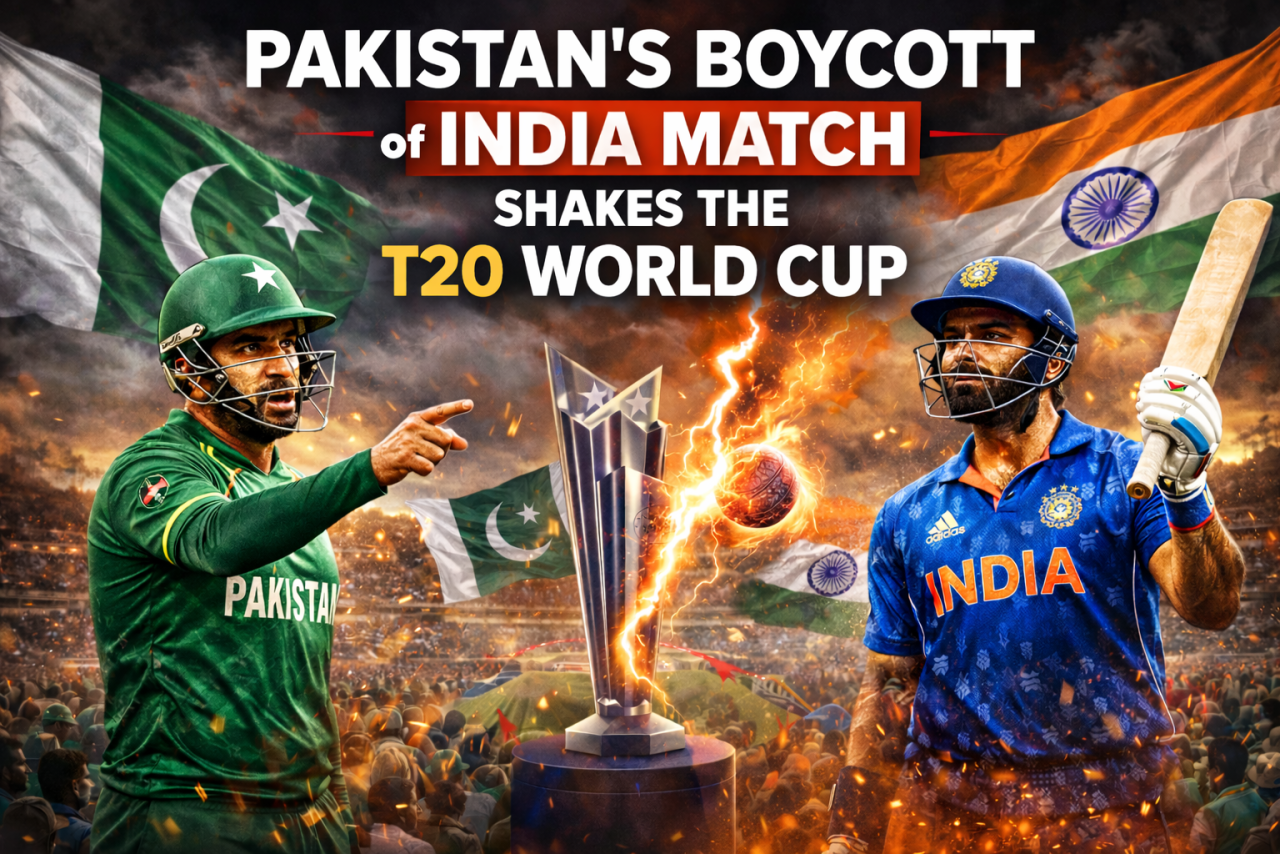
The world’s most-watched cricket rivalry may not happen this time, as Pakistan pulls out of its scheduled T20 World Cup clash against India.
Cricket fans around the world were left stunned after Pakistan announced it would boycott its group-stage match against India, scheduled for February 15, 2026, in the ICC Men’s T20 World Cup. The decision, taken at the government level, has added a new layer of controversy to a tournament that was meant to celebrate the game’s global appeal.
The India–Pakistan clash is widely regarded as the biggest rivalry in cricket. Every time the two teams meet, viewership breaks records, stadiums sell out, and broadcasters see massive returns. A boycott of such a high-profile match is not just a sporting decision. It has far-reaching consequences for the tournament, players, and fans.
What Exactly Happened?
Pakistan has made it clear that its team will participate in the T20 World Cup but will not play against India on February 15. The match was scheduled to be held at a neutral venue, following the long-standing arrangement that prevents bilateral cricket between the two nations due to political tensions.
While no detailed official statement has explained the precise reasons, the decision is widely seen as being driven by political considerations rather than cricketing ones. Pakistani players themselves were reportedly not involved in the decision-making process and are expected to follow government instructions.
Why This Decision Matters
An India–Pakistan match is not just another group game. It is often the most anticipated fixture of any ICC tournament. Millions of fans plan their schedules around it, and for many casual viewers, this single match defines the World Cup experience.
By choosing to boycott the February 15 encounter, Pakistan risks forfeiting the match, which under ICC rules would hand India full points without a ball being bowled. This could seriously hurt Pakistan’s chances of progressing further in the tournament, especially in a tightly contested group.
ICC’s Stand and Possible Action
The International Cricket Council has taken a firm position, stating that all qualified teams are expected to honor their fixtures. The ICC has emphasized that selective participation goes against the principles of fairness and sporting integrity.
If Pakistan formally refuses to play, the consequences may extend beyond just losing points. The country could face financial penalties, reduced revenue sharing, and even administrative action. Broadcasters and sponsors, who invest heavily in India–Pakistan matches, also stand to lose, increasing pressure on the global cricket body to respond strongly.
Impact on Players and Fans
For players, especially those appearing in their first World Cup, missing out on an India–Pakistan match is a major disappointment. These games often define careers and provide rare moments to perform on the biggest stage.
Fans, meanwhile, are divided. Some support the decision as a political statement, while many others believe cricket should remain separate from politics. Across social media, frustration is evident, with supporters expressing sadness that one of cricket’s most iconic rivalries may not be seen on the field.
A Blow to the Spirit of the Game
Cricket has long been seen as a bridge between nations, especially in South Asia where emotions run deep. ICC tournaments have traditionally been the only platform where India and Pakistan still compete against each other.
This boycott raises uncomfortable questions. If one team can refuse to play a specific opponent, could this set a precedent for future tournaments? Will political disputes increasingly shape sporting calendars?
What Lies Ahead?
As the tournament approaches and February 15 draws closer, all eyes will be on the ICC and the Pakistan Cricket Board to see if there is any last-minute change. Diplomatic efforts, behind-the-scenes negotiations, or revised decisions cannot be ruled out.
For now, the boycott has cast a shadow over the T20 World Cup. Instead of discussing team combinations and match strategies, the cricket world is debating politics, penalties, and lost opportunities.
The absence of an India–Pakistan match will be felt across the tournament, underlining how political tensions continue to spill over into the world of sport.













Leave a Comment